

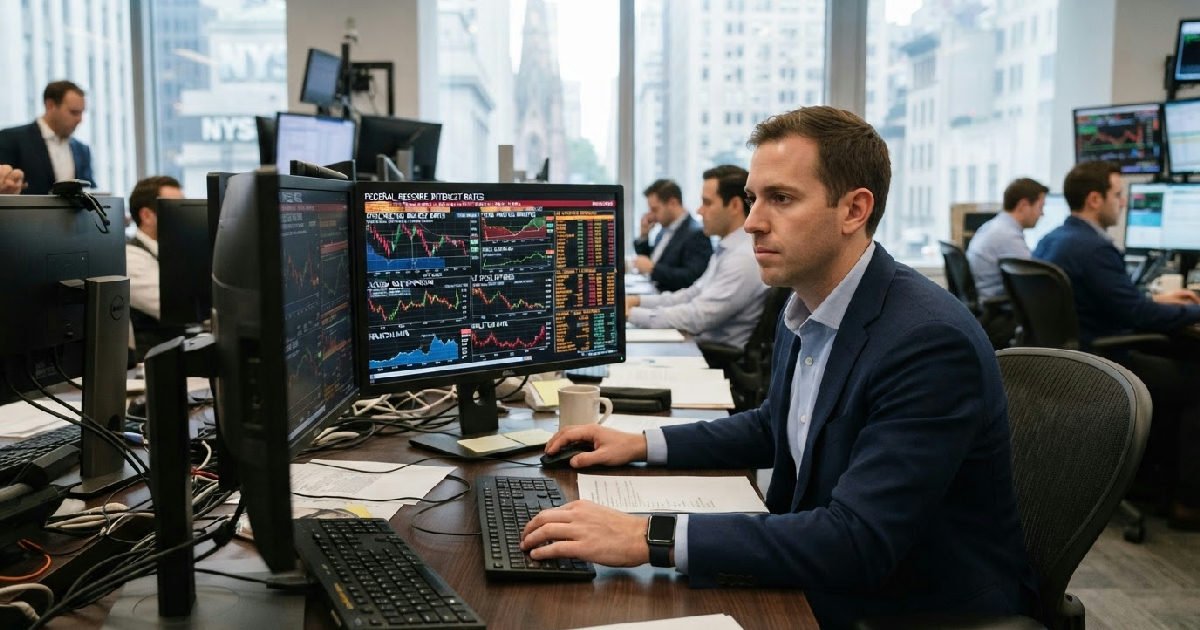
US stock futures flat as investors await clues on Federal Reserve interest rates
Investors await signals on Federal Reserve interest rates as U.S. stock futures remain nearly unchanged heading into the week of August 17, 2026. S. stock futures were nearly unchanged heading into the week of August 17, 2026, as investors adopted a holding pattern.
Traders are anxiously awaiting fresh signals from the Federal Reserve on the future path of interest rates, with all eyes on two key events in the coming days.
The quiet open follows a mixed performance on Wall Street last week. The S&P 500 managed to notch a new record high, but the Dow Jones Industrial Average snapped a two-week winning streak, highlighting a market grappling with uncertainty over the economic outlook and monetary policy.
A market holding its breath for Federal Reserve interest rates
As of late Sunday evening, futures contracts for the Dow Jones Industrial Average (YM00), S&P 500 (ES00), and Nasdaq-100 (NQ00) were all pointing to a muted start to the trading week. By Monday morning GMT, S&P 500 futures had edged 0.1% higher to 7,809.50, while Nasdaq 100 futures rose 0.2%. Dow futures, however, ticked 0.1% lower to 53,779.0 points.
This cautious sentiment stems directly from the Federal Reserve. After years of battling stubbornly high inflation, which remains above the central bank’s 2% target, investors are desperate for clarity.
The central question is whether recent signs of cooling inflation are enough for the Fed to pause its tightening cycle or if more rate hikes are on the horizon. This has become a persistent dilemma for central banks globally.
Two upcoming events are now the market’s primary focus. First, the minutes from the Federal Open Market Committee’s (FOMC) July 29 meeting will be released on Wednesday, August 19. Investors will scrutinize the text for any clues about the internal debate among policymakers regarding the strength of the economy and the persistence of inflation.
Following that, the Fed’s annual economic policy symposium in Jackson Hole, Wyoming, kicks off on August 27. Speeches from top central bankers at this event are often used to signal significant shifts in policy. Any commentary from Federal Reserve Chair Kevin Warsh will be particularly significant for setting market expectations for the rest of the year.
Inflation data offers glimmers of hope
The market’s intense focus on the Fed comes on the heels of recent inflation data that offered some encouragement. The consumer price index (CPI) for July rose by a modest 0.1% from the previous month, while the producer price index was completely flat. These figures suggest that price pressures may finally be easing in a more sustained way.
On an annual basis, the headline CPI was 3.4% in the 12 months through July, a slight deceleration from the 3.5% recorded in June. More importantly for the Fed, core CPI, which strips out volatile food and energy costs, eased to 2.5% from 2.6%. While this is a move in the right direction, it’s still significantly above the Fed’s official 2% target.
Investors are also awaiting the release of the Personal Consumption Expenditures (PCE) price index on August 26. This is the Fed’s preferred inflation gauge, and the June reading showed headline PCE at 3.7% and core PCE at 3.3%. A further slowdown in these numbers could strengthen the case for the Fed to hold interest rates steady at its September meeting.
The employment picture remains mixed
The other side of the Fed’s dual mandate—maximum employment—is presenting a more complicated picture. The U.S. unemployment rate dipped slightly to 4.1% in July from 4.2% in June, but this was partly due to a decrease in the number of people actively looking for work. The economy actually shed 23,000 jobs in July, according to preliminary data.
At the same time, weekly jobless claims have been creeping up. For the week ending August 8, initial claims rose to 209,000. While not an alarming figure historically, the upward trend suggests some cooling in the previously red-hot labor market, a factor the Fed will weigh heavily in its deliberations.
A new era for the Federal Reserve under Kevin Warsh
Adding another layer of complexity is the new leadership at the central bank. Kevin Warsh took over as Federal Reserve Chair in May 2026, succeeding Jerome H. Powell. Warsh has already signaled a potential change in how the institution communicates its intentions to the public, a move that is keeping Wall Street on edge.
Warsh has initiated five internal task forces to review the Fed’s operational framework, including its communication strategy. Analysts believe this could lead to a departure from the explicit “forward guidance” that the market had grown accustomed to under Powell. The previous era was defined by the Fed clearly telegraphing its moves months in advance.
This potential shift has some analysts predicting choppier waters ahead. Preston Caldwell of Morningstar noted that a less transparent Fed could lead to increased volatility in interest rates and bond prices as traders are forced to react to data in real-time without a clear roadmap from the central bank. The uncertainty has created new concerns for bond traders and equity investors alike.
For investors, this means the game of Fed-watching is changing. The focus will shift from parsing the specific wording of official statements to interpreting a broader range of economic data to anticipate the Fed’s next move. It marks a return to a more traditional, and perhaps more uncertain, style of central banking.
Decoding probabilities for the next rate hike
Despite the uncertainty, traders are still placing their bets. The current federal funds rate target range stands at 3.50% – 3.75%, where it has been held since the March 2026 meeting. As of this past weekend, the market’s odds of a rate hike at the next FOMC meeting in September were hovering around 33%, according to the CME FedWatch tool.
This suggests that while a hike isn’t the baseline expectation, it remains a distinct possibility if incoming data—particularly the next PCE inflation report—comes in hotter than expected. The minutes from the July meeting will be key to understanding how many committee members are leaning toward further tightening.
Looking further out, futures markets are pricing in a slow, gradual path upward for interest rates. The consensus implies the federal funds rate will climb to approximately 3.8% by November 2026 and reach roughly 4% by this time next year. This indicates the market believes the Fed is close to the end of its hiking cycle but is unlikely to begin cutting rates anytime soon.
Broader market conditions and the road ahead
While the Fed’s next move is the main story, other market indicators provide important context. The 10-year Treasury note yield rose last week to 4.695%, reflecting some nervousness in the bond market about persistent inflation. Bond yields are a key benchmark for borrowing costs across the economy.
In commodities, West Texas Intermediate crude oil settled near $82.40 a barrel, finishing last week up around 7%. Analysts at Oxford Economics expect Brent crude, the international benchmark, to remain in the mid-$80s for the rest of the year, which could contribute to sticky inflation. The search for growth continues as investors wonder what the next major asset class will be in this environment.
Meanwhile, the speculative fervor in cryptocurrencies has cooled, with Bitcoin trading below $63,000, down about 3% over the past week. On a more positive note, the corporate earnings season has been largely successful. According to LSEG data, about 85% of S&P 500 companies that have reported so far have beaten analysts’ profit expectations, suggesting solid underlying business fundamentals despite the macroeconomic headwinds.
Ultimately, the market is in a state of suspended animation. The week ahead is pivotal, with the FOMC minutes and subsequent Jackson Hole symposium poised to either validate the market’s cautious optimism or force a painful repricing of expectations for interest rates and economic growth.