

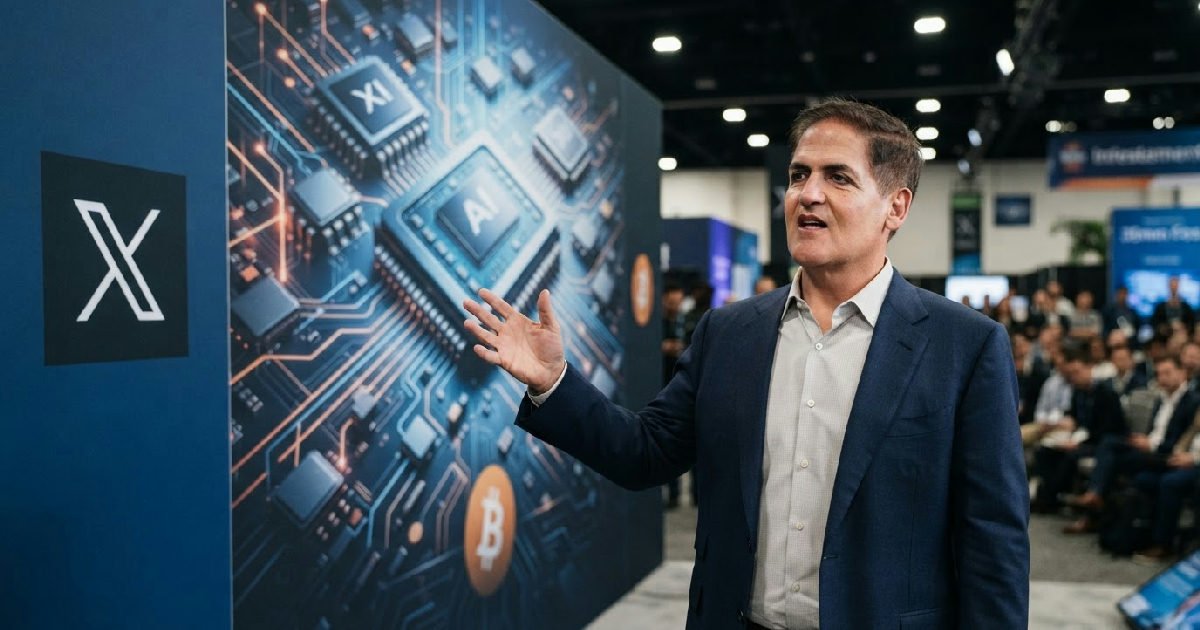
Mark Cuban predicts AI chips will be next major asset class, akin to crypto
Billionaire investor and entrepreneur Mark Cuban recently made a provocative declaration: “chips as an asset class will be the new crypto.” His statement, posted on X (formerly Twitter) on August 15, 2026, underscores a growing sentiment that the insatiable demand for artificial intelligence could elevate computing hardware, particularly high-end AI accelerators like Graphics Processing Units (GPUs), into a distinct and highly investable financial category.
This bold prediction from Mark Cuban emerges as the artificial intelligence sector drives unprecedented demand for advanced computing hardware, transforming these once-mere tools into strategic, highly valued commodities. It also reflects a broader financial trend where the physical infrastructure underpinning digital innovation is becoming an asset ripe for novel financing structures and speculative interest.
The billionaire’s bold prediction ignites discussion
Mark Cuban’s concise pronouncement quickly sparked debate across financial and tech circles. While he didn’t specify which “chips” he had in mind, the prevailing interpretation points to high-performance AI accelerators such as GPUs. These specialized processors are the backbone of modern AI, powering everything from large language models to complex data analysis.
His claim remains an investment thesis at this stage, not a defined financial product or an established market. Still, it highlights a fundamental shift: AI capital expenditures are changing how hardware is perceived, moving it from a depreciating operational cost to a securitized, lendable financial instrument.
Evolving views on digital assets
Cuban’s latest commentary fits a pattern of evolving perspectives on digital and technological assets. He famously shifted from a Bitcoin skeptic in 2019 to an enthusiastic supporter of Ethereum, valuing its smart contract capabilities and decentralized finance applications. Yet, in May 2026, he significantly reduced his Bitcoin holdings, citing disappointment that it “lost the plot” as a hedge against macro risks.
His continued belief in Ethereum’s utility and his latest AI chip prediction show a consistent interest in assets that offer clear functional value and disruptive potential. The pivot suggests that for Mark Cuban, the allure of an asset class lies not just in its speculative value, but also in its foundational role in future technological dominance and economic growth.
Institutional confidence boosts GPU-backed financing
Cuban’s vision for AI chips as an asset class isn’t entirely speculative; it builds on real-world financial innovations already taking shape. Companies like CoreWeave are at the forefront, pioneering financial structures that leverage AI hardware. These initiatives demonstrate that chips can indeed function as collateral within institutional credit markets, suggesting a maturation of the underlying technology’s perceived value.
Just this month, on August 10, 2026, CoreWeave successfully secured a $2.6 billion delayed draw term loan facility. This substantial financing package is earmarked to fund the expansion of its high-performance computing infrastructure. The structure of the loan itself reflects significant lender confidence, extending for approximately five years, which is notably longer than the average three-year duration of the customer contracts it supports.
CoreWeave’s pioneering financing model
Lenders backing CoreWeave’s facility are clearly accepting a degree of renewal risk, a decision based largely on their optimistic expectations for the future value and persistent demand for Nvidia GPUs deployed across CoreWeave’s cloud platform. This oversubscribed transaction underscores the institutional appetite for such innovative financial products tied to AI infrastructure.
CoreWeave has been exploring GPU-backed financing for several years. Back in May, the company completed another $3.1 billion publicly syndicated facility, a move that prompted it to characterize AI infrastructure financing as an “emerging asset class.” This characterization, while specific to CoreWeave’s view, indicates a tangible shift in how computing power is valued and financed in the broader market.
Surging demand underpins robust GPU economics
The financial confidence in AI chips isn’t just based on innovative lending; it’s strongly supported by hard economic data from industry leaders. Nvidia, a dominant player in the AI chip market, recently reported impressive quarterly results that highlight the explosive demand for its data center products. These figures provide a tangible measure of the robust economics driving Cuban’s prediction.
For the quarter ending April 26, Nvidia recorded an astounding $75.2 billion in data center revenue. This represents a remarkable 92% increase compared to the previous year. The chipmaker’s total quarterly revenue soared to a record $81.6 billion, marking an 85% annual jump, according to its May financial results. These numbers reflect the intense investment pouring into AI infrastructure globally.
Nvidia’s data center dominance
While these impressive figures demonstrate the massive growth in the AI hardware market, they don’t automatically establish chips as a standalone investment class comparable to cryptocurrencies. GPUs are physical assets, subject to depreciation and technological obsolescence. Their value is intrinsically tied to operational factors like electricity, networking, data center capacity, and continuous customer utilization to generate revenue.
Nvidia’s strong performance illustrates a powerful market trend: the fundamental components of AI are highly prized and in short supply. This situation creates a fertile ground for financial innovation, as seen with CoreWeave, and fuels the discussion around their potential as a new class of asset. Still, the practicalities of managing physical hardware differ significantly from purely digital tokens.
Debating the “new crypto” analogy
Not everyone agrees with Mark Cuban’s direct comparison of AI chips to crypto. Bitcoin advocate Pierre Rochard, for instance, swiftly countered Cuban’s analogy. He argued that chip manufacturing fundamentally lacks the unique economic characteristics that define Bitcoin, such as programmed scarcity and self-adjusting supply mechanisms.
Pierre Rochard specifically pointed out that chip manufacturing doesn’t involve “halvings,” the periodic reduction in new Bitcoin supply, nor does it feature “difficulty adjustments” that dynamically alter the effort required to mine new coins. These mechanisms are central to Bitcoin’s monetary policy, creating predictable scarcity and a decentralized issuance schedule. Without these, Rochard contended, AI chips can’t truly be considered the “new Bitcoin.”
This debate highlights a critical distinction: are we talking about chips as a new investment *category* due to their demand, or as a *replacement* for the unique properties of cryptocurrencies? Cuban’s statement suggests the former, focusing on their potential as collateral and a store of future value rather than replicating crypto’s underlying economic model.
Broader implications and future outlook
The emerging financialization of AI compute extends beyond private financing deals. Regulated markets are also looking to offer exposure to this burgeoning sector. The CME Group, for example, plans to list Silicon Data H100 and B200 rental index futures on NYMEX this coming October 5.
Each contract will cover one month of GPU rental costs, an initiative designed to standardize compute power as a tradable commodity.
This move by CME Group signifies a concrete step towards institutionalizing AI compute as an asset. It creates a mechanism for hedging, speculation, and price discovery in a market that has, until recently, been dominated by direct hardware purchases and cloud service agreements. Such futures contracts could provide the liquidity and transparency necessary for AI chips to truly function as an “asset class.”
Mark Cuban’s perspective also extends to broader concerns within the AI industry. In July 2026, he voiced apprehension about Nvidia’s extensive AI deals and its practice of financing customer hardware purchases, drawing parallels to the dot-com bust.
“This is so analogous to the dot com burst,” he stated, adding, “But instead of IPOs, Nvidia is the ‘ipo,’ funding everyone and anyone.” He even wrote, “One breakthrough in another chip provider, or a misstep, and it all could crumble. It’s truly scary.”
These warnings show he’s acutely aware of potential bubbles and risks in this rapidly expanding sector.
Moreover, Cuban has also proposed innovative regulatory solutions for the AI space. In May 2026, he suggested a federal AI token tax, recommending a charge of less than 50 cents for every one million AI tokens processed by large commercial models. He argued that such a tax could generate billions annually, while also encouraging greater efficiency in AI development and resource allocation.
Challenges and market evolution
The primary hurdle for Mark Cuban’s prediction is whether the financing and trading of GPUs can move beyond specialized AI infrastructure operators to become widely standardized and accessible. While CoreWeave’s multi-billion dollar transactions confirm institutional lenders’ willingness to finance computing infrastructure, these remain bespoke deals in a niche market.
The willingness to accept risk tied to the future earning power of GPUs is there, but a broader, more liquid market is still nascent.
The planned CME Group futures contracts could be a significant step in this direction, providing a standardized, tradable instrument.
However, for chips to truly rival crypto as a standalone asset class, they would need to overcome challenges related to physical storage, maintenance, and the rapid pace of technological advancements that can quickly render older hardware obsolete. Unlike a purely digital asset, a physical chip requires infrastructure and energy to maintain its value and utility.
The question of whether AI chips can achieve the decentralized, liquid, and easily transferable characteristics of a true cryptocurrency remains open. While the financial structures around them are evolving rapidly, their fundamental nature as physical, depreciating assets presents a different investment profile. The underlying trend of soaring demand for AI compute is undeniable, and the financial innovation surrounding it will likely continue to accelerate.
Ultimately, Mark Cuban’s prediction acts as a powerful thought experiment, pushing investors and industry observers to consider the next frontier of high-growth assets. As AI continues to reshape industries, the tools that power it — the chips themselves — are certainly cementing their place as a critical economic driver, regardless of whether they ever become fully interchangeable with digital currencies.
For now, “chips as an asset class” exists more as a visionary statement than a fully realized market category. But the measurable growth in Nvidia’s data center sales and the increasing scale of GPU-backed financial transactions suggest that the groundwork for this transformation is being laid.
How far this evolution will go, and whether it will truly mirror the dynamics of crypto, will be a defining narrative in the coming years.