

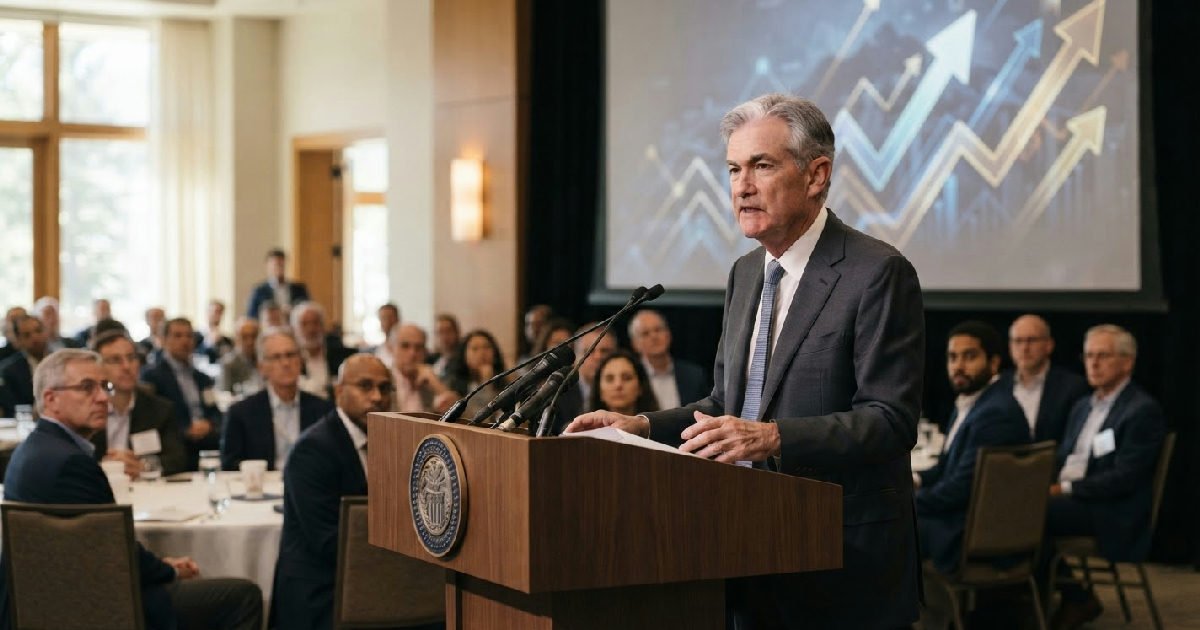
Fed’s Jerome Powell signals higher interest rates are the new normal
The era of cheap money is definitively over, and the United States Federal Reserve wants everyone to get used to it. In a landmark speech, Federal Reserve Chair Jerome Powell issued a stark warning that the central bank is prepared to maintain higher interest rates—and even raise them further—until inflation is brought firmly under control.
The message from the annual Jackson Hole Economic Policy Symposium on August 25, 2023, was unambiguous: a new economic reality is here.
The impact of higher interest rates on the economy
Powell’s remarks signaled a significant policy posture, intending to shift market psychology away from expectations of swift rate cuts. He stated the Fed would “hold policy at a restrictive level until we are confident that inflation is moving sustainably down toward our objective.”
For consumers, businesses, and investors, this means the elevated cost of borrowing that has defined the post-pandemic economy is set to continue for the foreseeable future.
At the time of Powell’s address, the federal funds rate already stood at a 22-year high, in a range of 5.25% to 5.50%. Yet, the economy was not cooling as anticipated. Powell pointed to “especially robust” consumer spending and a persistently tight labor market as signs that further action might be necessary. The underlying strength of the economy, while positive, complicates the Fed’s inflation fight.
This resilience has been visible across various sectors, with some industries continuing to make significant capital outlays. For instance, despite higher borrowing costs, tech companies have pushed forward with major spending, as seen in how Micron accelerates investments in advanced chip manufacturing.
This type of activity indicates that the economy still has substantial momentum, giving the Fed less room to ease its restrictive policies without risking a resurgence in prices.
The central bank’s primary goal is to return inflation to its 2% target. Powell acknowledged that while there had been some moderation, “inflation remains too high.” His commitment was firm: “We will keep at it until the job is done.” This suggests a prolonged period where monetary policy remains a headwind for economic growth, a necessary trade-off to ensure long-term price stability.
Breaking the market’s reliance on Fed guidance
A key undercurrent of the Fed’s messaging is the desire to break what former Fed Chair Ben Bernanke once called a “hall-of-mirrors problem.” This describes the feedback loop where markets watch the Fed for signals, and the Fed, in turn, watches market reactions to gauge its policy effectiveness. This dynamic can reduce the information value of both market prices and central bank communications.
For over a decade following the 2008 financial crisis, the Fed actively guided markets with forward-looking statements and quantitative easing. This was necessary to combat deflationary pressures and revive an economy “pushing on a string.” But in today’s inflationary environment, that level of hand-holding is not just unnecessary; it’s counterproductive. Powell is now pushing investors to do their own homework.
Instead of waiting for dovish or hawkish hints, the Fed wants market participants to analyze economic data independently and draw their own conclusions. This shift implies greater tolerance for short-term market volatility. The goal is to avoid bigger, long-term policy errors that can occur when everyone is caught looking in the same direction, unprepared for a sudden turn of events.
The painful arithmetic of government debt
Persistently higher interest rates have profound consequences for government finances, particularly in heavily indebted nations like the United States. As rates rise, so does the cost of servicing the national debt. According to some analyses, the U.S. now spends more annually on interest payments than on its national defense budget, with both figures exceeding an eye-watering $1 trillion.
This isn’t just a U.S. problem. Developed countries across the globe are facing similar pressures. The era of low inflation allowed governments to accumulate massive debts with little immediate consequence. Now, as central banks hike rates to fight inflation, that bill is coming due. In August 2023, U.S. 30-year bond yields hit their highest levels since 2001, reflecting the rising cost of long-term government borrowing.
This creates a difficult fiscal situation. More money spent on interest means less is available for other priorities like infrastructure, education, and social programs. This dynamic is unfolding in other major economies as well. While some nations have resorted to stimulus, such as when China boosts banks with capital injections, the U.S. is focused on tightening its belt.
A new paradigm for prosperity
The Fed’s strategy appears to be a calculated gamble on the underlying strength and dynamism of the American economy. Powell and his colleagues believe that a world of high growth and moderate inflation can coexist with higher interest rates. In this paradigm, elevated rates are not a sign of impending doom but a natural consequence of a prosperous economy.
This thinking directly challenges the investor mindset conditioned by nearly two decades of crisis-fighting. Since the dot-com bust, and especially after 2008, markets have operated on the assumption that higher rates inevitably lead to economic disaster. Any sign of volatility was often met with central bank intervention, creating a “Fed put” that insulated investors from risk. Powell is now trying to remove that safety net.
The message is that markets must learn to price risk properly again, without relying on an “illusory omnipotent central bank.” This new approach also presents a political challenge. Officials often prefer lower rates to stimulate growth, a sentiment previously voiced by figures like Donald Trump renewing criticism of Fed policy.
By deliberately asserting its independence, the Fed is aiming to change the market’s reaction function, even if it can’t change the political one.
What this means for the future
The clear takeaway is that the bar for the Federal Reserve to start cutting interest rates is exceptionally high. The bank will need to see a sustained, convincing trend of inflation returning to its 2% target before it considers loosening its grip. Until then, businesses and households must adapt to a world where capital is more expensive and financial conditions remain tight.
This environment favors companies with strong balance sheets and durable cash flows, while punishing those reliant on cheap debt to fund growth. For consumers, it means higher rates on mortgages, car loans, and credit cards will persist. The adjustment may be painful, but the Fed views it as the necessary price to pay for escaping the corrosive effects of entrenched inflation.
Ultimately, the Federal Reserve is forcing a structural shift in the American economy. It is weaning markets off the monetary stimulus that has defined a generation and reintroducing the principle that prosperity and high interest rates can, and should, go hand in hand. If higher rates are the cost of a strong economy, the Fed’s message is simple: it’s a price worth paying.