

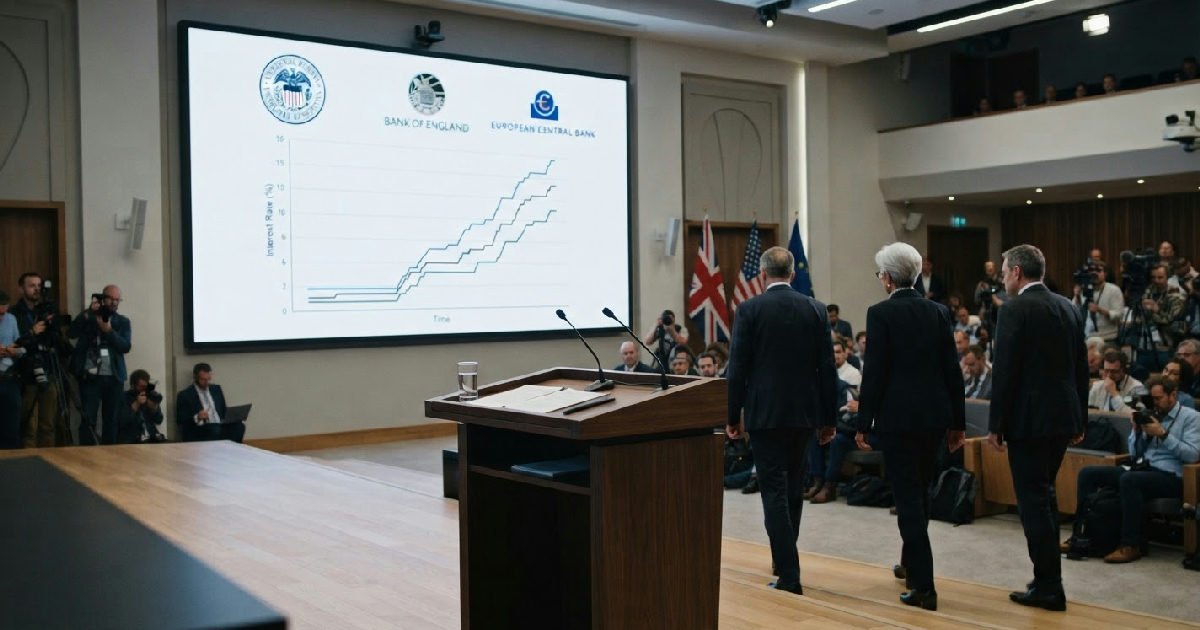
Central banks juggle interest rates amid inflation and slow growth
Major financial institutions across the industrialised world are grappling with a complex dilemma over central bank interest rates this week. The US Federal Reserve, the Bank of England, and the European Central Bank face mounting pressure to curb persistent inflation, intensified by the ongoing Middle East war and rising energy prices.
Yet, they must also contend with a global economy exhibiting sluggish growth and a looming “stagflationary shock.” This challenging environment means policymakers are adopting increasingly divergent monetary strategies, highlighting a critical moment for global financial stability on August 16, 2026.
Global economic pressures intensify amidst rising inflation
The global economy navigates a precarious path, with projections indicating a significant slowdown. Global GDP growth for 2026 is now forecast at 2.5%, a 0.2 percentage point downgrade from earlier estimates.
This figure falls well below pre-pandemic norms and only a modest recovery to 2.8% is anticipated for 2027. Such a subdued economic growth outlook complicates any central bank’s decision to increase the cost of borrowing.
The energy shock’s far-reaching impact
Inflation remains a primary concern for central bankers worldwide. Developed economies expect inflation to rise from 2.6% in 2025 to 2.9% in 2026, often exceeding their 2% targets.
Developing economies face an even steeper climb, with projections jumping from 4.2% to 5.2% due to higher energy, transport, and import expenses. John H. Cochrane, a senior fellow at the Hoover Institute, noted that “Inflation never got fully under control after 2021-2022, and the current surge is not all oil prices, so central banks feel they have to move fast to contain a wider outbreak.”
A significant driver of these inflationary pressures stems from the ongoing Middle East war, particularly its profound impact on the energy sector. The crisis has constrained supply chains, driven up freight and insurance costs, and pushed the price of Brent crude to approximately $90 per barrel.
This rebound is expected to significantly increase energy and transport prices across the US during the latter half of the year. The persistent blockade of the Strait of Hormuz also remains a key factor, threatening to extend target-busting price growth for a sixth or even seventh year.
Federal Reserve rethinks its approach to central bank interest rates
In the United States, the Federal Reserve is undergoing a significant strategic overhaul under its new boss, Kevin Warsh. His term as Chair began after Jerome Powell’s expired in May 2026, marking a new era for the central bank.
Warsh has instigated an expansive review of the Fed’s operations, drawing on the expertise of 15 outside economists and experts. This signals a clear departure from previous practices, especially after criticism for perceived inaction when US inflation topped 9% in 2022.
Warsh’s shift from traditional monetary tools
US inflation edged down slightly to 3.4% in July from 3.5% in June and 4.2% in May, largely thanks to falling petrol prices. But with Brent crude prices now rebounding, Fed officials are contemplating whether US inflation could climb back towards 4%.
That figure would double their 2% target, reigniting concerns about price stability. The new leadership appears to be charting a different course for monetary policy.
A key change under Warsh is the abandonment of forward guidance, the explicit signalling of the likely future path of interest rates. He’s also declined to join other Fed policymakers in creating dot plots, which graphically project economic and inflation developments.
This move has drawn both praise and criticism. Mohamed El-Erian, an economist and professor at the Wharton Business School, says Warsh recognises that many traditional monetary policymaking “shibboleths” proved flawed.
“The key issue for me is having someone there who’s committed to long-overdue Fed reforms,” El-Erian stated. He added that this is “essential for future Fed effectiveness, credibility and political independence.”
Among Warsh’s 15 appointments to subject committees is Lord Mervyn King, the former governor of the Bank of England, once a foundational figure in inflation forecasting. King has since argued that trying to predict the future is ultimately a fool’s game.
His 2022 book, Radical Uncertainty, suggests central banks should move away from models that treat consumers and businesses as predictable “atoms” and instead account for emotional responses. He describes forward guidance as “silly,” emphasising that no central bank truly knows future interest rates.
El-Erian echoed this, calling forward guidance “spurious accuracy” and arguing that financial markets need to understand the central bank’s “reaction function” instead. However, not everyone agrees with this new direction.
Market expectations for Fed policy
Charlie Bean, a professor at the London School of Economics and a former deputy governor of the Bank of England, voiced concerns. He believes Warsh is “getting in a bit of a mess” by not guiding on rates or the central bank’s reaction to economic changes.
“It means he is not saying anything of substance,” Bean concluded. The Fed held rates in July, and financial markets expect another hold in September, though a rise remains possible.
Markets currently anticipate at least one, and possibly two, quarter-point increases by mid-2027. This would push the Fed’s target rate from its current 3.5-3.75% range to 4-4.25%. MacroMicro, however, suggests stable inflation might allow the Fed to stand pat this year.
Conflicting forecasts abound, with Capital Economics now expecting two rate hikes this year to reach 4.00-4.25%, while ING THINK predicts cuts to around 3.25% in 2026. The reported deepening internal divisions within the Fed, with three dissenting votes at the latest July meeting, underscore the uncertainty.
Bank of England navigates domestic and global headwinds
The Bank of England, unlike the Fed, has acted consistently since the start of the Iran war, according to reports. It has maintained its commitment to raise borrowing costs should persistent inflation signals emerge.
However, the decision to hold the Bank Rate steady at 3.75% so far this year could come under significant pressure. The UK consumer price index (CPI) dropped to 2.6% in June, but analysts expect it to climb to 2.9% or even 3% when July’s figures are released on August 19.
The challenge of government debt
A majority of the nine-member Monetary Policy Committee (MPC) remains wary of increasing interest rates. They acknowledge that higher borrowing costs would likely depress an already weak UK economy.
These policymakers recognise that such hikes would have little effect on global oil prices, a primary driver of current inflation. Bean also highlights pressure on the MPC from more fundamental trends, particularly high and rising government debt.
This debt burden creates a significant problem: a rise in borrowing costs directly increases the government’s debt financing bill. Central banks must then choose between potentially crippling government finances or allowing inflation to remain above target for longer.
This challenge isn’t unique to the UK; it also impacts the Fed’s Warsh, especially after the US paid its highest borrowing costs for 30-year bonds since 2001 in a recent debt auction. Neil Shearing, chief economist at Capital Economics, suggests central banks might tolerate higher inflation levels.
He argues that central banks cannot publicly admit this without being accused of misleading the public and financial markets. Shearing believes the conceit is maintaining a 2% target while quietly tolerating a slightly higher inflation rate due to government debt pressures.
Market forecasts for UK rates
Most inflationary shocks today originate from global events and supply restrictions for essential goods. Interest rate rises primarily dampen consumer spending, having little direct impact on the price of imported items.
Despite these complexities, financial markets anticipate the Bank of England will raise rates this year, possibly as early as its next September meeting. They project rates could reach as high as 4.25% by late 2027.
European Central Bank’s assertive stance on inflation
In contrast to the Federal Reserve and the Bank of England, the European Central Bank (ECB) has already acted this year, raising the cost of borrowing. On June 11, 2026, its Governing Council decided to increase the three key ECB interest rates by 25 basis points.
Effective June 17, 2026, the deposit facility rate rose to 2.25%, main refinancing operations to 2.40%, and marginal lending facility to 2.65%. The ECB has also freed itself from forward guidance, yet critics argue it remains confused about responding to climbing inflation.
Critics question early rate hike
The ECB raised interest rates in June after only a modest rise in inflation caused by the Middle East war and increasing oil prices. Many economists believe this move was premature, considering much of the eurozone economy continues to reel from the energy shock that followed Russia’s invasion of Ukraine.
Shearing commented, “The ECB was clearly fighting the previous war and prematurely raising rates. The underlying picture in the eurozone is one of weakness.” He is among many analysts who think financial markets are wrong.
Markets expect the ECB to raise its main deposit rate by a quarter-point to 2.5% at its next September meeting, with another quarter-point possible next year. Shearing contends that while high oil prices fuel inflation, they also brake economic activity.
A rate hike, he suggests, would be akin to “kicking the economy when it is already down.” He believes the ECB wouldn’t gain any accolades for such an action, highlighting a fundamental disagreement on the appropriate monetary policy response.
The wider global dilemma for central bank interest rates
The diverging approaches and internal debates among these major central banks highlight a profound global dilemma. They’re all wrestling with how to tame persistent global inflation without triggering a deeper economic downturn.
This struggle is particularly acute given that it’s been five years since any of them met their 2% inflation target. The confluence of geopolitical tensions, energy supply shocks, and high government debt makes this period uniquely challenging for monetary authorities.
The world watches to see if Warsh’s experimental approach at the Fed will yield better results, or if the more traditional, yet still cautious, stances of the Bank of England and the assertive ECB will prevail. Ultimately, the effectiveness of any central bank interest rates strategy will depend on balancing these complex, intertwined global forces.