

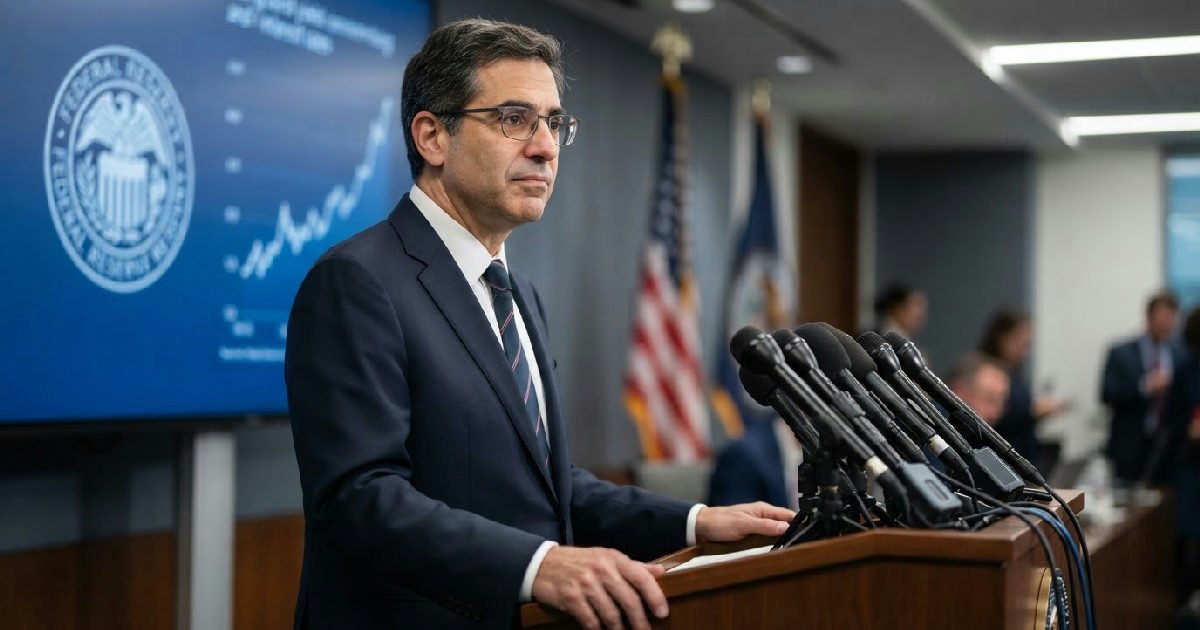
Economic data pushes Treasury yields higher, firming Federal Reserve rate bets
US Treasury yields surged and global stock markets wavered on August 26, 2026, as a fresh batch of economic reports solidified investor expectations for a Federal Reserve interest rate hike later this year. Despite mixed signals, the overarching strength in the economy suggests the central bank, led by Federal Reserve Chair Kevin Warsh, still has room to tighten monetary policy.
The market’s reaction underscores a persistent concern about inflation, which remains stubbornly elevated even as consumer spending showed signs of stalling. This scenario puts pressure on policymakers ahead of key upcoming speeches and decisions.
Economic Data Fuels Federal Reserve Rate Hike Expectations
Recent economic indicators have painted a complex picture, yet one that largely reinforces the Federal Reserve’s hawkish stance. While US consumer spending stalled in the latest reporting period, a key price gauge rose precisely in line with analyst expectations.
Crucially, other data points revealed a solid pace of economic expansion. Strong consumption, robust spending habits, and an uptick in durable goods orders all point towards an economy that continues to exhibit underlying strength.
This resilience suggests the Federal Reserve has ample scope to increase borrowing costs further without immediately tipping the economy into recession. Ellen Zentner of Morgan Stanley Wealth Management noted that while recent numbers weren’t ideal, they weren’t enough to shift the September Fed meeting’s balance.
However, Zentner cautioned that if subsequent figures continue this trend, the central bank might feel greater pressure to act. Inflation is still widely viewed as “too high for comfort” across financial markets.
Treasury Market Reacts to Policy Outlook
The bond market responded swiftly to the reinforced rate hike prospects. The yield on the policy-sensitive two-year Treasury note climbed 11 basis points to 4.16% following a recent Federal Reserve decision, illustrating immediate market sensitivity to central bank signals.
Earlier in July 2026, the yield on two-year notes had already surged by about 6 basis points, reaching around 4.36%, its highest level since early 2025. This move highlights a sustained upward trend in short-term borrowing costs.
Longer-dated bonds also saw significant movement. On a Friday in August 2026, 30-year U.S. Treasury bonds were yielding 5.27%, a slight increase from the week prior and notably higher than the 4.85% seen at the end of 2025. The global bond market continues to recalibrate.
The gap between two-year and 10-year Treasury yields, a key indicator of economic sentiment, narrowed to within 30 basis points. This marks the smallest spread recorded in over a year, often signaling market anticipation of tighter monetary conditions.
Warsh’s Stance and the Jackson Hole Speech
Federal Reserve Chair Kevin Warsh finds himself at a critical juncture. The June Federal Reserve meeting, his first as chair, saw the benchmark interest rate held steady between 3.5% and 3.75%, but the accompanying “dot plot” projections revealed significant internal division.
Nine officials projected at least one quarter-point rate increase in 2026, with six anticipating at least two hikes. Conversely, nine others expected no move or even a rate cut, creating a complex policy landscape. Chair Warsh notably declined to submit his own forecast.
All eyes are now on the Jackson Hole Economic Policy Symposium, where Chair Kevin Warsh is scheduled to deliver a pivotal speech next Friday. Bret Kenwell, an analyst at eToro, underscored the challenge facing the Fed.
“Inflation is still too high for comfort,” Kenwell stated, adding that investors would be watching to see how Warsh plans to address bringing inflation back to the Fed’s long-term target. This speech is a critical test for Fed Chair Kevin Warsh.
Geopolitical Tensions Add Inflationary Pressure
Beyond domestic economic data, escalating geopolitical tensions have played a significant role in stoking inflation fears and strengthening arguments for higher rates. The threat of widening conflict in the Middle East has notably sent oil prices upward.
Specifically, US and Israeli strikes on Iran in late February caused energy prices to surge, which immediately revived concerns about persistent inflation. Higher energy costs feed into broader price increases across the economy, making the Fed’s job harder.
This geopolitical factor has directly boosted bets for a Federal Reserve rate hike, as central banks typically respond to inflationary pressures regardless of their origin. The market’s assessment is that the Fed will prioritize price stability.
While oil prices saw some relief as Iran and Oman discussed a deal to revive activity in the Strait of Hormuz, the underlying risks remain. These external shocks continue to complicate the monetary policy outlook.
Divergent Views on Inflation and Future Moves
Despite the market consensus leaning towards rate hikes, there remains a divergence of opinion among experts regarding the path of inflation and the Federal Reserve’s ultimate response. Sonu Varghese of Carson Group remarked, “We’re still a long way from being out of the inflation hot water.”
This sentiment is echoed by David Russell of TradeStation, who pointed out that the economy remains strong while inflation isn’t dropping. “These numbers support hawkish policymakers at the Fed’s committee and increase pressure on Kevin Warsh later this week,” Russell said, suggesting it’s becoming harder for Chair Warsh to avoid the issue of raising rates.
The Treasury Department has also played a role in market dynamics. Its intervention on a Wednesday, announcing the doubling of its buybacks of long-dated bonds, initially caused the yield on 30-year Treasury bonds to decline by 10 basis points. But yields climbed back by 6 basis points the following day, showing the market’s underlying direction.
Market’s Shifting Rate Hike Timeline
Money markets are now fully pricing in a Federal Reserve rate hike by December 2026, with a significant probability assigned to a move as early as September. This represents a substantial shift from earlier in the year.
At the beginning of 2026, Wall Street analysts had largely anticipated multiple rate cuts, especially following former President Donald Trump’s selection of Kevin Warsh as Fed chair. However, subsequent economic developments and geopolitical events rapidly altered those expectations.
The resilience of the US economy, coupled with persistent inflation and rising energy costs, has forced a complete repricing of future borrowing costs. Investors now believe the Federal Reserve will likely need to act to cool an overheating economy and bring price pressures under control. This outlook has profound implications for corporate borrowing and consumer credit.
What This Means for Global Markets
The continued rise in Treasury yields and the increasing certainty of further Federal Reserve rate hikes signal a period of potentially higher borrowing costs across the global economy. As the benchmark for risk-free rates, US Treasuries influence everything from corporate bond yields to mortgage rates worldwide.
For investors, this environment suggests a continued preference for assets that can withstand higher interest rates or benefit from inflationary trends. We’ve already seen the broader Treasury market fall around 1.5% since late February, with benchmark 10-year yields climbing nearly half a percentage point over the same period.
The path forward remains uncertain, as Jim Lebenthal, a market strategist, famously observed in 2009: “No one can tell you with a straight face where interest rates are going.” Yet, current data strongly indicates the Federal Reserve is on a trajectory to further tighten monetary policy, which will continue to ripple through financial markets globally. Asset allocations will react accordingly.