

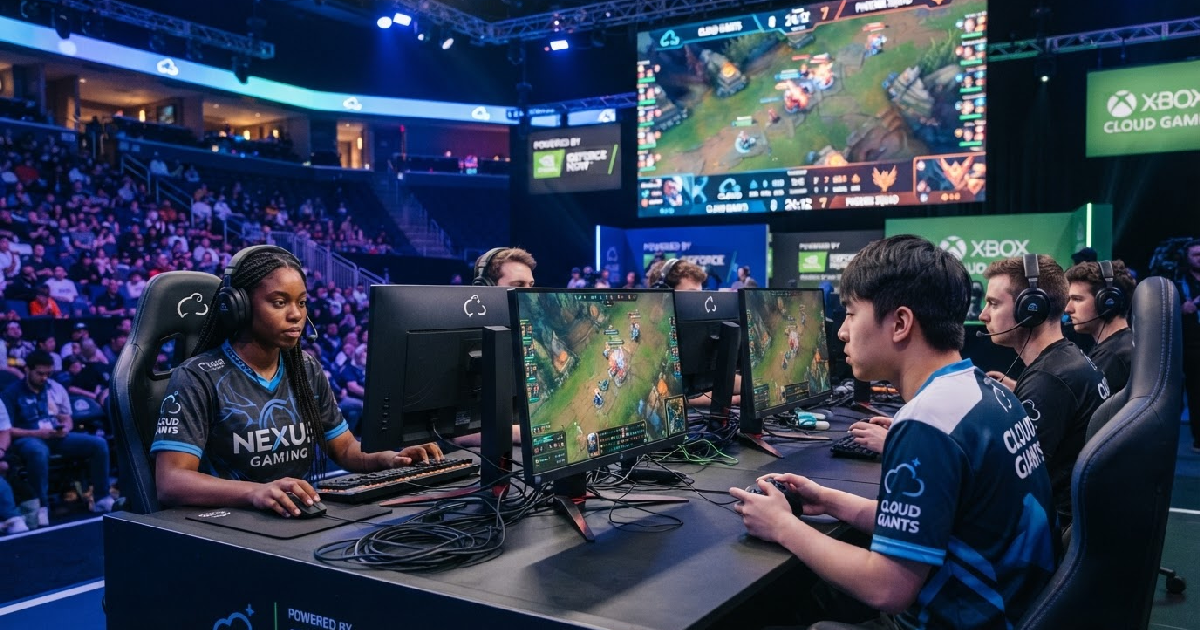
How Cloud Gaming Reshapes Esports Competition
Cloud gaming esports potential is significant, as it reshapes esports gaming trends by broadening access and standardizing critical hardware for competitive play. This technology fundamentally alters how esports tournaments are organized and played, centralizing game processing on remote servers.
It offers a unique blend of opportunities for growth and persistent technical challenges related to latency and visual fidelity. Its widespread adoption could level the playing field for aspiring professionals globally, but overcoming streaming’s inherent drawbacks remains crucial.
Understanding cloud gaming technology
Cloud gaming, often called game streaming or gaming on demand, involves running video games on remote servers in data centers. Players access these games over the internet, with video and audio streamed to their devices. Input commands are simultaneously sent back to the remote server.
This setup means the player’s local hardware only needs to be capable of receiving a video stream and sending inputs. It doesn’t need to process the game itself, making high-end gaming accessible on a wider range of devices. The entire process relies on robust internet infrastructure to deliver a smooth, responsive experience.
Democratizing esports access and competition
One of cloud gaming’s most compelling promises for esports lies in its ability to democratize participation on a global scale. It abstracts away the need for expensive gaming rigs, significantly lowering the financial barrier for entry into competitive play. Aspiring professional gamers from regions with limited access to high-end hardware could participate more readily.
This broader access means a wider talent pool could emerge. It could bring fresh perspectives and new competitive dynamics to established esports titles, regardless of economic background or geographical location. This aligns with broader trends reshaping the gaming industry, where key trends shaping the gaming industry are constantly evolving with advancements like cloud technology.
Standardizing hardware for fair play
A significant advantage for competitive integrity is cloud gaming’s inherent standardization of hardware. Traditional esports often see players competing on varying personal setups, which can introduce subtle performance differences. When games run on identical server-side hardware, every participant experiences the same processing power and graphical fidelity.
This standardization creates a truly level playing field. It ensures that victory hinges purely on skill, strategy, and teamwork, not on who can afford the most powerful graphics card. Tournament organizers also benefit by no longer needing to manage diverse player setups, simplifying event logistics dramatically.
Streamlining tournament logistics
The logistical benefits for esports event organizers are substantial. With cloud gaming, organizers don’t need to transport, set up, and maintain hundreds of high-performance gaming PCs for large-scale tournaments. Instead, they can provision cloud instances, ensuring consistent performance for every competitor.
This significantly reduces setup time, physical space requirements, and overall operational costs. Such streamlining could enable more frequent and geographically diverse events, expanding the global footprint of esports. It also simplifies patching and updates, as changes are applied centrally to the server infrastructure.
Addressing cloud gaming’s core challenges
Despite its transformative potential, cloud gaming faces critical technical hurdles. These are particularly pronounced in the high-stakes world of esports, primarily revolving around the very nature of streaming technology itself: latency and visual fidelity. For competitive play, where split-second reactions and pixel-perfect aim are paramount, these factors can be deal-breakers.
The critical latency hurdle
Latency, the delay between a player’s input and the game’s response on screen, is arguably the biggest obstacle for cloud esports. Even minor delays, imperceptible in casual gaming, can be decisive in competitive scenarios. Every millisecond counts when a headshot or a perfectly timed ability means the difference between winning and losing.
The internet connection quality between the player, the cloud server, and the game server all contribute to this cumulative delay. Reducing this end-to-end latency to levels acceptable for professional esports demands ultra-low-latency networks and geographically optimized server placement. Developers continually refine streaming protocols to minimize these delays.
Maintaining visual fidelity in competitive settings
Visual fidelity, specifically the consistent delivery of high frame rates and crisp image quality, is another vital consideration. Competitive players rely on clear, responsive visuals to track opponents, react to environmental cues, and maintain precise aim. Any compression artifacts, frame drops, or resolution scaling inherent in video streaming can hinder performance.
While cloud gaming services have made significant strides in delivering high-quality streams, ensuring this fidelity under variable network conditions for every competitive player is complex. A slight degradation in visual clarity might be acceptable for a single-player adventure game. However, it could compromise the competitive integrity of an esports match, making understanding these latest esports trends key to appreciating the challenges.
The evolving landscape and future outlook
Cloud gaming’s integration into esports isn’t a matter of if, but when and how it will overcome its inherent limitations. Companies are investing heavily in network infrastructure, advanced compression algorithms, and edge computing. These efforts aim to bring servers closer to players, all focused on reducing latency.
The sustained growth of esports also means more resources are being poured into solutions that enhance competitive play. The future of esports hinges on continuous innovation and adaptation to new technologies. Indeed, the future of esports will undoubtedly be shaped by these technological advancements.
While traditional local hardware will likely remain the standard for top-tier professional tournaments in the near term, cloud gaming is poised to revolutionize amateur circuits, online qualifiers, and talent scouting. It offers an accessible pathway for millions of players to engage in competitive gaming without significant upfront investment.
As technology matures, the line between local and cloud-based esports experiences will undoubtedly blur. This blurring could potentially unlock unprecedented global participation and viewership for competitive gaming. The ecosystem continues to mature, attracting new players and audiences alike.