

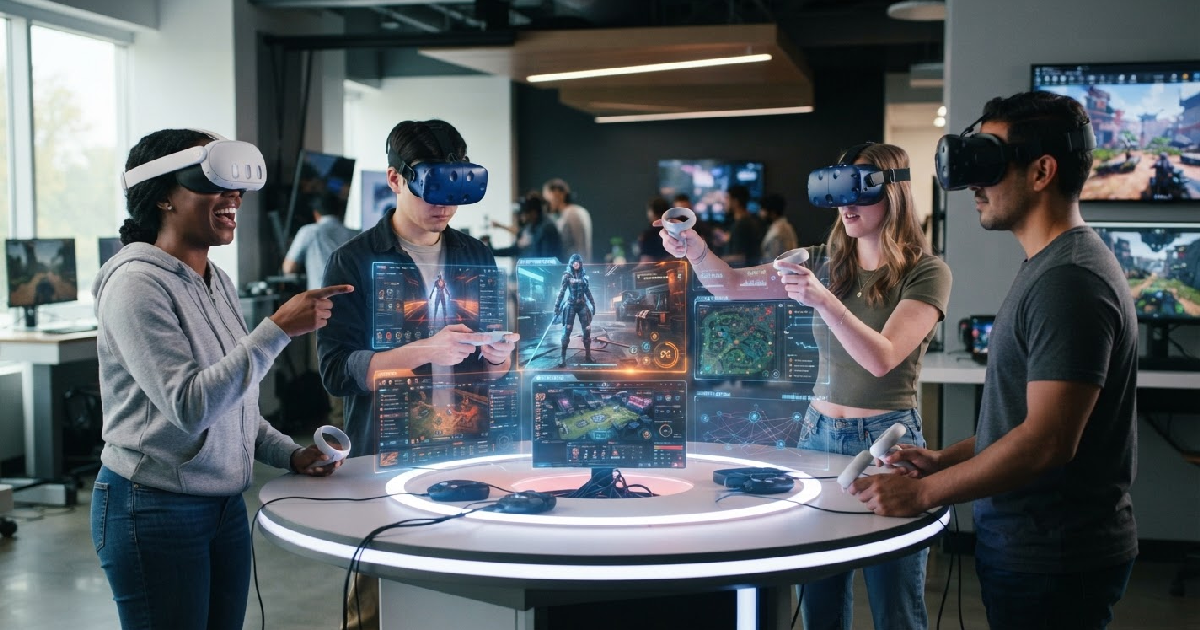
Key Trends Shaping the Gaming Industry: A Look at AI, Immersive Realities, and Cloud Gaming
The global gaming market is in the midst of a profound transformation, driven by an array of technological advancements and evolving player expectations. Valued at an estimated USD 298.1 billion in 2024, this dynamic sector is projected to hit USD 505.2 billion by 2030, boasting an impressive compound annual growth rate of 8.7% in gaming industry trends.
This significant expansion stems from several key trends shaping the gaming industry, including the pervasive influence of artificial intelligence (AI), the growing adoption of immersive realities like Virtual Reality (VR) and Augmented Reality (AR), the continued dominance of mobile gaming, and the rise of cloud gaming. Asia-Pacific currently accounts for over 52% of the global market share.
AI and machine learning transform game development
Artificial Intelligence (AI) and Machine Learning (ML) are fundamentally redefining both the creation and consumption of video games, moving far beyond simple pre-scripted actions. AI now simulates human-like intelligence in Non-Player Characters (NPCs), automates various development processes, and deeply personalizes individual player experiences.
Machine Learning, a core subset of AI, empowers these systems to learn from extensive data, identify complex patterns, and make decisions with minimal human intervention. This powerful synergy leads to richer, more responsive game worlds and significantly more efficient production pipelines for developers.
Smarter NPCs and dynamic worlds with AI
AI’s influence is deeply embedded in the core of interactive entertainment. NPCs, for example, now display more realistic and adaptive behaviors, responding intelligently to player actions and changing environmental cues in ways that enhance immersion.
Beyond character intelligence, AI drives procedural content generation, automatically creating expansive game environments, intricate levels, engaging quests, and diverse assets. This capability drastically cuts down development time while offering players seemingly infinite, adaptive worlds that evolve directly from their choices.
AI also plays a crucial role in automated quality assurance (QA) testing, swiftly identifying bugs and optimizing game performance before public release. This ensures a smoother, more polished experience for gamers across all platforms.
Personalization stands out as another major benefit, with AI dynamically balancing game difficulty and tailoring content to individual player preferences. It’s even enabling AI storyworlds, where audiences actively sculpt narratives through their decisions, creating experiences far beyond traditional linear storytelling.
A particularly innovative breakthrough is generative AI, which crafts unique art, dialogue, and facilitates rapid prototyping for game developers. This technology is actively paving the way for “generative realities,” effectively transforming game worlds into living, self-evolving ecosystems.
Game engine integration of advanced AI capabilities
Major game development platforms are now integrating sophisticated AI capabilities directly into their core ecosystems. Engines such as Unity, Godot, CryENGINE, Unreal, and XNA Shader 3D Game Engine now offer developers powerful built-in tools for AI implementation.
These integrations provide essential features like advanced version control, robust game design patterns, sophisticated audio middleware, and seamless in-app purchase systems. The widespread adoption means cutting-edge AI is increasingly accessible to a broader range of game creators, not just the largest studios.
Immersive realities redefine player engagement
Virtual Reality (VR), Augmented Reality (AR), and Mixed Reality (MR) are pushing the boundaries of interactive game design. These immersive technologies are giving players entirely new ways to experience digital worlds and engage with content.
They create a much deeper sense of presence and enable innovative gameplay mechanics that were previously technologically unfeasible, changing how we interact with games.
Virtual Reality (VR) offers complete immersion
Virtual Reality fully immerses players within a three-dimensional, computer-generated environment. Users typically don specialized VR headsets to enter these simulated digital worlds, interacting with games using specialized controllers or intuitive hand movements.
VR experiences transport players completely, offering unparalleled escapism into fantastical or hyper-realistic settings. The sensation of being truly *inside* the game world is what defines this technology.
Augmented and Mixed Reality blend digital and physical
Augmented Reality overlays digital information and virtual objects directly onto the real-world environment. It utilizes device cameras, such as those on smartphones or dedicated AR glasses, to project digital elements into a user’s live view.
This allows for games that directly interact with physical surroundings, seamlessly blending the digital and the real. Mixed Reality takes this concept further, blurring the lines between real and virtual objects within a shared space.
MR often requires more advanced hardware and spatial mapping technologies to allow virtual elements to convincingly interact with physical objects in a dynamic way. These immersive technologies are also enhancing esports viewership, allowing fans to dive into game environments or view real-time statistics overlaid on live streams, offering a far more dynamic viewing experience.
You can see how this plays out in the competitive esports scene.
Cloud and mobile gaming expand accessibility
Cloud gaming and the continued ascent of mobile gaming are democratizing access to interactive entertainment on a global scale. They’re actively breaking down traditional hardware barriers and making gaming far more flexible for millions of players worldwide.
This increased accessibility is a critical factor in the gaming market’s projected growth, successfully reaching new audiences and previously untapped geographical regions.
Cloud gaming’s instant access benefits
Cloud gaming services let players stream video games directly over the internet, much like how one streams movies or music. This eliminates the need to download or install games on local hardware, making powerful titles accessible to almost any internet-connected device.
The game’s execution, rendering, and complex calculations all occur on powerful remote servers located in data centers. The rendered video and audio then stream directly to the player’s device, while their commands are sent back to the server, creating a continuous, interactive loop.
This model provides instant access, unparalleled device flexibility across PCs, consoles, mobiles, and smart TVs, and smoother performance regardless of local hardware specifications. Cloud gaming is actively pushing the industry toward a truly platform-agnostic future, where hardware is no longer a barrier.
Mobile gaming sustains market dominance
Mobile gaming remains the largest category globally, driven by widespread smartphone penetration and continually improving internet infrastructure. It serves as the primary entry point for a vast number of new gamers worldwide, especially in emerging markets.
In 2024, mobile gaming accounted for over 46% of the total gaming market revenue and is projected to reach an impressive USD 120 billion by 2035. Its convenience and low barrier to entry are unmatched, cultivating an enormous and incredibly diverse player base.
Cross-platform play further enhances this trend, allowing players on different systems like PC, console, and mobile to compete or cooperate together. Developers are specifically designing games with compatible network architectures and input schemes, successfully breaking down traditional platform boundaries and fostering greater convergence within the gaming industry.
The future of gaming: personalized and expansive
The convergence of these technological advancements points toward a future where gaming is more personalized, immersive, and accessible than ever before. Developers are cleverly leveraging these powerful tools to craft experiences that are not only visually stunning but also deeply engaging and highly responsive to individual players.
The ongoing transformation in how games are created and consumed underscores the enduring vibrancy and innovative spirit of the sector. As these key trends shaping the gaming industry continue to evolve, they promise a landscape rich with innovation and sustained growth for many years to come.