

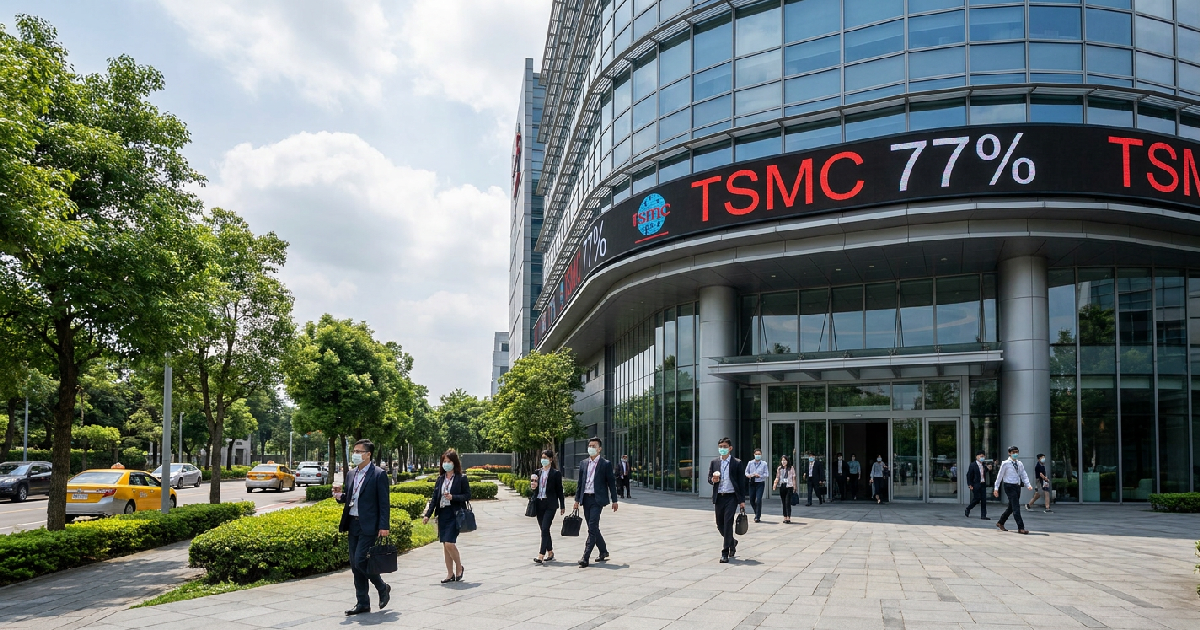
Taiwan Semiconductor Manufacturing Company reports 77
Taiwan Semiconductor Manufacturing Company (TSMC), the world’s largest contract chipmaker, announced a monumental second quarter for 2026 today, July 16, from its Taipei headquarters. Its net profit surged by 77% year-over-year to a record NT$706.6 billion (approximately $21.99 billion). This performance significantly surpassed market forecasts, driven by robust global demand for high-end artificial intelligence (AI) processors and advanced manufacturing technologies.
This impressive financial showing marks the fifth consecutive quarter the Taiwanese tech giant has achieved record-high net income. It underscores TSMC’s critical role in the burgeoning AI hardware ecosystem and its unwavering dominance in the semiconductor industry.
Breaking down TSMC’s record-breaking Q2 earnings
TSMC’s net income soared to NT$706.56 billion, or about $21.99 billion, for the second quarter. This figure comfortably beat LSEG SmartEstimates of NT$632.64 billion. The 77.4% year-over-year jump also marks a 23.4% increase from the prior quarter.
Total revenue for the quarter hit NT$1.27 trillion, approximately $39.45 billion. This surpassed expectations of NT$1.264 trillion. It’s also a significant 36% rise from the NT$933.79 billion reported in the same quarter last year.
Much of this robust growth comes from TSMC’s cutting-edge production. Advanced technologies, those at 7-nanometers and below, made up 77% of total wafer revenue. This focus on advanced nodes keeps TSMC at the forefront of the high-performance computing market.
AI and advanced computing fueling demand
Relentless demand for artificial intelligence (AI) chips and high-performance computing (HPC) applications are driving TSMC’s stellar results. AI’s growing integration across industries, including cloud computing and generative AI, creates a massive need for powerful processors.
TSMC manufactures these sophisticated components for major global tech giants. Nvidia, Apple, and Broadcom notably depend on TSMC’s foundries for advanced chip designs, especially for AI accelerators. This also plays into broader global market movements, where global stocks sometimes rise and fall on geopolitical expectations.
The global AI chip market shows explosive growth, projected to rise from $61.83 billion in 2025 to $84.17 billion in 2026. This reflects a compound annual growth rate (CAGR) of 36.1%. Analysts expect the market to hit $286.7 billion by 2030, with a 35.9% CAGR.
AI’s expansion in data centers and widespread GPU adoption for machine learning are key boom factors. This explains the incredibly high demand for TSMC’s specialized services, including CoWoS advanced packaging. Capacity constraints for CoWoS production are currently an issue.
Shifting customer landscape and market leadership
Taiwan Semiconductor Manufacturing Company holds undisputed leadership in the semiconductor foundry market. The company commands about 70% of the global market share. Its pure-foundry market share reached 73% in Q1 2026 alone.
TSMC’s client roster is seeing a notable reshuffle, driven by AI investments, even with long-standing partners. Nvidia is projected to overtake Apple as TSMC’s largest customer in 2026. It could generate $33-34 billion for TSMC, compared to Apple’s projected $27 billion.
Broadcom is rapidly ascending the ranks, potentially becoming TSMC’s second-largest client by 2026. This growth comes from substantial AI orders, including custom ASIC chips for companies like OpenAI. Broadcom’s revenue growth to $12 billion in 2026 reflects a 132% year-over-year increase, largely due to Google’s TPU ramp.
TSMC’s strategic position and long-term outlook
TSMC’s consistent ability to exceed profit estimates highlights its critical strategic position in the global technology supply chain. The company manufactures chips for today’s advanced electronics. It also pioneers the next generation of semiconductor technologies, much like Posco International is expanding its reach into US rare earth production.
For the full year 2026, TSMC expects its revenue to grow by “close to 30%” in U.S. dollars. Analysts support this optimistic outlook, projecting an average 2026 revenue of $5.2 trillion. This represents a 36.5% gain compared to 2025.
Looking ahead, TSMC projects a compound annual growth rate (CAGR) of about 25% in U.S. dollars from 2024 to 2029. AI accelerator-specific revenue is even more striking, expected to approach a “mid-to-high 50% CAGR” during this period. This vision underlines TSMC’s confidence in sustained AI and advanced computing growth.
Taiwan Semiconductor Manufacturing Company Limited (TSMC) was founded on February 21, 1987. It began as a joint venture involving Taiwan’s government, the Industrial Technology Research Institute (ITRI), and private investors. Morris Chang, the founder, commercialized ITRI’s semiconductor research. He pioneered the “pure-play foundry” business model, focusing solely on manufacturing chips for other designers.
This model has been hugely successful, forming a cornerstone of the modern tech economy.
Global implications of TSMC’s chip strength
TSMC’s robust financial health and technological leadership extend beyond the semiconductor industry. Its performance signals strong demand for advanced computing capabilities across the broader technology sector. The company’s results indirectly affect many industries, including consumer electronics and automotive, which increasingly rely on high-performance chips.
Taiwan’s dominance in advanced semiconductor manufacturing carries significant geopolitical weight. TSMC acts as a global linchpin, where any operational disruptions could create global economic shockwaves. This has pushed governments worldwide to invest in domestic chip manufacturing. Yet, replicating TSMC’s scale and expertise remains a huge challenge, especially with issues like China’s trading curbs potentially impacting billions in assets.
Ultimately, TSMC’s Q2 success solidifies its position as a crucial global player, not just a profitable enterprise. Its capacity to innovate and execute in a complex, competitive environment continues to shape the technological future. TSMC’s trajectory is deeply intertwined with AI and high-performance computing, areas showing no signs of slowing down.