

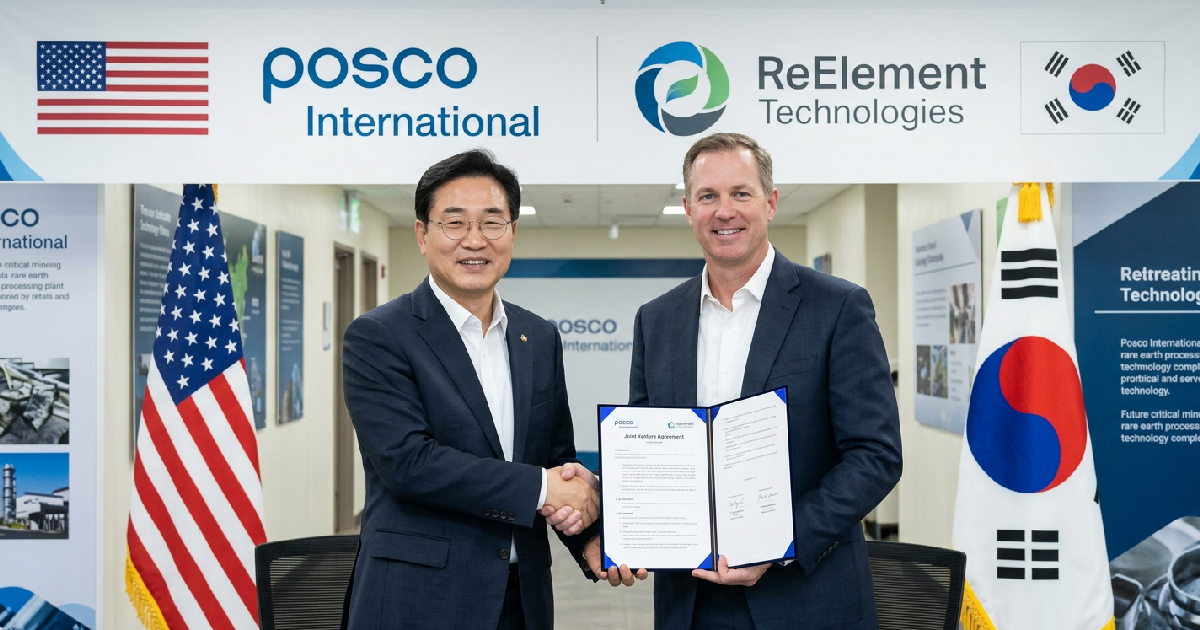
Posco International reveals plans for US rare earth plant with ReElement Technologies
Posco International CEO Lee Kye-in and ReElement Technologies CEO Mark Jensen signed a joint venture agreement in Washington, D.C. on May 21, 2026, to establish a rare earth separation and refining facility in the United States. The deal, announced publicly on May 22, involves a total investment of $200 million aimed at creating a domestic supply chain for critical minerals used in electric vehicles and artificial intelligence data centers. The South Korean energy giant will hold a controlling stake in the venture, which plans to begin pilot production by late 2027.
The move represents a strategic effort to challenge China’s dominance over the critical minerals market. Currently, China controls approximately 70% of global rare earth processing and holds a near-total monopoly on heavy rare earths like dysprosium. By establishing a foothold in the U.S., Posco International aims to provide Western manufacturers with a diversified source of neodymium and praseodymium oxides, which are essential for the permanent magnets found in modern tech hardware.
This industrial shift mirrors broader market adjustments across technology sectors, much like how AI and quantum tech divert capital from traditional assets as investors prioritize resources that power next-generation computing. The U.S. Department of Commerce has prioritized these materials to ensure national security and economic resilience against potential trade blockades or supply disruptions.
Advanced refining technology and environmental standards
The new facility will utilize a water-based ion chromatography method developed by ReElement Technologies, an affiliate of American Resources Corporation. This specific technology serves as a cornerstone of the partnership because it avoids the toxic solvents typically used in conventional Chinese refining processes. CEO Mark Jensen noted that combining this refining platform with Posco International’s industrial scale creates an integrated system that addresses existing gaps in the American supply chain.
The joint venture will be managed by Posco International, the energy and trading arm of the broader Posco Group. While a specific site for the plant is still being scouted, the project is scheduled to move in two distinct phases. The initial $100 million investment will cover construction and equipment setup, while a second $100 million is earmarked for future expansion based on market demand.
Production targets and volume goals
Phase 1 of the project aims for an annual production capacity of 3,000 tons of refined rare earth materials by 2028. Following this, the partners intend to double that output to 6,000 tons by 2030 during Phase 2. These volumes are designed to meet the growing needs of the electric vehicle market, where permanent magnets are a non-negotiable component for efficient motors.
The facility will focus on extracting neodymium (Nd), praseodymium (Pr), and heavy rare earths such as dysprosium (Dy) and terbium (Tb). These minerals are critical not only for automotive use but also for robotics and specialized industrial applications. Given the precision required for such high-tech infrastructure, the project’s valuation reflects the high stakes of modern industrial competition, similar to how a share price correction can signal a shift in market confidence for firms involved in mid-market advisory and valuations.
Strengthening the United States rare earth supply chain
The signing ceremony in Washington was attended by senior officials from the U.S. State Department, Commerce Department, and Energy Department, underscoring the political weight of the agreement. For the United States, bringing Posco International’s global logistics expertise into a domestic refining project helps mitigate the risks of relying on a single overseas supplier for nearly 92% of its neodymium magnets.
Posco International President Lee Kye-in characterized the factory as more than just a processing plant. He described it as the starting point for a “critical minerals value chain” that will eventually link raw material sourcing to the final manufacturing of permanent magnets within the United States. This “mine-to-magnet” strategy is intended to insulate the U.S. market from international volatility.
The timing of the deal is particularly relevant as global trade routes face increasing scrutiny. For instance, recent actions where naval forces redirect commercial vessels during maritime blockades highlight the fragility of international shipping. By producing critical minerals on American soil, the joint venture reduces the distance processed materials must travel to reach end-users in the tech hubs of North America.
Future outlook for Posco and ReElement
If pilot production begins as scheduled in the fourth quarter of 2027, the venture will be one of the few operational rare earth refineries in the Western Hemisphere using non-traditional, environmentally friendly methods. Full-scale mass production in 2028 is expected to provide a significant boost to the U.S. manufacturing sector’s autonomy.
For Posco International, the project secures a stable revenue stream and expands its portfolio beyond steel trading and conventional energy. The company’s leadership remains optimistic that the synergy between ReElement’s technology and Posco’s capital will allow the venture to scale rapidly as the world transitions toward a more electrified economy.