

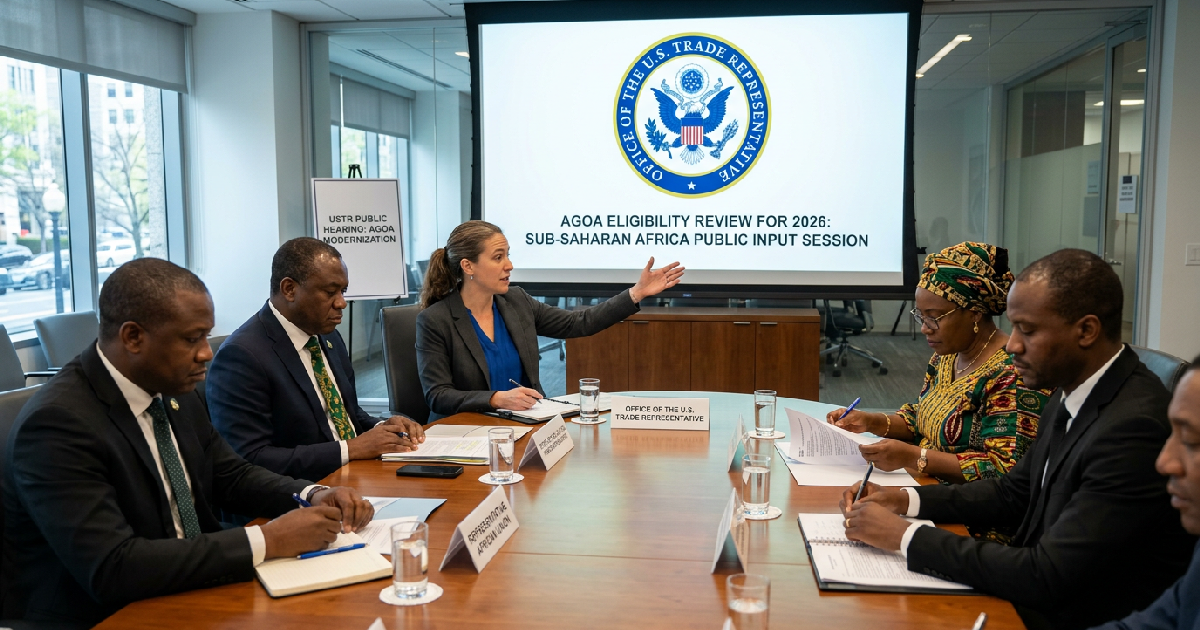
Office of the U.S. Trade Representative solicits feedback for 2026 African trade review
The Office of the U.S. Trade Representative (USTR) is officially soliciting public feedback to inform two critical tracks of African trade policy: the annual eligibility review for 2026 and the long-term modernization of the African Growth and Opportunity Act (AGOA).
While the 2026 eligibility review is a statutory requirement to determine which sub-Saharan nations maintain duty-free market access, the second solicitation looks toward a broader legislative overhaul as the program nears its current 2026 expiration.
USTR criteria for AGOA eligibility and market access
Congress renewed AGOA in February 2025, extending its life through the end of 2026 to provide a buffer for lawmakers and the administration to implement reforms. The current call for input regarding modernization, which carries a submission deadline of May 15, 2026, aims to provide recommendations to Congress for a more reciprocal trade framework.
This shift follows years of one-way trade preferences that have historically defined the economic relationship between the United States and the African continent.
To retain access to duty-free treatment for more than 1,800 products, sub-Saharan African nations must meet stringent benchmarks defined by Section 506A of the 1974 Act. The TPSC (Trade Policy Staff Committee) AGOA Implementation Subcommittee evaluates whether countries are making progress toward market-based economies, the rule of law, and political pluralism.
Key details
Additionally, the USTR monitors the elimination of barriers to U.S. trade and investment and the protection of internationally recognized worker rights.
Economic policies focused on poverty reduction and the implementation of systems to combat corruption are also mandatory for continued participation. The U.S. President retains the authority to suspend or remove countries that engage in gross violations of human rights or activities that threaten U.S. national security.
For regional exporters, maintaining this status is vital for industries like textile and apparel manufacturing, which rely on preferential access to remain globally competitive.
The precision required in navigating these trade audits is a high-stakes endeavor for local industries. Decisions on eligibility can affect regional investment strategies as significantly as a valuation correction affects corporate stakeholders in other sectors. When eligibility is lost, the sudden imposition of tariffs often leads to immediate economic contraction in specialized manufacturing sectors.
Recent shifts in the beneficiary country roster
The 2025 eligibility list currently comprises 32 countries, including Kenya, Nigeria, and South Africa. However, recent years have seen active use of the program’s enforcement mechanisms. In 2024, President Joe Biden removed Uganda and the Central African Republic citing human rights violations, while Gabon and Niger were ousted following military coups that compromised the rule of law and political pluralism.
Reinstatement and regional progress
Conversely, the review process also allows for the restoration of benefits. Mauritania regained its AGOA status in 2024 after showing measurable progress in eliminating forced labor and improving worker rights. This “carrot and stick” approach remains a primary tool for U.S. diplomacy in the region.
Just as international diplomatic shifts can stabilize global energy markets, the consistent application of AGOA standards is intended to encourage democratic reforms across sub-Saharan Africa.
Some nations remain permanently or temporarily excluded for reasons ranging from economic graduation to lack of interest. Sudan, for instance, has never requested designation as a beneficiary. Countries like Equatorial Guinea and Seychelles are ineligible because they reached high-income status, graduating from the Generalized System of Preferences (GSP) that underpins AGOA qualification.
Modernization and the push for reciprocal trade
The second solicitation, managed under docket USTR-2026-0166, marks a pivot toward a more mature economic partnership. Ambassador Greer stated that a modern AGOA must build on its 25-year foundation to benefit American workers and eliminate trade barriers. The goal is to move beyond the original year-2000 framework and create a path for reciprocal trade agreements with more advanced African economies.
This modernization effort seeks to ensure the program advances U.S. national security and economic goals. As industrial firms prioritize securing critical supply chains, the USTR is exploring how trade policy can facilitate better access to essential materials while balancing bilateral trade flows. The deadline for stakeholders to contribute to this modernization roadmap is May 15, 2026.
Reviewing the historical 2025 hearing cycle
The 2026 eligibility determinations are informed by a cycle of public testimony and commentary that began in 2025. This rigorous administrative process ensures that private sector interests and human rights organizations have a formal venue to present evidence regarding country compliance. The schedule for that review cycle was as follows:
- June 30, 2025: Deadline for pre-hearing written comments and requests to testify at the public hearing.
- July 18, 2025: Public hearing held at the USTR headquarters at 1724 F Street NW, Washington, D.C.
- July 31, 2025: Final deadline for post-hearing written comments and supplementary materials.
While those specific dates have passed, the data gathered during that cycle remains the foundation for current recommendations. Jeremy Streatfeild, the Director of African Affairs, and Ann Marie Warmenhoven-Tilias have been key points of contact for stakeholders navigating these submissions. All formal input must be submitted in English via the Regulations.gov portal to be considered for the official record.
As the USTR prepares its final recommendations for the 2027 cycle and the subsequent reauthorization, the focus remains on whether sub-Saharan nations can maintain the democratic and economic progress required by U.S. law. The outcome of these reviews will define the parameters of U.S.-Africa commerce through the end of the decade.