

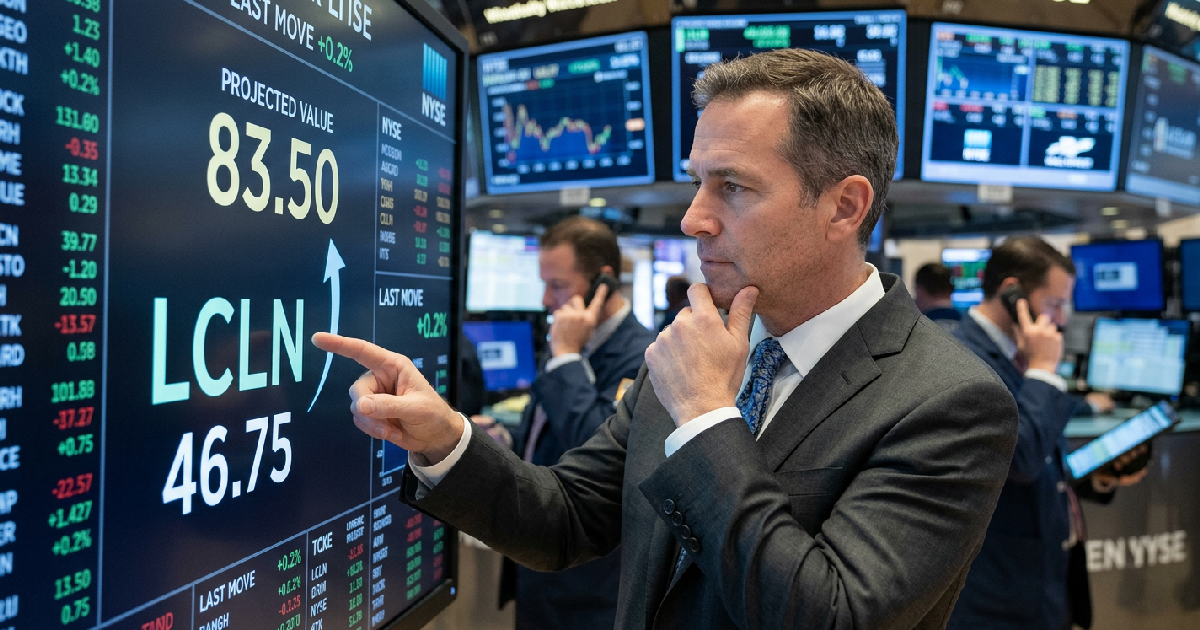
Lincoln International valuation shows 79% discount after LCLN share price move
Lincoln International (LCLN) shares closed at US$24.06 following a 4.38% rise in the latest trading session, signaling initial secondary market interest after the firm’s May 20, 2026, debut on the New York Stock Exchange. The investment banking firm, which priced its initial public offering at US$20.00 per share, has seen a year-to-date return of 6.84%. Despite the upward move, quantitative models from Simply Wall St suggest the stock remains significantly undervalued, trading at a 79.75% discount to an estimated future cash flow value of $118.83 per share.
The discrepancy between the current market price and intrinsic value estimates highlights a cautious Period of price discovery for the Chicago-based advisor. Lincoln International currently carries a price-to-earnings (P/E) ratio of 4x, which sits far below the US capital markets industry average of 39.9x and the peer average of 20.8x. This conservative valuation persists despite the firm reporting a return on equity (ROE) of 55.3% and net margins of 24% in recent financial disclosures.
Global financial institutions are currently navigating a complex period of institutional reorganization and geopolitical shifts. While some sectors face disruptions, such as when US naval forces redirect commercial vessels during maritime blockades, the middle-market M&A sector has remained active. Lincoln International completed 321 investment banking advisory transactions in 2025, up from 273 in the prior year, marking a steady increase in deal flow ahead of its public listing.
Analysis of the Lincoln International valuation and market metrics
The company’s IPO, led by Goldman Sachs and Morgan Stanley, saw the sale of 21,049,988 Class A shares. Of these, 20,604,046 were sold by the company itself, while existing stockholders offloaded 445,942 shares. The pricing at the top of the $18.00 to $20.00 range implied an initial valuation of approximately US$2.3 billion, which has since adjusted to a market capitalization of US$2.35 billion following the recent share price appreciation.
New Class A shareholders faced an immediate tangible-book dilution of approximately $18.27 per share at the time of the offering. This dilution was accompanied by a $70.4 million special dividend paid to pre-IPO holders. Financial data from the most recent earnings update on March 30, 2026, shows that while 2025 net income stood at $214.1 million prior to adjustments, the pro forma net income following reorganization was $12.6 million.
The complexity of these pro forma adjustments may be influencing the stock’s current 4x P/E ratio. For the three months ended March 31, 2026, the firm reported a pro forma basic loss per share of $0.24. This contrasts with the 2025 pro forma basic earnings per share of $0.16, creating a mixed data set for investors to evaluate as the firm transitions from a private partnership to a public entity.
Intrinsic utility and growth projections
Underpinning the 79.8% discount identified by Simply Wall St is a revenue growth rate of 28.3% per year. The Discounted Cash Flow (DCF) model’s $118.83 target assumes this growth can be sustained even as the firm matures in the public eye. Corporations often use such growth periods to expand their reach, much like how The Navigator Company scales international tissue business through strategic partnerships to secure long-term market share.
The firm’s valuation score of 4/6 reflects these strong underlying growth metrics. However, investors often balance growth with governance concerns. Post-IPO, Class C holders — primarily company insiders — are expected to retain approximately 87% of the total voting power. This concentrated control is a common feature in investment banking IPOs but can sometimes lead to lower market multiples compared to more widely held peers.
Board composition and corporate governance structures
As of May 23, 2026, the board of Lincoln International includes four non-independent directors and zero independent directors. Among the board members is Eric Malchow, who serves as President and Global Head of Merger and Acquisitions. Malchow is cited as the most experienced director, having officially commenced his role on the board in 2026.
The lack of independent oversight is a specific point of interest for institutional investors who track governance standards. Changes in corporate structure can have significant secondary effects on labor and operational contracts. We have seen similar scrutiny in other sectors, such as when Meta ends its Sama contract in Kenya resulting in major workforce shifts. Lincoln International has added four new directors over the last three years, but the current absence of independent voices remains a defining characteristic of its post-IPO board.
Market outlook and institutional participation
The technical structure of the IPO includes a 30-day option for underwriters to purchase up to an additional 3,157,498 shares at the US$20.00 IPO price. This overallotment option, excluding underwriting discounts and commissions, is a standard mechanism to manage volatility during the initial weeks of trading. The company’s ability to maintain its price above the $20.00 threshold suggests a level of stability that may encourage further institutional involvement.
Future performance will likely depend on whether the firm can reverse the 13.5% annual earnings decline recorded over the past five years. While the most recent year showed profit growth of 10.1%, the market appears to be waiting for more consistent results from the new pro forma structure. If Lincoln International can align its market price with its “outstanding” ROE, the current US$24.06 entry point may eventually be viewed as a significant outlier in its historical valuation.