

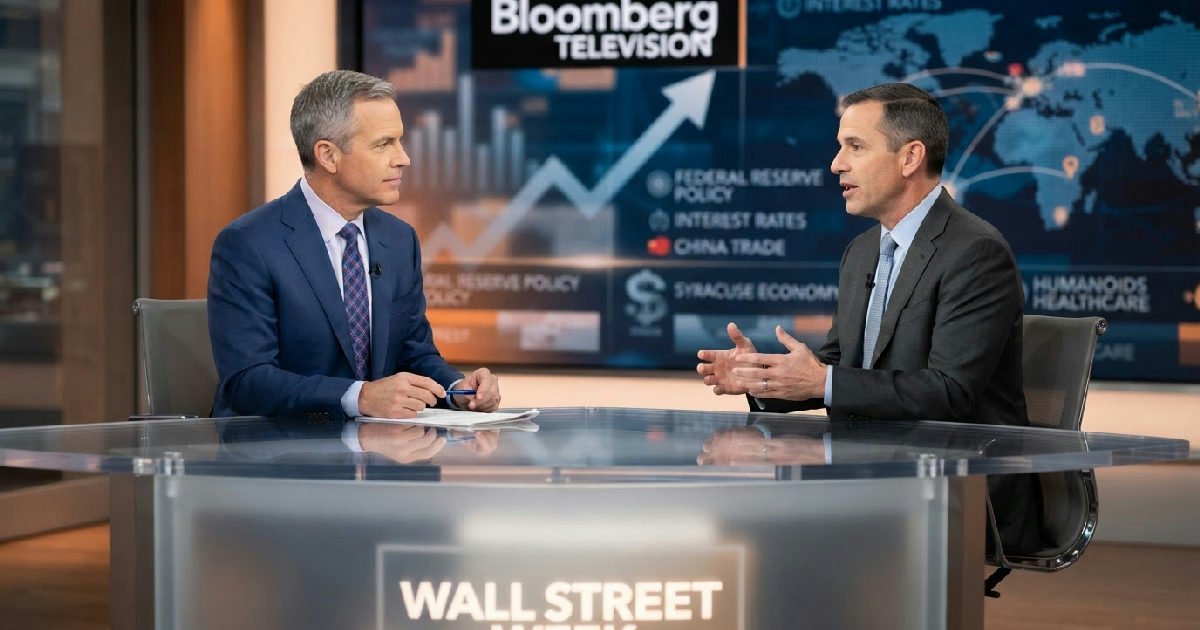
wall street week discussions on china and fed policy
Bloomberg Television’s “Wall Street Week,” hosted by David Westin, dedicated its May 17, 2024, episode to pressing global economic and technological subjects. The program offered deep Wall Street Week discussions on China’s evolving trade dynamics, Federal Reserve policy, and AI in healthcare.
Distinguished guests provided expert analysis on these complex topics, including insights into US industrial policy and the potential for a rust belt city like Syracuse to redefine its economic future. The episode encapsulated a crucial moment for policymakers and investors alike, grappling with shifting economic landscapes.
Fed’s inflation fight: Wall Street Week discussions
BlackRock Global Chief Investment Officer of Fixed Income, Rick Rieder, offered a provocative perspective on the Federal Reserve’s approach to inflation. He suggested that reducing interest rates could, counterintuitively, help curb rising prices. This stands against the conventional wisdom of tightening monetary policy.
Rieder highlighted a significant burden on lower-income individuals, where interest expenses now surpass mortgage payments. Conversely, he noted that higher-income households often benefit from elevated interest rates, skewing the economic impact of current Fed policy.
A Contrarian View on Rate Cuts
Rick Rieder argued that many companies have secured debt at lower, long-term rates and possess substantial cash reserves, lessening the impact of higher benchmark rates. He posited that the Federal Reserve could realistically lower its rate from 5.3% to between 4% and 4.5%.
Furthermore, Rieder voiced concern over the burgeoning national debt. He also mentioned the future clearing of 30-year auctions, suggesting potential instability in the bond market. These factors underscore the delicate balance the Fed must strike.
China’s Export Machine and Trade Reckoning
The program delved into China’s significant role in global trade, focusing on its massive export engine and the sustained ineffectiveness of two decades of US pressure. Michael Froman, President of the Council on Foreign Relations, led this segment, exploring future scenarios for the US-China economic relationship.
Meanwhile, Elizabeth Krear, J.D. Power Vice President of Electric Vehicle Practice, examined the potential consumer impact of tariffs on Chinese electric vehicles in the US. Her analysis highlighted how these geopolitical decisions could directly affect American buyers and the burgeoning EV market.
US and China remain at loggerheads over various trade issues, complicating global economic stability. This ongoing tension was a core element of the “Wall Street Week” discussions.
Implications of Chinese Overcapacity
Related discussions on “Bloomberg Surveillance” the same day further illuminated China’s strategy. The nation uses industrial overcapacity and low-cost exports to fuel its growth. This approach raises concerns about fair competition and market distortion globally.
New data revealing rising industrial output in China, coupled with Beijing’s property market rescue package, provides crucial context. Brainard of the National Economic Council was cited, underscoring the broader implications of China’s economic playbook on international relations and trade.
Syracuse’s Ambitious Reindustrialization
Another key segment, “Syracuse’s Second Chance,” explored a monumental economic development project. The discussion centered on whether a proposed $100 billion Micron factory could fundamentally alter the city’s economic trajectory. It’s a significant investment aimed at revitalizing a once-struggling region.
Syracuse, long viewed as a “Rust Belt cautionary tale,” now aspires to become a leading example of American reindustrialization. This massive factory could bring thousands of jobs and substantial investment, fostering a new era of prosperity for the area.
Revitalizing American Manufacturing
The Micron project represents a broader national effort to boost domestic manufacturing and reduce reliance on overseas production. Such large-scale investments are crucial for creating resilient supply chains and high-tech employment opportunities within the United States.
This initiative could serve as a blueprint for other cities grappling with industrial decline. The success of Syracuse’s reindustrialization effort holds significant implications for future economic development strategies across the country.
Antitrust Concerns and Humanoids in Healthcare
Paul J. Taubman, Founder, Chairman, and CEO of PJT Partners, contributed to the program’s insights. He asserted that the US government’s current stance on antitrust is fostering a “chilling effect” on business deals. This perspective suggests regulatory hurdles are deterring potential mergers and acquisitions.
This strict regulatory environment, according to Taubman, could stifle innovation and economic growth. Companies might become hesitant to pursue strategic partnerships or consolidations, impacting overall market dynamics and investment.
The Future of Robotics in Medicine
The episode also touched upon “Humanoids in Healthcare,” a topic highlighting the cutting-edge intersection of technology and medicine. While specific details from this segment weren’t extensively outlined in available summaries, its inclusion on the program signals growing interest.
The discussion likely explored the potential for advanced robotics to transform medical care, from assisting in surgeries to providing patient support. This growing field promises significant advancements, though it also presents complex ethical and practical considerations for the healthcare sector.
This segment underscores the rapid pace of technological change and its potential to reshape various industries. The evolving role of AI and robotics in daily life remains a compelling subject for market analysts and the public.
Market Insights and Forward Outlook
The “Wall Street Week” episode provided a comprehensive snapshot of the key forces shaping global markets and policy. David Westin guided viewers through intricate economic debates, offering diverse perspectives from leading financial minds. These discussions are vital for understanding current trends.
From the Federal Reserve’s inflation fight to China’s trade strategies and the future of American manufacturing, the program covered crucial ground. It also cast a light on emerging technological frontiers, like humanoids in healthcare, shaping tomorrow’s industries.
Such in-depth Wall Street Week discussions equip investors and business leaders with essential context for navigating an unpredictable global economy. The insights shared continue to resonate, influencing strategic decisions across various sectors.