

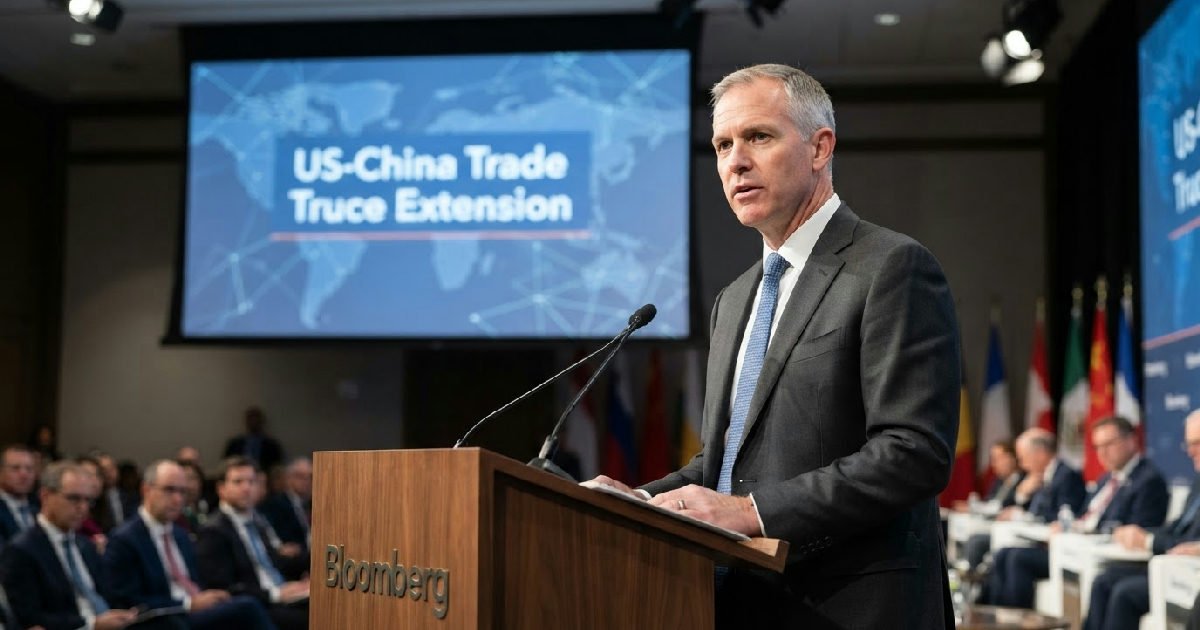
US, China Still Divided on Trade Truce Extension
Significant divisions remain between the U.S. and China regarding terms for a US-China trade truce extension, with a three-to-six-month period probable for discussions. S. Trade Representative Jamieson Greer revealed on Monday that significant divisions still exist between the United States and China regarding the terms for a US-China trade truce extension.
While no immediate announcement is expected this week, Greer indicated a three-to-six-month extension remains a “probable range” for discussions.
The existing agreement is slated to expire on November 10, 2026, setting a clear deadline for Washington and Beijing to find common ground. Greer made these comments during an appearance on “Bloomberg Surveillance,” underscoring the delicate nature of ongoing economic negotiations between the world’s two largest economies.
Divisions Persist in US-China Trade Truce Extension Talks
U.S. Trade Representative Jamieson Greer’s remarks highlight the persistent challenges in forging a consensus on trade matters between the two global powers. He explicitly stated that despite ongoing dialogue, the two nations haven’t yet aligned on the specific conditions required for a renewed trade agreement.
This divergence complicates efforts to provide stability for businesses caught in the crossfire of tariffs and trade barriers. The timeframe of a potential three-to-six-month extension offers a glimpse into what both sides might consider a workable interim solution.
Such an extension would buy valuable time for more comprehensive discussions, rather than pushing for a hasty, potentially unstable long-term deal. However, the lack of an immediate announcement this week signals the complexity of even these temporary arrangements.
Background of the Current Truce
The current trade truce, set to lapse on November 10, 2026, was initially forged to de-escalate a period of intense economic conflict. It provided a much-needed pause, allowing businesses to plan with some degree of predictability.
This temporary agreement aimed to create space for more detailed negotiations on structural issues, intellectual property rights, and market access. But since its inception, the truce has been a fragile peace.
Both countries have continued to engage in strategic competition across various sectors, from technology to national security. The upcoming deadline adds pressure to an already fraught relationship, making any extension crucial for avoiding a potential return to harsher tariff regimes.
Key Players in the Ongoing Negotiations
The complex web of US-China trade discussions involves several high-profile officials from both sides. On the American front, U.S. Trade Representative Jamieson Greer is a central figure, responsible for shaping and executing Washington’s trade policy.
His experience, including a previous stint as Chief of Staff to Ambassador Robert Lighthizer during the Trump administration, gives him a deep understanding of the intricacies of these bilateral talks. This background is pivotal in navigating the intricate trade landscape.
Accompanying Greer in these critical dialogues is U.S. Treasury Secretary Scott Bessent, whose role often involves managing the broader economic relationship and financial stability. Bessent’s involvement underscores the financial implications of the trade negotiations.
Their Chinese counterparts include Vice Premier He Lifeng, a key economic advisor, and official Li Chenggang, both instrumental in communicating Beijing’s positions and priorities. These individuals form the core negotiating teams, whose interactions will ultimately determine the future of the trade relationship.
The Broader Economic and Geopolitical Context
Any discussion about a US-China trade truce extension occurs against a backdrop of evolving global economic pressures. High borrowing costs, for instance, are a significant factor shaping global fiscal policies, and protracted trade disputes only exacerbate these strains.
These financial realities inevitably influence high-stakes negotiations between major economic powers. Such fiscal challenges add another layer of complexity to the ongoing trade dialogue.
The global semiconductor industry, a critical sector, is also heavily impacted by the relationship between Washington and Beijing. Restrictive trade practices and national security concerns often spill over into technology policy, creating ripples throughout international supply chains.
Finding a balanced trade relationship is therefore not just about tariffs, but about broader technological and strategic dominance. The geopolitical stakes are considerable, influencing everything from manufacturing to innovation.
Potential Outcomes and Market Reactions
The market’s reaction to news of a potential trade truce extension will likely hinge on the perceived stability and duration of any agreement. A short-term extension, even one of three to six months, would offer immediate relief by averting a sudden re-escalation of tariffs.
Such a move could bolster investor confidence and provide a clearer, albeit temporary, outlook for businesses. This predictability is vital for long-term planning and investment decisions in a volatile global economy.
Conversely, a failure to secure an extension before the November 10 deadline could trigger renewed market volatility and uncertainty. Businesses have already invested heavily in adapting to previous trade shifts, and further disruptions would force costly adjustments.
Investors are particularly sensitive to these signals, as they reflect the underlying health of global commerce. Disruptions in major economies can also influence funding rounds and valuations in rapidly growing sectors like artificial intelligence, impacting overall market sentiment and future innovation.
Path Forward for Bilateral Relations
Looking ahead, the discussions between the US and China transcend mere trade figures; they represent a continual negotiation of influence and economic philosophy. The current environment demands strategic patience and pragmatic diplomacy.
Both nations grapple with domestic economic priorities and international responsibilities. The outcome of these extension talks could set a precedent for how future disputes are managed, shaping the global trade rulebook.
Even if a temporary truce is secured, the fundamental disagreements on issues like intellectual property, industrial subsidies, and human rights will remain. These deeper fissures suggest a comprehensive, lasting resolution will require sustained, high-level engagement over many years.
Both sides are playing a long game, and every negotiation, even on an extension, is a piece of that larger strategic puzzle. The path to a truly stable economic partnership is long and complex.