

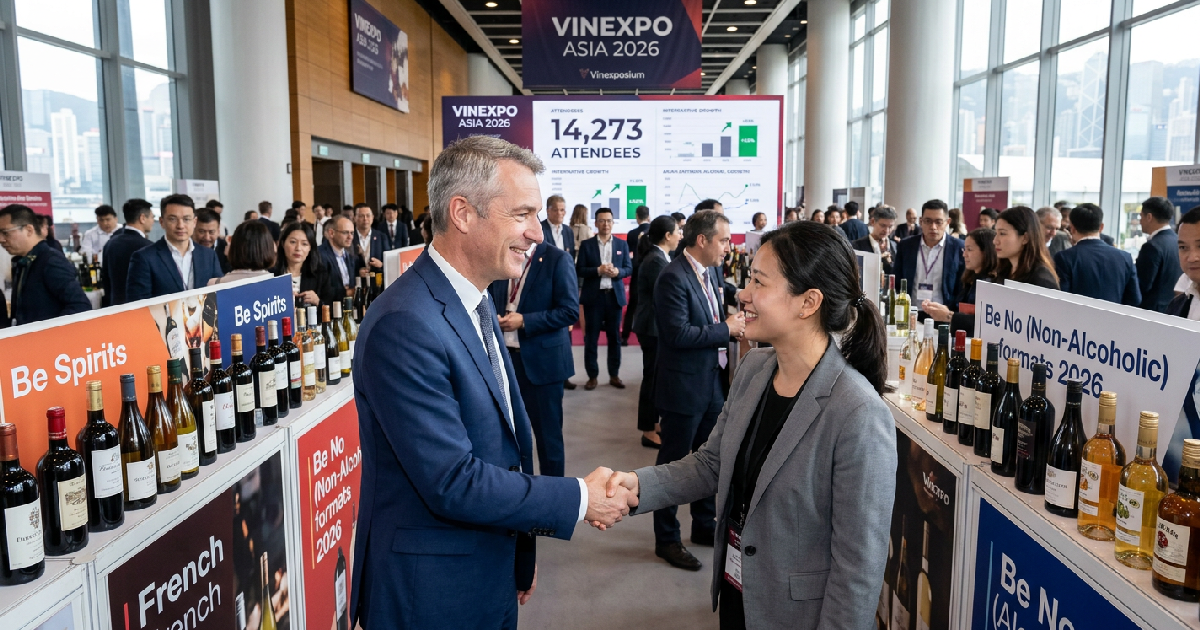
Rodolphe Lameyse confirms 14,273 professionals attended Hong Kong wine and spirits fair
Vinexpo Asia 2026 concluded its three-day run at the Hong Kong Convention and Exhibition Centre (HKCEC) on May 28, 2026, reporting a sharp rise in attendance and broader international participation. The trade fair, led by Vinexposium CEO Rodolphe Lameyse, attracted 14,273 trade professionals from 76 different markets. This represents a significant expansion from the 59 markets represented at the 2024 event, signaling renewed confidence in the Asian beverages sector.
The exhibition featured 38 producing countries, an increase from 35 in 2024, with nine nations making their debut, including Austria and Uruguay. Dr. Bernard Chan, the Acting Secretary for Commerce and Economic Development of the Hong Kong SAR Government, officially opened the event alongside several high-level diplomats. The delegation included the French Ambassador, the Ambassador of the European Union, and twenty-five consuls general from eighteen different countries.
This year marked the 10th edition of Vinexpo Asia in Hong Kong since its 1998 launch, reinforcing the city’s role as a primary gateway to Greater China. While certain reports on China trading curbs affecting assets have created regional economic discussions, the trade foundation for wine and spirits remains a priority for international producers. The success of the 2026 edition emphasizes Hong Kong’s ability to act as a lasting point of convergence for the Asia-Pacific trade.
International producers expand presence during Vinexpo Asia 2026
The scale of the 2026 event was supported by 28 trade associations, up from 19 in 2024. This collective presence provided a platform for both boutique labels and global industry leaders. Major exhibitors included LES GRANDS CHAIS DE FRANCE, Tommasi Family Estates, and Champagne GH Martel & Cie. The diversity of participants shows that global firms are increasingly looking to Asian hubs to balance their international trade flows.
European producers maintained a dominant presence at the HKCEC. Confirmed exhibitors included VICENTE GANDIA and RAÍCES IBÉRICAS from Spain, as well as Italian heavyweights like Edoardo Freddi International and DBGitalia. These firms participated in qualified business meetings designed to navigate a market CEO Rodolphe Lameyse described as undergoing “significant transformation.”
Strategic growth was also visible among New World producers. Organizations like Wine Australia and BTT Winery – Lonco Wines from Chile engaged with regional buyers to secure long-term distribution deals. These interactions are often more stable than the fluctuating valuation models in finance, as they rely on physical commodity demand in established consumption markets.
The expansion of Be Spirits and the non-alcoholic segment
A major development in the 2026 format was the rapid growth of the Be Spirits section, which tripled its exhibitor base. This area focused on spirits including baijiu, soju, sake, and cider, alongside traditional wine offerings. The expansion indicates that trade professionals are diversifying their portfolios to meet changing consumer tastes across metropolitan Asia.
The debut of the “Be No” format addressed the rising demand for non-alcoholic beverages. These products accounted for one in ten exhibitor references during the three-day exhibition. Japanese and South Korean pavilions highlighted the “no-and-low” alcohol category, showing that these options are moving from niche interests to mainstream commercial importance in the region.
Hong Kong serves as a strategic regional gateway
Hong Kong’s selection as the 2026 host city remains central to the Vinexposium rotation strategy. While the 2025 event in Singapore gathered nearly 9,000 professionals focusing on Southeast Asia, the Hong Kong edition provides direct access to the mainland Chinese market. High-end brands like CHAMPAGNE CARBON and Edmond de Rothschild utilized the venue to strengthen their ties with regional distributors.
Institutional support played a vital role in the event’s logistics and outreach. The Hong Kong Tourism Board sealed a five-year protocol with the Bordeaux Wine Council. This partnership aims to integrate wine tourism and gastronomy into the city’s broader appeal for international visitors. Such agreements provide a stable framework for trade even as capital flows shift into digital assets and alternative investment classes elsewhere.
Educational insights provided by the Vinexpo Academy
The Vinexpo Academy hosted more than 40 sessions, including masterclasses and round tables. These sessions served as decision-support tools, focusing on the complexities of the current Chinese market. Rodolphe Lameyse noted during the program that “when the market grows more complex, knowledge becomes a tool” for industry professionals to maintain their competitive edge.
These sessions explored regional issues and international trade redefinitions. Producers like Nath. Johnston & Fils and those represented by VIGNOBLES & SIGNATURES used these insights to align their production with Asian consumer trends. The Academy’s focus on data and regional specifics helps firms adapt to a landscape where traditional trade flows are being actively redefined.
Vinexpo Asia to become annual event from 2027
The conclusion of the May 2026 exhibition marks the end of the current rotation cycle between Hong Kong and Singapore. Organizers confirmed that starting in 2027, Vinexpo Asia will become an annual event anchored in a single Asian hub. This shift aims to provide the industry with a consistent, yearly meeting point to address rapid changes in global trade balances.
Producers such as CVR TEJO – TEJO WINES and other international trade bodies have expressed the need for a more frequent presence in the region. By moving to an annual schedule, Vinexpo Asia intends to solidify its position as the most important trade gathering in the Asia-Pacific. This strategy reflects a broader move toward market consolidation as global brands seek reliable, year-on-year access to Asian consumers.