

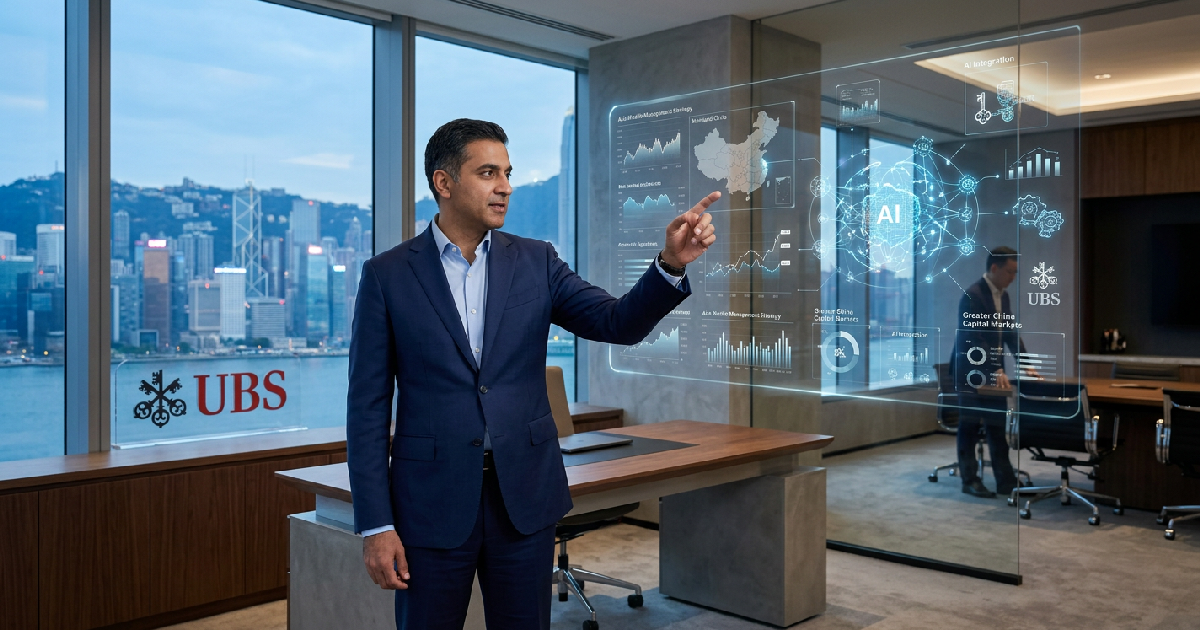
UBS Asia President Iqbal Khan views AI as ‘biggest transformation’ for banking jobs
Iqbal Khan, the Asia Pacific President of UBS Group AG, has warned that the integration of artificial intelligence will force an industry-wide reckoning over headcount if financial services firms cannot leverage new technical capacity to drive faster growth. In an interview with Bloomberg Television reported on May 27, 2026, the executive outlined a dual-track future where AI acts as a significant productivity lever while simultaneously threatening status quo employment structures within the banking sector.
The UBS executive, who recently completed a high-profile relocation to lead the bank’s Asia-Pacific operations, described AI as “the biggest transformation we’re going to see.” Khan noted that while the technology “frees up capacity and improves productivity,” the ultimate impact on costs and jobs depends on whether banks can use that extra time to capture more “share of the wallet” from their clients. If the industry fails to grow its revenue base in tandem with these productivity gains, Khan admitted there will be ramifications for the workforce.
UBS is currently prioritizing the “up-skilling” of its staff to prepare for this shift. This focus on human-centric adaptation suggest that while automation is accelerating, the bank views professional expertise as a necessary component for its wealth management business model. This evolution is particularly relevant as AI and quantum tech divert capital away from some traditional assets, requiring advisors to navigate increasingly complex digital landscapes.
Iqbal Khan signals long-term optimism for China
Despite persistent economic shifts, Iqbal Khan urged investors to remain “positive” on China over the long term. He emphasized that the industry should not underestimate the opportunities and possibilities related to technology and talent in Asia, including China. This stance aligns with the bank’s recent decision to increase its stake in its UBS securities entity in mainland China from 67% to 100%.
The bank’s strategy appears rooted in the belief that Chinese authorities will continue to prioritize development in strategically important industries. These include semiconductors, life sciences, healthcare, and financial services. By consolidating its hold on its mainland securities entity, UBS is positioning itself to capture wealth creation within these specific sectors, even as China trading curbs remain a point of concern for some market participants.
Market leadership and the relocation of power
The structural shift at UBS underscores the importance of the Asia-Pacific (APAC) market to the group’s global ambitions. Khan’s recent move to Asia marked the first time a divisional president for the bank has been based in the region. This transition follows a leadership shuffle where Edmund Koh stepped down from the Group Executive Board effective September 1, 2024, to become UBS’s regional chair of Asia-Pacific.
Effective from that same date in 2024, Iqbal Khan became President UBS Asia-Pacific while maintaining his role as Co-President of Global Wealth Management (GWM). Placing a top decision-maker directly within the region allows the bank to more closely monitor local dynamics, such as when stocks rise and oil falls based on shifting expectations in the Middle East and their subsequent impact on Asian capital flows.
Capacity gains and the productivity paradox
The conversation around artificial intelligence at UBS focuses on practical output rather than theoretical potential. Khan pointed out that the primary goal of AI integration is to free up internal capacity, allowing the bank to serve its clients better and grow faster. However, a productivity paradox remains: if automation allows for significantly more work with fewer hours, firms must find new avenues for growth to maintain their current workforce levels.
By expanding its digital toolkit, the firm hopes to use that extra capacity to gain a larger share of the market. This strategy mirrors broader trends in the financial services space where firms must choose between using AI to reduce costs or to fuel expansion. For Khan, the emphasis is on “us learning” and ensuring the workforce is equipped to handle the biggest technological transformation of the decade.
Broader perspective on the Middle East corridor
While Khan’s current focus is firmly on Asia, his previous tenure as President of UBS Europe, Middle East and Africa (EMEA) from 2021 to 2023 provides a unique perspective on global corridors. The bank views the Middle East as a critical bridge for capital flows, especially as investors in that region increasingly seek out the “technology and talent” Khan identified as being central to Asia’s future.
The success of the “Khan era” in Asia will likely be defined by how well the bank manages the internal cultural shift toward an AI-assisted workforce while navigating the regulatory landscape of mainland China. If the bank can successfully use AI to drive growth without drastic cost-cutting, it may provide a blueprint for the wider banking industry in an era defined by rapid technological change.