

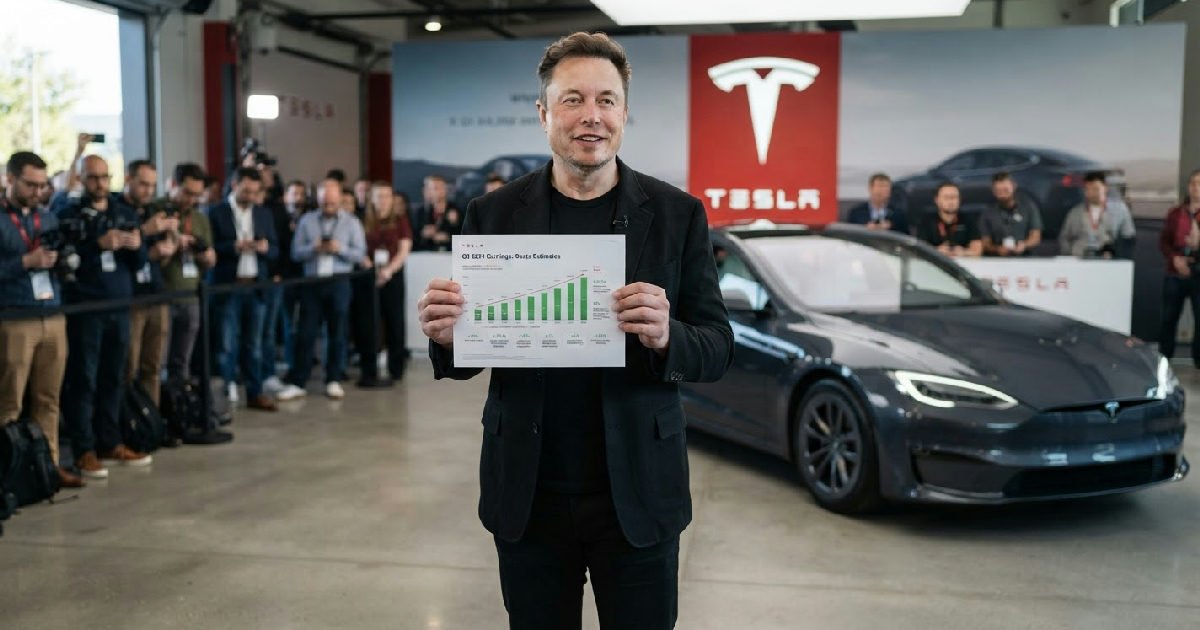
Tesla beats earnings estimates despite automotive revenue dip
Tesla Q3 earnings for 2026, reported on 2026-10-21, exceeded analyst expectations with an adjusted EPS of $0.48 and revenues of $28.05 billion. reported third-quarter 2026 financial results on 2026-10-21, exceeding analyst expectations for both adjusted earnings per share and total revenue. The electric vehicle giant posted an adjusted EPS of $0.48 on revenues of $28.05 billion.
However, the company’s crucial automotive revenue saw a 3% decline compared to the previous year, pointing to a mixed financial picture. This performance follows a period of intense market scrutiny.
Analyzing Tesla Q3 Earnings Performance
While the overall revenue figure of $28.05 billion narrowly edged out the $27.9 billion estimated by analysts, it represented a slight 0.2% decrease from the $28.24 billion recorded in the third quarter of 2025. This near-flat growth signals a challenging period for the company amid broader economic shifts.
Net income attributable to common shareholders also saw a significant drop, plummeting 29% to $787 million, or $0.22 per share. This figure is down from $1.11 billion, or $0.32 per share, reported a year ago, reflecting increased operational costs and strategic investments.
Operating income suffered an even steeper decline, falling 56% year-on-year to $718 million from $1.62 billion in Q3 2025. Consequently, Tesla’s operating margin narrowed considerably to 2.6%, a stark contrast to the 5.8% achieved in the same period last year.
Despite these pressures, the company’s overall gross margin saw an improvement, rising to 19.6% from 18% a year earlier. This increase indicates some efficiency gains or shifts in product mix outside the core automotive segment. These results come as several major financial institutions navigate their own quarterly performances, such as Capital One exceeding forecasts in its recent Q3 earnings.
Automotive Sector Faces Headwinds
Tesla’s core automotive business experienced a notable slowdown, with revenue decreasing 3% year-on-year to $20.56 billion from $21.21 billion in Q3 2025. This contraction highlights growing challenges in its primary market, particularly with intense competition.
Worldwide vehicle deliveries for the quarter totaled 486,532 units, marking an approximate 2% decrease from the previous year. This dip occurred despite a 4% increase in vehicle production, which reached 464,391 units, indicating a gap between manufacturing output and customer uptake.
The company attributed the lackluster automotive performance and reduced profitability to several factors. Lower average sales prices for its vehicles played a significant role, as Tesla has implemented price adjustments to stimulate demand in a competitive landscape.
Battery supply constraints also limited the number of vehicles Tesla could deliver, resulting in its largest passenger vehicle backlog in four years. This bottleneck impacts the company’s ability to capitalise fully on its production capacity. Moreover, the expiration of a federal EV tax credit last year impacted sales, removing a key incentive for many buyers.
Intensifying Global EV Competition
The competitive landscape continues to intensify, with Chinese EV manufacturers like BYD and Xiaomi gaining market share in Asia and Europe with their more affordable and innovative offerings. These companies are actively challenging Tesla’s dominance in crucial international markets.
This increased rivalry forces Tesla to continually innovate and adjust its pricing strategies, directly influencing its automotive revenue. The battle for market share in the rapidly expanding global electric vehicle segment is becoming increasingly fierce, impacting profit margins across the industry.
Investments in AI and Future Technologies Drive Spending
A major contributing factor to the decline in net income was Tesla’s aggressive spending on new initiatives, particularly in advanced technologies. Capital expenditures more than doubled to $4.73 billion, up from $2.25 billion in Q3 2025, signaling a strategic pivot.
These significant investments are primarily directed towards manufacturing capacity expansion, artificial intelligence projects, and the development of Optimus humanoid robots. Tesla views these areas as crucial for its long-term growth beyond traditional vehicle sales.
The company’s focus on AI is evident in its increased research and development (R&D) outlays. This shift toward advanced robotics and autonomous systems reflects a strategic decision to diversify revenue streams and cement its position as a technology leader, not just an automaker.
FSD Progress and Robotaxi Ambitions
In a promising development for its software division, active subscriptions for Tesla’s Full Self-Driving (FSD) system (Supervised) grew by 67% year-on-year, reaching 1.74 million. This indicates growing customer adoption and confidence in its autonomous driving capabilities.
Ashok Elluswamy, Tesla’s vice president of Autopilot, stated plans to roll out access to its forthcoming FSD (Unsupervised) systems to some customers around the second quarter of next year. This advancement could further bolster software revenue and accelerate autonomous vehicle development. Meanwhile, news from other sectors also reflects shifting market dynamics, with Moody’s Q3 earnings missing estimates recently.
The company also saw progress with its Cybercab robotaxi service, which launched its unsupervised operations in Austin, Texas, on September 3, 2026. Cumulative unsupervised miles for Cybercab reportedly grew eightfold quarter-over-quarter, indicating rapid deployment and testing of the autonomous fleet and its potential for future revenue generation.
Strategic Outlook and Market Challenges
Despite the current financial pressures, Elon Musk outlined an ambitious vision for the future, particularly regarding the Robotaxi fleet. He predicted these driverless vehicles would begin to significantly contribute to the company’s financials in 2027, with noticeable impact by Q2 and a substantial role by Q3 or Q4 of next year.
Musk boldly forecast that Tesla could eventually handle the majority of all passenger miles on Earth, provided regulatory environments allow it to operate freely. This long-term outlook underscores the company’s aspirations to transform transportation services globally, moving beyond simply selling cars.
The stock slid more than 3% in extended trading after the bell on Wednesday, reflecting investor apprehension about the immediate financial figures and the significant capital outlays. Tesla shares are down 14% this year, underperforming the broader market and other megacap tech firms.
Musk’s Visionary Bets and Investor Skepticism
The mixed Q3 results landed a day after CEO Elon Musk openly discussed a potential merger between Tesla and SpaceX during a SpaceX quarterly call. Boards at both companies have formed special committees to explore a possible tie-up, creating a layer of complexity and speculation around Tesla’s future direction.
Musk addressed the merger speculation on the Tesla call, stating he had already said everything necessary on the matter. This kind of announcement, though brief, adds to the narrative of Musk’s audacious long-term bets, which often divide investor opinion between steadfast belief and cautious skepticism. Similarly, the financial health of major banks like HDFC and ICICI Bank also garners significant attention in global markets.
The company’s increased spending on AI, including the Optimus humanoid robot project, is another significant long-term play. Musk acknowledged there’s “still quite a lot of work to do” for Optimus to be truly useful, with current issues expected to be resolved “around the end of next year.” These projects, while potentially transformative, demand substantial upfront investment and carry inherent risks.
Tesla’s strategy clearly involves enduring short-term profitability pressures to fund ambitious projects that could redefine its business model. The success of these ventures will ultimately determine whether its current investment phase yields the revolutionary returns Musk envisions, or if it further strains the company’s financial performance.