

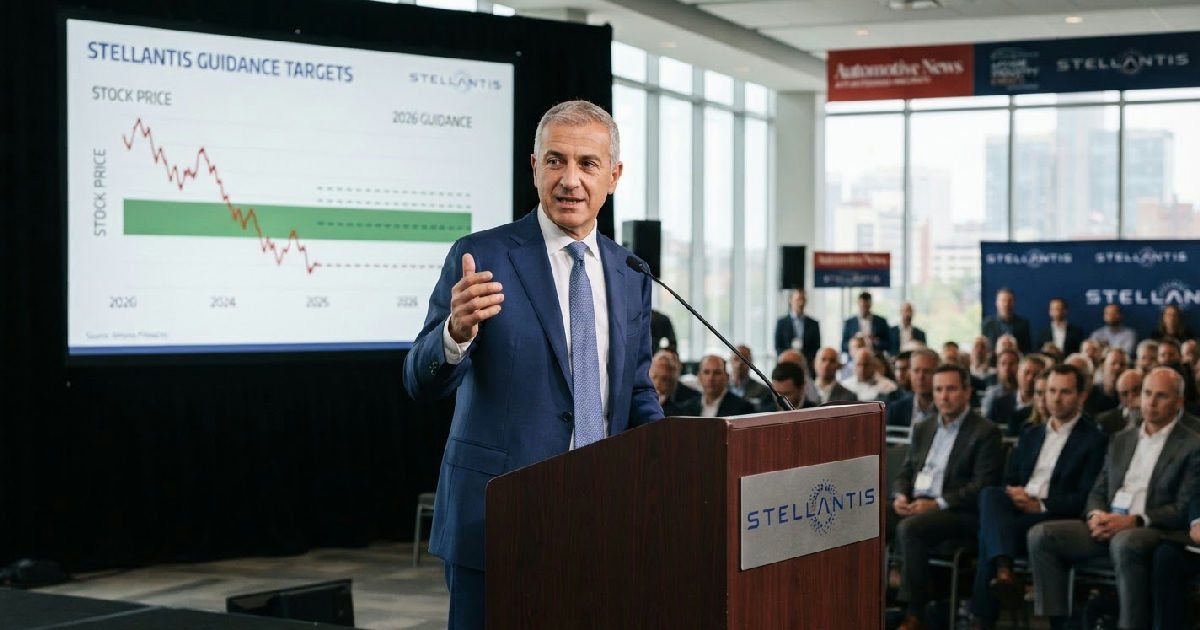
Antonio Filosa reaffirms Stellantis guidance amid stock slump
Stellantis CEO Antonio Filosa projected a steady hand on Wednesday, reaffirming the company’s 2026 financial guidance and long-term cash-flow targets even as the automaker’s U.S. shares plumbed new depths. Speaking at an Automotive News event in Detroit, Filosa’s comments aimed to calm investor nerves after a punishing year for the company on the stock market.
The transatlantic automotive giant, formed from the 2021 merger of Fiat Chrysler and PSA Groupe, has seen its market valuation tumble. The public reassurance comes just a day after the company’s stock hit an all-time closing low, raising questions about the viability of its ambitious recovery strategy.
Stellantis guidance and investor anxiety tests Filosa’s resolve
The backdrop for Filosa’s address was decidedly grim. Stellantis’s U.S. shares closed at $4.43 on Tuesday, a fresh low following a 4.1% drop in a single trading session. This has contributed to a staggering loss of nearly 60% for the stock so far this year, putting it on course for its worst annual performance since its inception.
This sharp decline reflects deep investor skepticism about the company’s ability to navigate years of sales declines and margin dilution, particularly in the critical North American market. The sell-off has been exacerbated by a broader market swoon where the S&P 500 has plunged amid rising bond yields and economic uncertainty, creating a difficult environment for companies undergoing major transitions.
Filosa, who took the helm in June 2025, is now tasked with convincing the market that his turnaround plan has teeth. His public statements are a direct challenge to the prevailing negative sentiment, betting that his strategy will ultimately bear fruit and prove the doubters wrong.
The core pillars of the $70 billion turnaround plan
At the heart of the CEO’s message is a massive, roughly $70 billion turnaround plan designed to reverse the company’s trajectory. This strategy was crafted to address fundamental weaknesses that have plagued the automaker, from falling sales figures to shrinking profit margins across its vast portfolio.
A central part of Filosa’s strategy involves a renewed focus on regional brand strength, particularly for stalwarts like Ram and Jeep in the United States. However, he has controversially decided not to streamline the company’s sprawling portfolio of 14 distinct automotive brands, a move that sets Stellantis apart from some rivals who have consolidated their offerings.
“The mantra of the reset is around freedom of choice,” Filosa explained during the event in Detroit. He emphasized that the new approach is centered on “listening more to the customer.” The plan’s core pillars include “sharper management” of the brand portfolio, significant new investments, enhanced partnerships, and an optimized manufacturing footprint to improve efficiency.
The strategy also calls for empowering the company’s regional and local teams, giving them more autonomy to respond to specific market demands. This decentralized approach, Filosa argues, will make the colossal organization more agile and customer-focused, enabling it to compete more effectively against both legacy automakers and new electric vehicle startups.
Unpacking the ambitious financial targets
Filosa was unequivocal in his commitment to the company’s previously stated goals. “We are completely committed and we are convinced that we will do that,” he stated, directly addressing the 2026 guidance. This public pledge puts his credibility on the line as the company navigates a volatile period.
The market is closely watching whether these targets are achievable or merely aspirational. Some analysts echo the sentiment that individual stock picking requires careful navigation in such a climate, with Stellantis representing a high-risk, high-reward proposition for investors willing to bet on the turnaround.
The 2026 outlook
The guidance for 2026, which Filosa reconfirmed, projects a mid-single-digit percentage increase in net revenue. It also targets a low-single-digit adjusted operating margin. While seemingly modest, achieving these goals would signal a significant stabilization for the company and a reversal of recent negative trends.
Hitting these numbers would demonstrate that the new management team can successfully manage costs and stimulate top-line growth simultaneously. It’s a crucial first step in rebuilding market confidence and showing that the colossal merger is beginning to create, rather than destroy, value for shareholders.
The long road to positive cash flow
Perhaps the most ambitious part of the plan involves the company’s cash flow. Filosa reconfirmed the goal to be cash flow positive by 2027. This is a formidable challenge, considering the automaker reported a free cash flow loss of 4.5 billion euros just last year.
Looking further ahead, the company is aiming to generate more than 3 billion euros of free cash flow in 2028. Turning a multi-billion euro loss into a multi-billion euro surplus in just a few years will require flawless execution of the turnaround plan, a stable global economy, and strong consumer demand for its new products.
A sprawling brand portfolio in a shifting market
The decision to retain all 14 of the company’s brands—including Peugeot, Citroën, Fiat, Chrysler, Dodge, and Alfa Romeo alongside Jeep and Ram—remains a major point of debate among industry analysts. While the strategy preserves a rich heritage and a wide market footprint, it also carries significant overhead in terms of marketing, development, and manufacturing complexity.
Filosa’s bet is that “sharper management” can unlock value from each brand by targeting specific customer segments and regions, avoiding internal cannibalization. The success of this approach will depend on the ability of local teams to execute hyper-focused strategies, from the rugged appeal of Jeep in North America to the urban efficiency of Fiat in Europe.
This contrasts with competitors like Ford, which has largely exited the sedan market in the U.S. to focus on trucks and SUVs, and General Motors, which has shed multiple brands over the years. Stellantis is charting its own course, arguing that its diversity of brands provides a resilient and flexible platform for long-term growth.
Leadership and the path forward for Stellantis
Having become CEO in June 2025, Antonio Filosa is still defining his leadership tenure. He inherited a company born of a complex transatlantic merger facing fierce competition and a costly transition to electric vehicles. His public commitment to the turnaround plan is a defining moment for his leadership.
The emphasis on empowering local teams and listening to customers marks a potential cultural shift for the historically bureaucratic organizations that combined to form Stellantis. It’s a high-stakes scenario reminiscent of other corporate leadership tests, though Stellantis insists there is no CEO succession timeline being discussed publicly.
Investors and industry observers will be watching for the next set of quarterly results as the first concrete evidence of whether the plan is working. Key indicators will include sales figures in North America, profit margins in Europe, and any progress made in stemming the massive cash burn.
For Stellantis, the road ahead is long, but its leadership has now firmly nailed its colours to the mast.