

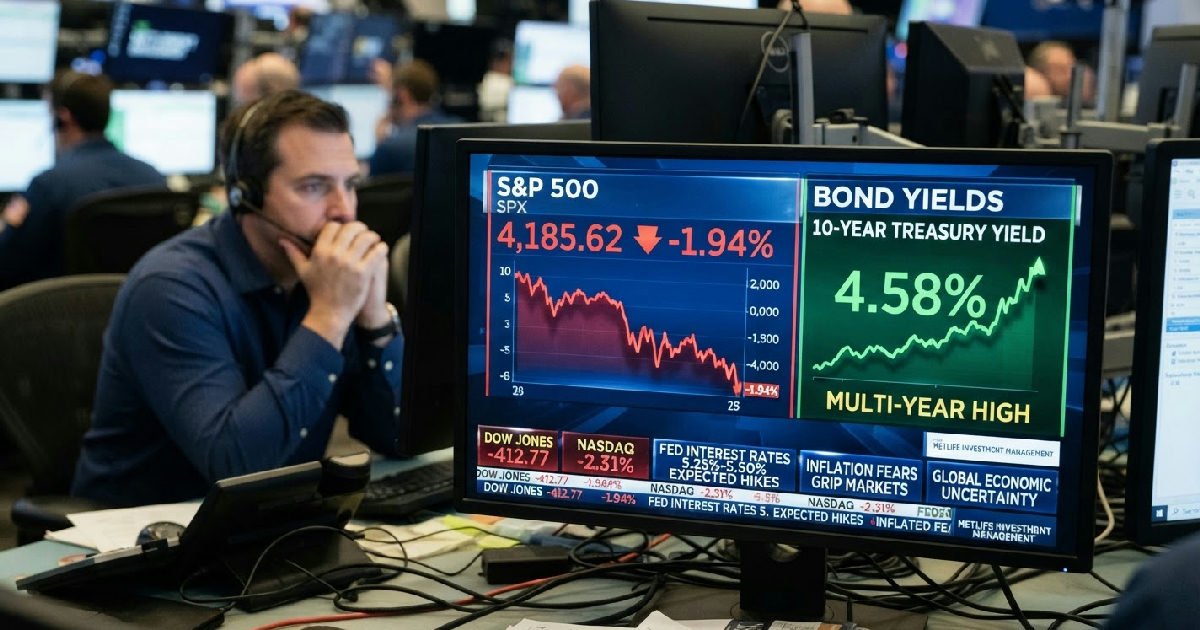
S&P 500 plunges as bond yields hit multi-year high
The S&P 500 plunged on September 28, 2026, as renewed inflation fears, fueled by soaring oil prices and robust U.S. economic data, propelled S&P 500 bond yields to multi-year highs. This market downturn signals growing investor concern that the Federal Reserve will likely continue its aggressive interest rate hikes to curb persistent price pressures.
Drew Matus, Chief Market Strategist at Metlife Investment Management, highlighted the market’s heightened sensitivity to economic signals, noting that investors are overreacting to “noisy” data.
Escalating Inflationary Pressures and S&P 500 Bond Yields
Investors are grappling with the dual impact of higher energy costs and unexpectedly strong economic performance. Both factors contribute to an environment where the path to lower inflation appears more challenging. This uncertainty is translating directly into market volatility, particularly in the equity and bond markets.
Rising energy costs are a key driver of current inflation anxieties across global markets. A protracted stalemate between the United States and Iran has significantly impacted crude oil supplies, pushing prices higher. Brent crude, a global benchmark, settled around $103 on September 23, 2026, reflecting the geopolitical risk premium now embedded in energy markets.
This surge in oil prices translates directly into increased costs for businesses and consumers, fueling broader inflationary trends.
Further exacerbating these worries is the robust U.S. economic activity data, which has recently reached its strongest level since 2021. While positive on its face, this surprising economic resilience suggests that underlying demand remains strong, potentially delaying the cooling effect needed to bring inflation back to the Federal Reserve’s target.
A surprisingly strong economic report released last week reinforced these inflation concerns, leading to an immediate market reaction.
The U.S. producer price index (PPI) also increased in August 2026, aligning with expectations but confirming a rebound in energy costs. This upstream inflation, where producers face higher input prices, invariably trickles down to consumer prices, sustaining inflationary pressures. Such consistent data points reinforce the market’s conviction about future interest rate adjustments, prompting a sell-off in risk assets.
Bond Yields Surge, Undercutting Equities
The upward trajectory of bond yields has been particularly impactful on market sentiment, drawing capital away from equities. The yield on the benchmark 10-year Treasury note jumped significantly to 5.22% on September 28, 2026, representing a 0.05 percentage point increase from the previous session. This marks its highest level since July 2007, a clear indicator of tightening financial conditions.
Just days earlier, on September 23, 2026, the 10-year Treasury yield had already climbed to 5.10% from 4.96%. These rapidly rising yields make borrowing more expensive for businesses, impacting their investment plans and profitability. Higher yields also make fixed-income investments more attractive relative to stocks, leading investors to reallocate capital away from equities.
This shift has tangible consequences for equity markets. Higher bond yields directly affect corporate valuations by increasing the discount rate used to calculate the present value of future earnings. This phenomenon disproportionately impacts growth stocks, which rely more heavily on future earnings projections.
The S&P 500 fell 0.8% on September 23, 2026, closing at 7,706.03 points, reflecting this negative correlation. It had already lost 2% in the four sessions leading up to September 11, 2026, and was nearly 3% down from its record high close on August 13, 2026.
At 19 times expected earnings as of September 11, 2026, the S&P 500’s valuation appears stretched to some investors in this high-yield environment.
The Federal Reserve’s Unwavering Resolve
The Federal Reserve’s commitment to tackling inflation remains a dominant theme influencing market movements and investor expectations. On September 16, 2026, the central bank’s policymakers increased the federal funds rate to a range between 3.75% and 4%, marking their first tightening in three years. This decisive action underscored the Fed’s firm resolve to bring inflation back to its 2% target.
Federal Reserve Governor Michael Barr reinforced this hawkish stance on September 23, 2026, stating publicly that further tightening would likely be necessary to achieve their inflation objectives. Such pronouncements carry significant weight, shaping market participants’ expectations for future policy decisions.
Money markets are now fully pricing in three additional rate hikes over the next year, with significant hedging against a potential fourth increase, signaling a broad consensus on the Fed’s aggressive path. Federal Reserve interest rates are increasingly dictating the pace of market activity, leaving little room for bullish sentiment in the short term.
The rising rate environment makes it harder for companies to finance growth and for consumers to borrow, acting as a brake on economic expansion.
Consumer Behavior: A Mixed Signal
Despite widespread economic anxieties, U.S. consumers continue to exhibit a degree of resilience, albeit with underlying caution. Drew Matus notes the peculiar situation where consumers “feel depressed” but are still spending money, largely buoyed by a robust job market. This divergence between sentiment and actual spending presents a complex picture for economic forecasters.
However, a closer look reveals cracks in consumer confidence. Sentiment fell to a four-month low in September 2026, reflecting growing worries about persistent inflation eroding purchasing power. Critically, views on personal finances slumped by approximately 10% during the same period.
Long-run inflation expectations among consumers also edged higher, rising to 3.4% in September 2026 from 3.3% in August 2026, indicating a lasting concern over their future financial well-being.
Economists are keenly awaiting the upcoming personal spending report and income data, expected mid-week, for clearer signals on consumer behavior. The breakdown between goods and services spending will be particularly crucial. Services spending tends to be less volatile, representing essential recurring outlays. A significant pullback in this area could signal a more widespread retrenchment in discretionary spending, impacting overall economic growth.
The AI Narrative and Capital Allocation
The market’s current narrative is heavily influenced by the pervasive artificial intelligence (AI) story, particularly concerning capital expenditure (CapEx). Drew Matus describes the present economic state as a “hinge economy,” largely driven by the monumental investments pouring into AI.
These substantial AI-related capital expenditures are not only bolstering equity markets but are also indirectly supporting the U.S. consumer, who, despite feeling economically strained, maintains employment and continues to spend.
However, a critical question persists: does the inherent value in the AI build-out truly match the lofty valuations currently assigned by the market? Matus draws parallels to the internet boom, where the value for end-users was undeniable, yet the economic justification for the massive investment was debated.
The challenge for investors lies in accurately assessing the long-term returns on these colossal AI investments. Tracking the intricate money flows dedicated to AI CapEx has become increasingly difficult for analysts trying to ascertain the true underlying demand and potential for overinvestment.
Navigating Persistent Market Uncertainty
The current economic environment has undoubtedly heightened investor caution, prompting a re-evaluation of optimal investment strategies. With the 10-year Treasury yield now standing at 5.22%, many investors are contemplating locking in these historically attractive yields as a safe haven, rather than enduring the volatility of equity markets.
This growing inclination towards fixed-income assets reflects a significant shift in risk appetite, away from growth and towards capital preservation.
Matus expresses personal apprehension regarding these rapidly moving yields, suggesting that the current market dynamics might not solely be driven by a long-term, AI-fueled productivity story. He points specifically to the front end of the yield curve, where the most pronounced movements are occurring.
This observation implies a shorter-term driver, potentially indicating unrecognized liquidity events within the financial system that could pose risks if left unchecked.
Adding another layer of complexity, some market participants are also considering the possibility of tax-loss selling within the bond market—a phenomenon traditionally associated with equities. Given the recent behavior of yields, such an unconventional factor could be contributing to the current market pressures.
These intricate considerations underscore the interconnectedness and inherent uncertainties pervading today’s global financial markets. S&P 500 profit growth remains a key metric for many investors, but the current interest rate environment is putting pressure on future earnings potential.
Key Economic Indicators and the Path Ahead
Looking ahead, several critical economic data points will provide further clarity on the market’s trajectory and the Federal Reserve’s likely actions. While the surge in AI-driven capital expenditures is relatively insensitive to interest rate fluctuations, consumer behavior remains a paramount concern for economic strategists like Drew Matus.
He stresses the importance of monitoring the national savings rate and scrutinizing the allocation of consumer spending between goods and services.
The upcoming personal spending and income report, slated for mid-week, is eagerly anticipated for its insights into these consumer trends. Any discernible reduction in services spending, which typically exhibits low volatility due to its essential nature, could signal a more significant and broad-based economic slowdown.
Currently, the Atlanta Fed GDPNow model projects a robust 5% growth for the current quarter. However, the market’s immediate focus remains squarely on the persistent threat of inflation and the Federal Reserve’s resolute response to it.
The evolving geopolitical landscape, particularly the continued US-Iran stalemate, is expected to maintain its influence on global oil prices, thereby directly impacting future inflation expectations and market stability.