

Samsung Electronics projects nine-fold profit surge in 2026
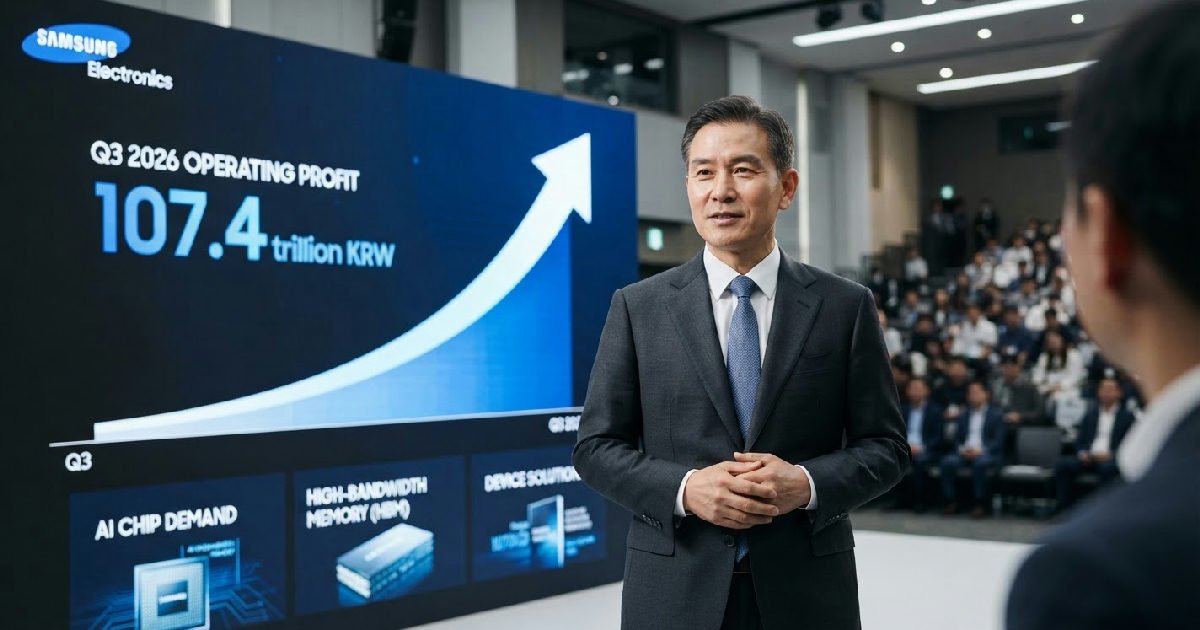
Samsung profit surge: Samsung Electronics Co. announced a projected near nine-fold increase in its third-quarter operating profit for 2026, reaching 107.4 trillion Korean Won. , Ltd. announced on 2026-10-07 a projected near nine-fold increase in its third-quarter operating profit for 2026. The company estimates this will reach 107.4 trillion Korean Won, or approximately $80.17 billion USD.
This staggering surge, marking a 782.5% jump year-over-year, is primarily fueled by the explosive global demand for artificial intelligence (AI) chips.
Samsung profit surge explained
The preliminary earnings guidance, issued from Seoul, South Korea, highlights a robust performance for the July-September period. It underscores Samsung’s dominant position in the rapidly expanding semiconductor market, particularly in high-bandwidth memory (HBM) and high-density DDR5 for servers. This market expansion mirrors the rapid innovation seen in digital finance platforms.
The projected operating profit of 107.4 trillion KRW for the third quarter of 2026 stands in stark contrast to the 12.17 trillion KRW recorded in the same period last year. This phenomenal growth translated into an estimated revenue of 195 trillion KRW, representing a 127% year-over-year increase.
Such figures result in an impressive operating margin of 55.08% for the quarter. This financial triumph marks the fourth consecutive quarter of record operating profit for the South Korean technology giant, showcasing its resilience and strategic pivot towards high-growth segments.
AI Chips Fuel Unprecedented Growth
The core catalyst behind Samsung’s dramatic earnings rebound is the insatiable global appetite for AI chips. The company has capitalized on this trend through increased sales of its advanced memory solutions, which are critical components for AI infrastructure.
Specifically, strong demand for high-bandwidth memory (HBM) and high-density DDR5 products for servers has been a significant driver. These specialized memory chips are essential for handling the massive data loads and parallel processing requirements of modern AI applications and large language models.
Furthermore, rising prices for conventional DRAM and NAND chips also contributed to the overall positive financial outlook. This broader market strength, combined with Samsung’s leadership in advanced memory, has created a powerful tailwind for the company’s semiconductor division.
This combination of high-demand, specialized products and robust pricing across its conventional memory portfolio positions Samsung uniquely. It allows the company to capitalize on both the cutting-edge needs of AI and the foundational requirements of the broader digital economy.
HBM4 and Nvidia’s Vera Rubin Accelerators
A notable factor in this quarter’s success is the full-scale contribution from sales of HBM4, Samsung’s sixth-generation high-bandwidth memory. These cutting-edge chips are being supplied for Nvidia’s Vera Rubin AI accelerators, which are integral to the next generation of AI supercomputing.
This strategic partnership with Nvidia, a leader in AI hardware, solidifies Samsung’s position at the forefront of the AI semiconductor supply chain. It illustrates the high value placed on Samsung’s innovative memory solutions within the highly competitive AI ecosystem. This market dynamic reflects ongoing strategic investment trends across the technology sector.
Device Solutions Division Leads the Charge
The Device Solutions (DS) division, which oversees Samsung’s crucial semiconductor business, has emerged as the primary driver of this substantial earnings improvement. Its operating profit alone is estimated to have surpassed 100 trillion KRW, roughly equivalent to $73.3 billion USD.
This division’s performance underscores the immense profitability of advanced memory and logic chips. It reflects years of significant investment in research and development, allowing Samsung to capture a substantial share of the rapidly expanding AI hardware market.
Four Consecutive Quarters of Record Earnings
Achieving four consecutive quarters of record operating profit is a testament to Samsung’s successful navigation of a dynamic global economic landscape. After a period of industry downturns, the company has leveraged its technological prowess and market positioning to bounce back stronger than ever.
This consistent performance indicates more than just a momentary surge; it suggests a sustained recovery and potential long-term growth trajectory for the semiconductor sector, particularly within the AI domain. Analysts are watching closely to see if this momentum can be maintained into 2027.
Outlook: Sustained Demand for Memory Technology
Looking ahead, the demand for advanced memory solutions shows no signs of abating. The continuous evolution of AI technologies, from data centers to edge computing, will likely ensure a sustained need for high-performance chips like HBM and DDR5.
Samsung Electronics is strategically positioned to meet this ongoing demand, with its robust manufacturing capabilities and continuous innovation in semiconductor technology. The company’s focus on developing next-generation memory products could further solidify its market leadership in the years to come.
The strong financial results also send a positive signal across the broader technology industry, indicating healthy underlying demand for cutting-edge components. This suggests a period of significant investment and expansion as companies vie for dominance in the burgeoning AI space. The impressive Q3 performance provides a clear benchmark for competitors, even as the broader crypto market faces volatility.
Samsung’s ability to project such a dramatic profit increase, largely on the back of AI chip sales, highlights a fundamental shift in the global tech economy. It signals that companies able to deliver crucial AI infrastructure components will reap substantial rewards. This trend is set to redefine market valuations and strategic priorities for years ahead.
The company’s investments in developing specialized memory tailored for AI workloads are clearly paying off. These chips, crucial for training and deploying complex AI models, represent a high-margin business that is critical for future technological advancements. It’s a strategic move that positions Samsung for continued success.
As AI continues to integrate into various industries and consumer products, the underlying hardware demand will only intensify. Samsung’s impressive financial performance offers a glimpse into the significant economic impact of this technological revolution. Its role in powering the AI era appears more central than ever.