

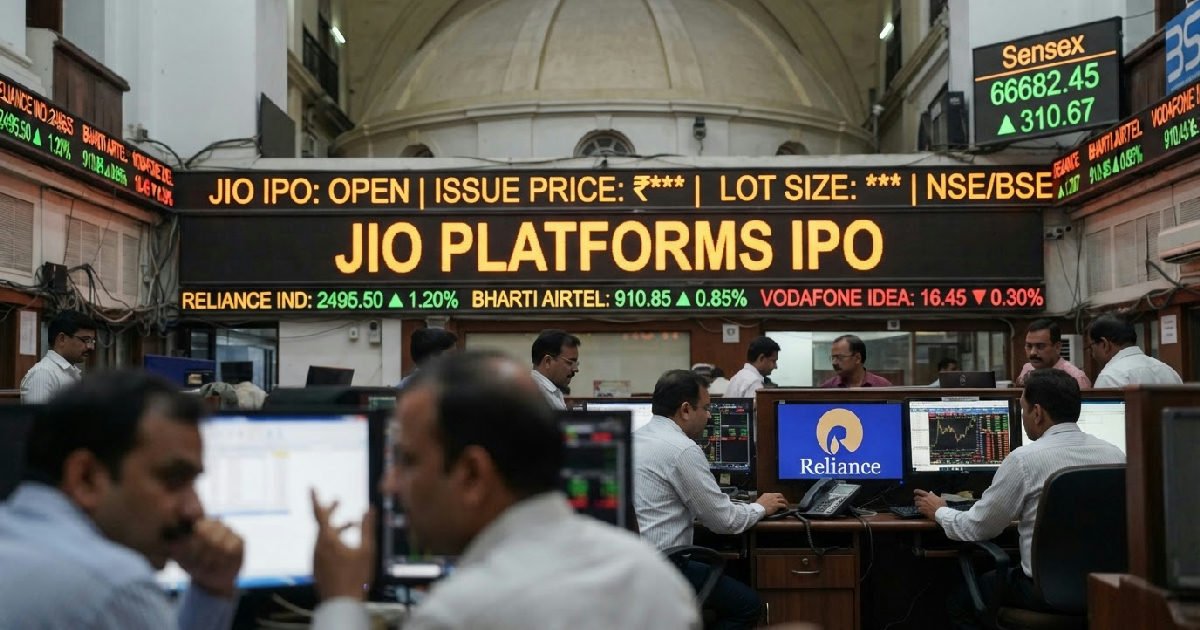
jio platforms to raise $3.2 billion in india ipo from october 21
Jio Platforms Limited, the digital services arm of Indian conglomerate Reliance Industries, aims to raise as much as 302 billion rupees ($3.2 billion) through an initial public offering (IPO) of shares in India. This highly anticipated share sale, backed by global tech giants Meta Platforms and Google International, marks a significant moment for India’s booming digital economy.
The company, India’s largest telecom operator, will offer 270 million shares at a price range between 1,065 rupees and 1,119 rupees apiece. Bidding for the shares is scheduled to run from October 21 to October 23, 2026, according to an exchange filing by Reliance Industries.
Jio Platforms IPO Nears
This IPO is poised to become the largest in India’s history when measured in rupee terms. However, in dollar terms, its $3.2 billion target marginally trails the $3.3 billion raised by Hyundai Motors’ 2024 IPO.
The scale of this offering underscores the immense growth and investment flowing into the country’s digital infrastructure. It also highlights the strategic importance of the Indian market for global technology players.
While the IPO is substantial, its estimated valuation at the top end of the price range sits around $108 billion. This figure comes in lower than market intelligence firm Prime Database’s earlier projection of around 377 billion rupees, suggesting a more conservative investor sentiment than initially anticipated.
Valuation and Investor Scrutiny
Jio Platforms has aggressively positioned itself as a comprehensive technology company, extending beyond traditional telecommunications. However, some investors remain unconvinced by this broader tech narrative, viewing the company primarily through its telecom lens.
Deven Choksey, managing director of Mumbai-based DRChoksey Finserv, emphasized this point to CNBC. He noted that while applications like entertainment or gaming platforms owned by Jio Platforms certainly boost data consumption, the company’s revenue stream still heavily relies on selling internet data.
This perception influences its market valuation. Despite its dominant subscriber base of over half a billion, the current IPO pricing positions Jio Platforms at a lower valuation than its closest competitor, Bharti Airtel. Bharti Airtel boasts a market capitalization of $117.5 billion, according to LSEG data.
Global Tech Giants Cement Their Stakes
The IPO documents confirm that both Meta Platforms and Google International, significant early investors in Jio Platforms, will not be divesting their stakes in the company. Indian billionaire Mukesh Ambani’s flagship firm, Reliance Industries, remains the majority stakeholder, holding more than a 66% stake.
Meta’s affiliate, Jaadhu Holdings, holds nearly 10% of Jio Platforms, while Google International owns a 7.7% stake. These investments, totaling over $10 billion, were part of a broader strategy by the US tech giants to deepen their presence in the rapidly expanding Indian digital ecosystem.
Their continued commitment signals long-term confidence in Jio Platforms’ growth trajectory and its pivotal role in India’s digital transformation. The collaboration has also included joint ventures, such as Google and Jio’s project to develop an affordable smartphone for the Indian market.
Jio’s Ambitious Satellite Communications Push
Beyond its terrestrial telecom operations, Jio Platforms is making aggressive moves into the burgeoning satellite communications sector within India. The company has laid out plans to establish a robust network comprising approximately 1,600 Low Earth Orbit (LEO) satellites and 23 ground stations across the country.
This ambitious initiative aims to significantly expand connectivity, particularly targeting India’s vast rural and remote regions, including maritime and border areas. The objective is to bring digital services to over 600,000 villages, bridging existing connectivity gaps.
The expansion into space has, however, placed Jio Platforms and its owner, Mukesh Ambani, directly into a public dispute with Elon Musk and his satellite internet venture, Starlink. Musk, a vocal critic, recently accused Ambani of deliberately hindering Starlink’s entry into the Indian market.
Musk-Ambani Spat Over Market Dominance
Elon Musk publicly alleged on October 9, 2026, that Mukesh Ambani was actively blocking Starlink’s launch in India. Musk claimed this was a move to maintain a “monopolistic exploitation” of the Indian market, reflecting growing tensions in the country’s competitive telecommunications landscape.
But the Indian Ministry of Communications, led by Union Minister Jyotiraditya Scindia, swiftly rejected Musk’s allegations just days later. On October 12, 2026, the Ministry stated that India’s satellite communications framework is fair and non-discriminatory, dismissing the claims as “baseless and misconceived.” The Indian government has consistently emphasized a level playing field for all businesses.
Outlook for India’s Digital Future
Jio Platforms’ IPO comes at a time of immense dynamism in India’s digital services and telecommunications sectors. The Indian telecom market is the world’s second-largest by subscribers, with impressive growth projections.
Experts anticipate the market, valued at USD 229.77 billion in 2025, to swell to nearly USD 507.35 billion by 2034, growing at a Compound Annual Growth Rate (CAGR) of 9.2% from 2026 to 2034. This makes it an irresistible magnet for both domestic and international investors.
Jio’s historical impact, beginning with its 2016 commercial launch of 4G services, dramatically reshaped the Indian telecom landscape, igniting intense competition and a price war that brought affordable data to millions. The company acquired 16 million subscribers within its first month and crossed 100 million by February 2017.
The success of the IPO will not only impact Reliance Industries and its high-profile investors but also serve as a barometer for broader investor confidence in India’s burgeoning digital economy. It will likely further intensify competition, particularly as Jio rolls out its True 5G service and ventures aggressively into satellite broadband, continuing its mission to expand connectivity across the nation.