

Russia’s economy shows widening cracks despite surprising growth figures
After four-and-a-half years of conflict with Ukraine, Russia’s economy, once deemed surprisingly resilient, now reveals deeper structural cracks despite recent official growth figures. Analysts and economists warn the Kremlin’s reliance on military spending has created a pronounced two-tier system, masking significant inflationary pressures and a worsening fiscal deficit.
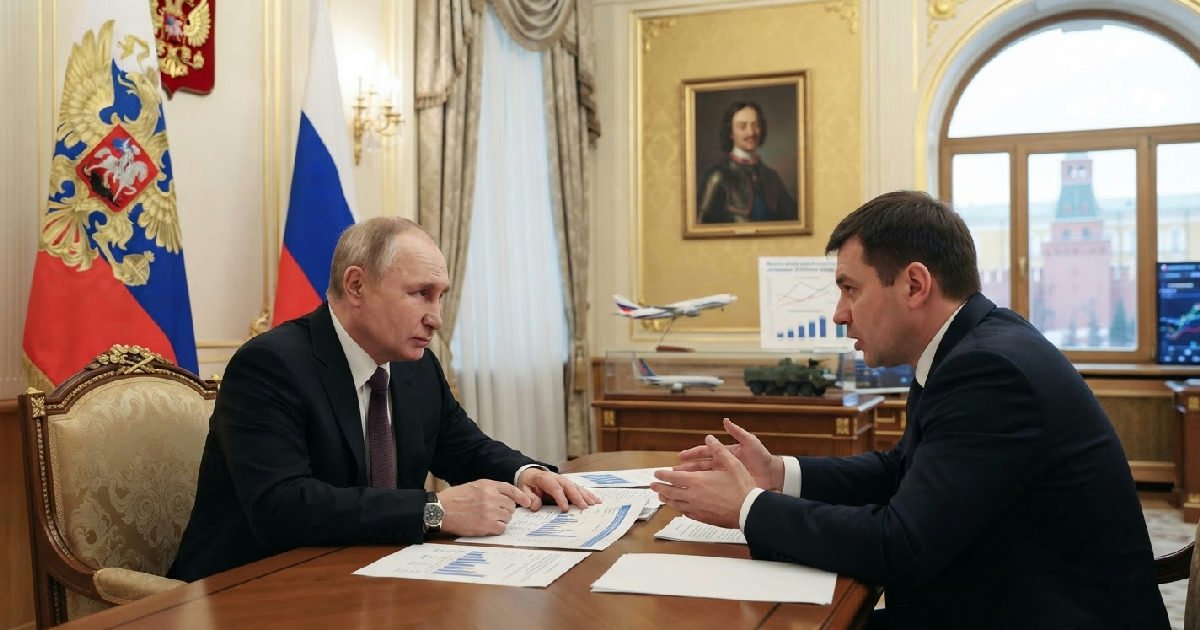
This dual economic reality poses a complex challenge for President Vladimir Putin, who met with Moscow-installed leader Yevgeny Balitsky from the Zaporizhzhia region in July 2026. Experts like Alex Kolyandr, director for Europe at consulting firm Eurasia Group, highlight that while the military-industrial complex thrives, ordinary citizens face increasing economic hardship.
Russia’s economic resilience faces mounting fiscal strain
Russia’s economy has shown growth in recent years, with its gross domestic product (GDP) rising by 4.1% in 2023 and 4.3% in 2024, defying initial predictions of collapse after the Ukraine invasion. However, forecasters project a deceleration for 2026.
The Central Bank of Russia lowered its GDP growth forecast to between 0.0% and 1.0% in July 2026, while the Economic Development Ministry projected 1.3% growth for the year.
This performance might seem robust on the surface, but a closer look reveals significant underlying issues. Much of this growth stems directly from the immense government spending on its military-industrial complex. This effort to sustain the war in Ukraine includes robust domestic demand, higher wages for those in critical sectors, and fiscal stimulus measures.
Growth driven by military production
The pivot to a war economy has seen defense expenditures climb dramatically, reaching an estimated 7.2% of GDP and accounting for 32% of the federal budget by 2025. This massive allocation fuels industries like tank production, providing employment and demand. By 2026, the military-industrial complex reportedly employed around 3.5 million Russians, roughly 5.1% of the total labor force.
But this surge in military production distorts the broader economic picture. Economist Sergey Guriev has noted that since 2022, Russia has operated with two distinct economies. One is a burgeoning military sector, and the other is a civilian sector grappling with high inflation and elevated credit rates.
Dual economic reality emerges
Alex Kolyandr of Eurasia Group articulated this stark division, saying, “If you are lucky and you’re employed by a tank production company, then everything’s good. Otherwise, you are probably facing problems.” This sentiment underscores the uneven distribution of the economic benefits, leaving many outside the military-focused industries struggling.
The economic landscape became clearer as Ukrainian long-range drone attacks recently targeted Russian oil refineries and delivery warehouses. These strikes underscore the vulnerabilities of key economic pillars, highlighting how external pressures can quickly expose internal weaknesses.
Escalating fiscal pressures and inflation
Beyond the headline GDP figures, two critical metrics—the state deficit and inflation—paint a more concerning picture for Russia’s economy. Charles Lichfield, director of economic foresight and analysis at the Atlantic Council’s GeoEconomics Center, points to these as the most accurate indicators of the country’s economic health.
He warned that the deficit is on track to double its 2025 levels, which themselves had doubled 2024’s figures. This deepening fiscal hole comes despite a recent boost in global fossil fuel prices, suggesting a fundamental issue with revenue generation and expenditure.
The deepening budget deficit
Oil and gas revenues, traditionally the bedrock of Russia’s budget, have been depressed, even with higher fossil fuel prices in recent months. The Russian finance ministry, for example, reported a 50% year-on-year drop in government oil revenues in January–May 2023. This downturn is attributed to sustained Ukrainian drone strikes on refineries and the increasing effectiveness of Western sanctions.
Tougher measures, including a lower European Union oil price cap and actions against Russia’s shadow-fleet enablers, have severely impacted export earnings. The EU adopted its 21st package of sanctions against Russia on July 23, 2026, further tightening the financial squeeze.
Companies like Alfa Bank, Russia’s largest private bank, have also faced the direct impact of these sanctions, with beneficiaries like Mikhail Fridman and Pyotr Aven departing the board following EU actions. This highlights the broader challenges facing entities that must ensure sanctions compliance in a rapidly evolving geopolitical landscape.
Inflationary pressures persist
On inflation, Charles Lichfield indicated Russia had sought to bring the rate down to a 4% target, but this has proved challenging. Annual inflation stood at 7.42% at the close of 2023. By April 2025, the annual inflation rate eased only marginally to 10.2% year-on-year, a slight dip from March 2025’s two-year high of 10.3%.
Services saw the sharpest increases, rising by 12.9% year-on-year in April 2025, while food products climbed 12.7% and non-food items rose 9.3%. Lichfield cautioned that any brief respite from high inflation would likely be short-lived, with pressures mounting.
President Vladimir Putin himself acknowledged inflation as a significant challenge in December 2024, reflecting the growing concern within the Kremlin. Such persistent inflationary pressures are often fueled by robust government spending and labor shortages. This is a common theme in international economic debates, where resource allocation and public sentiment frequently clash.
Impact on ordinary Russian households
The economic strains are increasingly felt by average Russians, who are adjusting their spending habits to cope with rising costs and diminished purchasing power. This subtle but significant shift in consumer behavior offers a telling glimpse into the everyday consequences of the wartime economy.
According to X5 Group President Yekaterina Lobacheva, the country’s largest retailer, citizens have been increasingly opting for lower-cost and store-brand food products. Lobacheva highlighted a notable increase in cookie consumption, almost two and a half times higher, in April 2026. This change reflects a move towards cheaper indulgences over more expensive confectionery like chocolate.
Shifting consumer spending habits
This preference for more affordable goods signals a broader trend of households tightening their belts. Many are trading down from premium brands as their incomes come under pressure. These micro-economic shifts are often early indicators of wider economic distress, even when macro-economic figures appear stable. Technology firms, for instance, are also adapting to changing consumer habits, as seen with SpaceX investment filings.
Russia’s economy unlikely to determine Ukraine war’s end
Despite the economic pressures, analysts largely agree that Russia’s economy isn’t likely to force an end to the war in Ukraine. Charles Lichfield doesn’t expect economic factors alone to drive Russia to conclude the conflict, even with the strains it faces.
Elina Ribakova, senior fellow at Peterson Institute for International Economics, echoes this sentiment. She told CNBC that the situation would need to become “much more dire,” with oil prices falling significantly—perhaps to $35 or $40 per barrel—to truly influence a change in strategy. Given current geopolitical tensions, such a drop remains unlikely.
Ribakova recalled a different conversation earlier in the year when oil prices were considerably lower in January and February 2026. At that time, the Russian government was reportedly discussing revisions to its 2026 budget, suggesting serious underlying trouble. But the current oil price boost eases some immediate fiscal concerns.
Ultimately, Ribakova believes President Putin has “staked so much” on the war that he feels compelled to continue, regardless of the mounting economic difficulties. This personal commitment appears to override purely economic considerations for the Kremlin’s strategic calculus.