

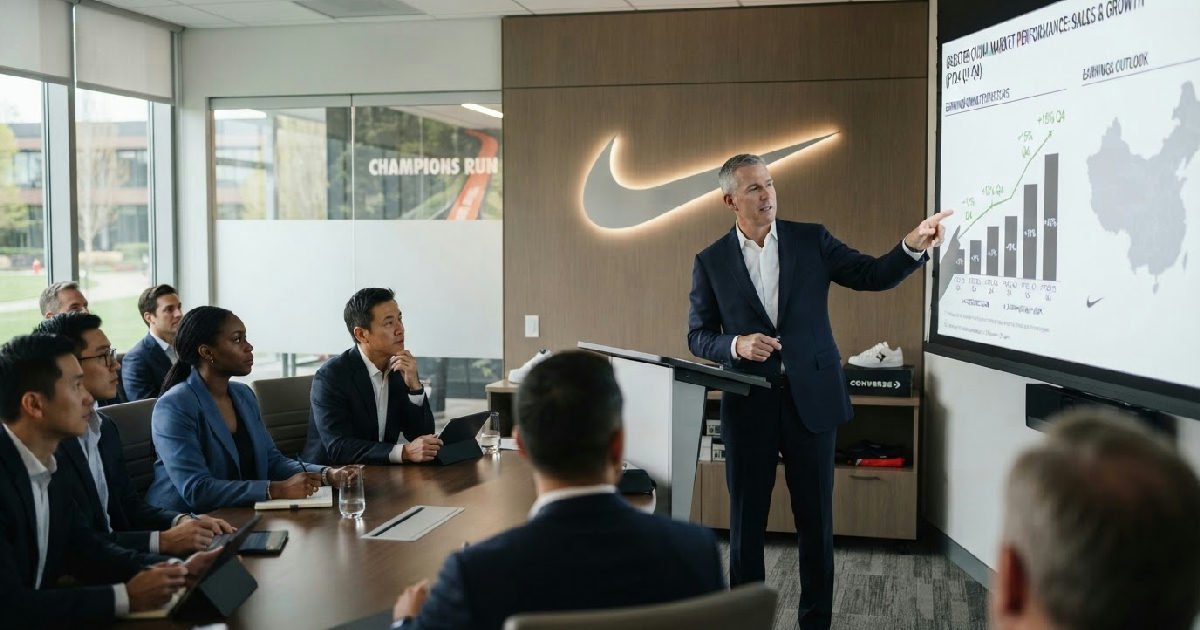
Nike investors scrutinize China growth and CEO Elliott Hill
Nike investors are intently focused on the sportswear behemoth’s performance in its critical Greater China market and the strategic direction under CEO Elliott Hill as the company prepares for its upcoming earnings release.
Poonam Goyal, an analyst with Bloomberg Intelligence, highlighted these areas, alongside the Converse brand’s showing and the health of core running categories, as key metrics for stakeholders. Hill’s tenure, now entering its third year, marks a significant juncture for the company to demonstrate concrete advancements after a period of leadership transition.
Strategic imperatives for Nike investors in China and beyond
The intense scrutiny on NIKE, Inc. (NYSE: NKE)’s operations stems from a confluence of factors, including the evolving competitive environment and macroeconomic shifts. Stakeholders are keen to see whether the recent strategic pivots under Hill are delivering tangible improvements, especially in areas that have historically posed challenges. The upcoming report will provide crucial insights into these efforts and the stability of the company’s forward guidance.
This heightened investor attention follows Nike’s previous release of its fourth-quarter and full-year fiscal 2024 financial results on Thursday, June 27, 2024. At that time, much of the market’s focus was already on the Greater China segment and the outlook provided by then-CEO John Donahoe and Chief Financial Officer Matthew Friend. Now, the spotlight shifts firmly to current CEO Elliott Hill.
China represents a complex yet immensely vital market for Nike, a dynamic arena where shifting consumer preferences and geopolitical considerations regularly influence sales. The company has grappled with various challenges, ranging from supply chain disruptions to an increasingly crowded competitive landscape populated by agile domestic players. These local brands often resonate deeply with nationalistic sentiment.
Investors will expect more than just a summary of past performance in China; they demand a clear, actionable roadmap for future growth. Lingering questions persist about Nike’s ability to regain lost market share and re-establish strong connections with Chinese consumers, particularly younger demographics. A robust and adaptable strategy for the region is paramount for the company’s sustainable success.
Any detailed commentary on localized product development, enhanced digital engagement platforms, or strengthened brand partnerships within China could provide critical assurances to the market. The specific demands of the Chinese consumer base require tailored approaches, moving beyond a one-size-fits-all global strategy. Failure to demonstrate such adaptability could further erode investor confidence in this crucial segment.
The situation in China is part of a broader trend of escalating global trade tensions, which companies like Nike must navigate carefully. Concerns over geopolitical friction mean that China vows ‘resolute response’ to perceived external pressures, underscoring the delicate balance required for international businesses operating there.
CEO Elliott Hill’s Third-Year Agenda Takes Center Stage
Elliott Hill’s leadership is under intense scrutiny as he enters his third year at the helm of Nike. His appointment was met with expectations for renewed vigor and innovative strategies to navigate a rapidly evolving global sportswear market. Investors will be seeking tangible evidence that his vision is translating into improved financial performance and robust brand momentum.
Hill’s tenure has coincided with a period of significant change, both within the broader retail landscape and specifically in key markets like China. He is tasked with revitalizing brand perception, accelerating product innovation cycles, and optimizing global distribution channels to meet modern demands. His ability to articulate a clear, compelling path forward will be crucial during the upcoming earnings call.
Stakeholders are looking for more than just steady management; they anticipate transformative leadership that can address systemic challenges and unlock new growth avenues. Clarity on future product pipelines, the effectiveness of recent marketing campaigns, and ongoing efforts to bolster supply chain resilience will be key elements of Hill’s address.
The market needs assurance that Nike is not merely reacting to events, but proactively shaping its future.
The Evolving Role of Executive Vision
The role of a CEO in a global powerhouse like Nike extends beyond merely presenting quarterly numbers; it encompasses shaping the long-term strategic culture and market positioning of the entire organization. Hill’s communication style and overall confidence in the company’s direction will be closely watched by analysts and shareholders alike. A well-articulated, confident narrative can often instill as much confidence as robust financial figures.
His strategic decisions will ultimately define Nike’s trajectory in an increasingly competitive environment. Investors will weigh his proposed initiatives against the company’s historical performance and the current market realities. The success of these initiatives will be critical to Nike’s continued dominance in the sportswear sector.
Converse Brand’s Path to Renewed Growth
Beyond the flagship Nike brand, the performance of Converse remains a significant point of interest for investors. This iconic subsidiary, known globally for its Chuck Taylor All-Star sneakers, holds considerable cultural weight but has faced its own set of market pressures and competitive challenges. Investors are looking for clear signs of a strategy to reignite its growth trajectory.
The brand’s ability to innovate while simultaneously preserving its deep heritage is a delicate balancing act that requires precise execution. Reports on new product lines, strategic collaborations with designers or celebrities, and expanded market reach will be critical data points. Converse’s consistent contribution to Nike’s overall portfolio is not insignificant, and its revitalization could provide a meaningful boost to the conglomerate’s bottom line.
Market analysis will also focus on how Converse is effectively differentiating itself in a highly saturated casual footwear segment. Success in this area could demonstrate Nike’s broader capacity for effective portfolio management and brand diversification across different consumer tastes. A strong showing from Converse would underscore the conglomerate’s overall resilience and strategic depth.
This pursuit of renewed growth across multiple brands is a challenge many large corporations face, requiring continuous vigilance and strategic overhauls. Companies across different sectors often seek to reaffirm guidance amid market shifts, showcasing the pressure on leadership to deliver amidst uncertainty.
Broader Market Dynamics and Athletic Footwear Trends
Nike doesn’t operate in a vacuum, remaining highly susceptible to external market forces. The broader athletic footwear and apparel market continues to evolve rapidly, heavily influenced by macroeconomic factors like persistent inflation and significant shifts in global consumer spending habits. These external pressures add another critical layer of complexity to Nike’s operational challenges and future growth projections.
The sustained popularity of athleisure wear, alongside a renewed global focus on performance-driven sports gear, presents Nike with both substantial opportunities and looming threats.
While Nike has historically dominated these crucial segments, the continuous emergence of agile new brands means that continuous product innovation is not just an advantage, but an absolute necessity for survival and growth. The company’s ability to accurately forecast and effectively capitalize on these fast-moving trends is paramount.
Investors will also pay extremely close attention to the health and vitality of “core areas such as running,” as specifically highlighted by Bloomberg Intelligence. Running remains a foundational and highly symbolic category for Nike, deeply tied to its brand identity, heritage, and technological prowess.
Any discernible indications of strength or weakness within this segment could have significant reverberations across the company’s entire product line and overall market perception.
Competitive Pressures Intensify Across the Industry
The competitive landscape extends far beyond the confines of China, encompassing global rivals like Adidas, Puma, and Under Armour, as well as an array of smaller, highly specialized niche brands.
Each of these players vigorously vies for consumer attention, loyalty, and market share, forcing Nike to constantly refine its product offerings, innovate its marketing strategies, and optimize its complex supply chain efficiencies. This ongoing, intense battle defines the modern sportswear industry and demands constant vigilance.
The fight for executive talent also reflects this intense competition, forcing companies to frequently adjust their leadership structures to stay ahead. Constant internal and external pressure is placed on CEOs to deliver clear results and maintain stable operations, often sparking public speculation about executive changes across various global sectors.
The Road Ahead: Investor Sentiment and Future Outlook
The upcoming earnings call isn’t just about presenting past financial figures; it represents a critical moment for Nike to shape and manage investor sentiment about its future prospects.
Positive signals regarding performance in China, sustained momentum in core product categories, and a clear, confidently articulated strategic vision from CEO Elliott Hill could provide a much-needed boost to the company’s stock price. Conversely, any missed targets or vague outlooks could trigger further concern and market apprehension.
Analysts, like Bloomberg Intelligence’s Poonam Goyal, are currently meticulously compiling their expectations, scrutinizing every nuance of Nike’s operational reports and any executive statements for hidden cues. Their collective assessments often sway market reactions significantly in the immediate aftermath of an earnings release. The delicate balance between setting ambitious growth targets and presenting realistic, achievable projections will be a key aspect influencing investor confidence.
Ultimately, this earnings call will serve as a crucial barometer for Nike’s overall resilience, adaptability, and strategic agility within a challenging and rapidly evolving global economic environment. It’s a significant test of leadership, brand strength, and the company’s responsiveness to market demands.
How Nike navigates these complex currents, particularly in the coming fiscal periods, will undoubtedly define its trajectory and standing for the remainder of the decade.