

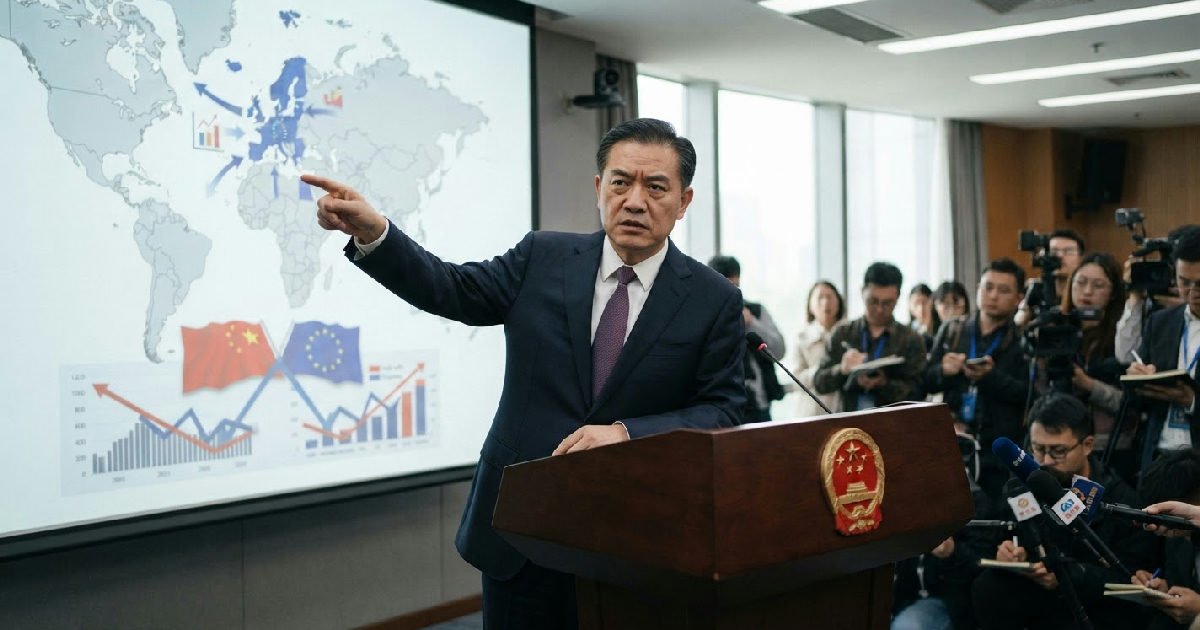
China vows ‘resolute response’ as EU trade tensions escalate
China’s Commerce Ministry has issued a sharp warning of retaliation if the European Union imposes new trade restrictions on Chinese businesses, significantly escalating China EU trade tensions. The statement, released late on September 29, 2026, sets a contentious tone ahead of crucial high-level economic talks scheduled in Beijing.
The ministry vowed a “resolute response” to safeguard its industries, framing the potential EU actions as “typical protectionist and unilateralist” measures. This escalating rhetoric threatens to destabilize a trade relationship worth nearly a trillion dollars annually.
Brussels weighs new tools amid China EU trade tensions
The core of the dispute is the EU’s growing trade imbalance with China, which officials in Brussels are under pressure to address. The bloc’s goods trade deficit soared to €360 billion (US$420 billion) in 2025, a substantial increase from €312 billion the previous year. This has prompted calls for more assertive measures to level the playing field for European companies.
According to reports, France and Germany are championing a joint paper that urges the European Commission to fast-track the creation of a new defensive trade instrument. Analysts suggest this tool could mirror the United States’ Section 301 provision, which allows for unilateral tariffs and other restrictions in response to unfair trade practices.
Some have even suggested it could give Brussels the power to “cut China off from the European market within 24 hours.” This push reflects a growing desire within the EU to gain stronger trade enforcement mechanisms against what it perceives as unfair practices.
China’s Commerce Ministry directly addressed these reports in its statement. It cautioned that such actions, taken while the two sides are actively engaged in negotiations, would “seriously undermine mutual trust.” The ministry’s language signals that Beijing views the development of these tools as an act of bad faith that could derail diplomatic efforts.
High-stakes diplomacy hangs in the balance
The timing of the warning is critical, coming just before a planned visit to Beijing by EU Trade Commissioner Maroš Šefčovič. He is expected to meet with his counterpart, Chinese Commerce Minister Wang Wentao, on October 8, 2026, for a second round of high-level trade discussions. Šefčovič recently warned that Beijing must deliver “concrete results” by October or potentially face “harsher measures.”
Beijing has interpreted this dual approach of dialogue and pressure as a threat. The Commerce Ministry explicitly stated, “If the European side engages in talks and consultations with China, while increasingly pressuring China, it will seriously undermine mutual trust, interfere with the overall process of consultation.” This sentiment was echoed earlier, on September 22, by Cai Rong, head of the Chinese Mission to the EU.
Cai warned against imposing “any restrictions under the guise of de-risking or reducing dependence” on China. He stated plainly that if the EU proceeds with such measures, “China will be forced to take countermeasures to defend its legitimate interests.” The public nature of these repeated warnings indicates a coordinated and hardening stance from Beijing.
This escalation also occurs against a backdrop of wider economic uncertainty. Fears of a trade war between two of the world’s largest economic blocs could contribute to global market instability, impacting everything from supply chains to consumer prices and investment flows.
Key industrial sectors at the center of the dispute
While the trade deficit is the headline number, the tensions are most acute in specific strategic sectors where Chinese exports have surged. The European automotive industry, in particular, has raised alarms about the flood of Chinese-made electric vehicles (EVs) and hybrids entering the market.
The competition has become so fierce that the EU has reportedly asked China to voluntarily limit its sales of hybrid vehicles to just 15% of the bloc’s market.
Steel is another major point of contention. In 2025, China accounted for over half of the EU’s imports of steel and related downstream products, putting immense pressure on European producers.
The EU has long accused China of using state subsidies to create overcapacity in its steel industry, allowing it to dump products on the global market at artificially low prices. This has led to a series of anti-dumping investigations and tariffs from Brussels over the years.
These sector-specific disputes highlight the EU’s dilemma. While it seeks to maintain a productive economic partnership with China, it also feels compelled to protect key domestic industries that are seen as vital for its economic security and sovereignty. Beijing, however, views these defensive moves as protectionism designed to stifle its legitimate economic growth and technological advancement.
What Chinese retaliation could look like
Beijing has not specified what its “resolute response” would entail, but analysts point to a range of tools at its disposal. Beyond imposing reciprocal tariffs on European goods, China could launch its own investigations into European companies operating within its borders. Potential actions reportedly include anti-discrimination probes, security investigations into industrial supply chains, and scrutiny of foreign subsidies received by EU firms.
Such moves would create significant uncertainty and operational challenges for European businesses that rely on the vast Chinese market for both sales and manufacturing. Sectors like luxury goods, automotive, and aerospace are particularly exposed. By targeting these areas, Beijing could exert considerable political pressure on key EU member states like Germany and France.
China could also leverage its control over critical raw materials, a strategy it has hinted at in the past. Furthermore, it could employ non-tariff barriers, such as slowing down customs clearances or implementing new regulatory hurdles for European products.
Some analysts note that financial tools are an increasing part of geopolitical disputes, similar to how western nations have moved to freeze certain digital assets to enforce sanctions.
The upcoming meeting between Wang Wentao and Maroš Šefčovič now carries immense weight. Its outcome could determine whether the two economic giants can find a path to de-escalation or whether they are headed for a damaging trade conflict that neither side can afford. The world will be watching to see if diplomacy can prevail over the rising tide of protectionism.