

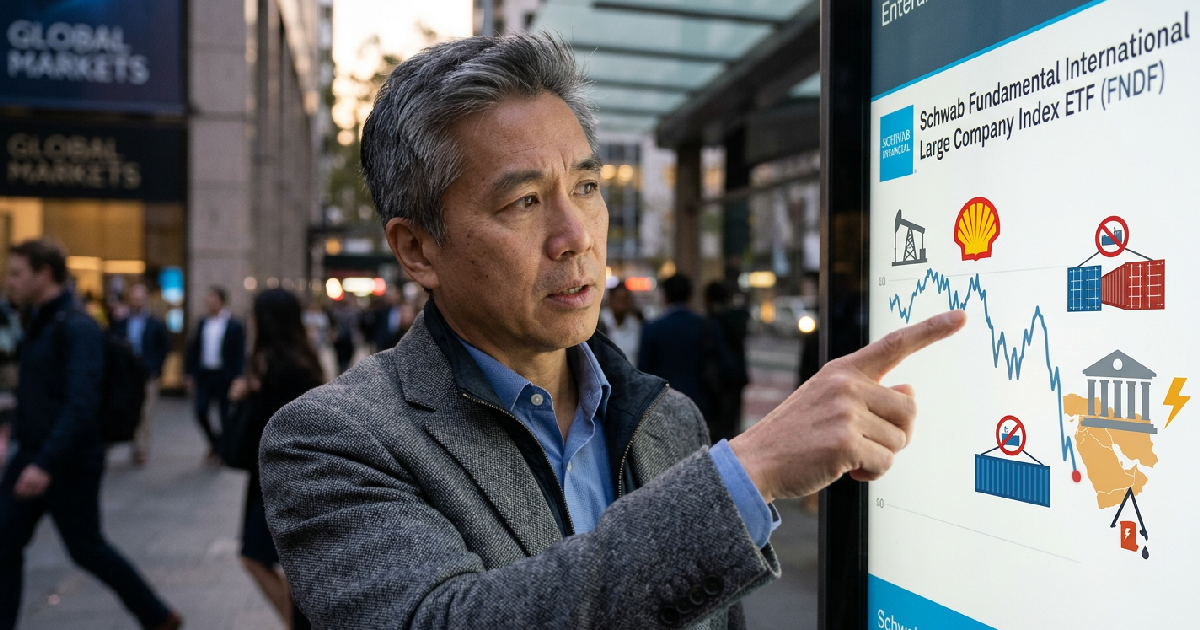
John Seetoo warns Schwab FNDF payouts face pressure from shifting cash flows
John Seetoo warns that the Schwab Fundamental International Large Company Index ETF (NYSEARCA:FNDF) may face pressure on its payouts due to shifting cash flows. The ETF continues to provide a semi-annual distribution to investors, drawing from approximately 800 large-cap companies across developed markets like Japan, Germany, and the United Kingdom. However, recent analysis from 24/7 Wall St. suggests potential challenges.
reporter John Seetoo warns that the durability of these payouts faces mounting pressure from shifting cash flows in the energy and banking sectors due to tariff pressure and Middle East disruption.
Weighting methodology and the mechanics of foreign dividend flow
While the fund has gained 16% year-to-date in 2026, the underlying financials of major holdings like Shell and HSBC are showing signs of strain that could influence future distribution safety.
FNDF operates by tracking the Russell RAFI Developed ex US Large Company Index, a benchmark that weights holdings based on fundamental factors—specifically sales, cash flow, and cash returned to shareholders—rather than traditional market capitalization. This methodology naturally tilts the portfolio toward mature, profitable enterprises that fund their dividends from real earnings.
As international value continues to lead global markets in 2026, this fundamental tilt has served as a tailwind for the fund’s price appreciation even as global shifts in stock sentiment react to fluctuating geopolitical tensions.
The fundamental appeal of FNDF lies in how it translates foreign corporate success into investor distributions without relying on complex financial engineering. Unlike many high-yield products, the fund does not write options, lend bonds, or use leverage to juice its returns.
Key details
Instead, the income is derived strictly from ordinary dividends paid by a diverse roster of companies located in developed economies outside the United States. This includes significant exposure to the industrial and financial powerhouses of France, Switzerland, and Germany.
Because these payouts are collected in local currencies—including the euro, British pound, Japanese yen, and Swiss franc—the ultimate value of the distribution is influenced by currency translation. The fund does not hedge this exposure, meaning a weaker U.S. dollar effectively inflates the dollar-denominated value of the dividends for American investors.
Conversely, a stronger dollar trims the final payout. This dynamic makes the fund a direct play on both global corporate health and currency fluctuations, which is critical as naval forces redirect commercial vessels during regional blockades.
The selection process for the index is reactive to specific risks. Geopolitical instability and trade hurdles feed directly into the fundamental data the index uses for its annual rebalancing. If a company’s cash flow is crimped by these external pressures, its weight within the index is likely to be adjusted.
This approach theoretically protects the portfolio from “dividend traps” where a high yield might mask deteriorating business fundamentals caused by trade volatility or regional conflict.
Analysis of top holdings and sectoral vulnerabilities
The health of FNDF’s payout is largely dictated by a handful of cash-generative giants, with Samsung and Shell sitting near the top of the holdings list. Energy remains a critical driver of the fund’s income, but it is also a source of heightened volatility.
For instance, Shell’s Q1 2026 quarterly dividend of $0.3906 was covered by $2.9 billion in free cash flow, yet the company’s net debt surged from $45.7 billion to $52.6 billion.
Energy and mining sector volatility
The spike in Shell’s debt followed an attack on the Pearl GTL facility in Qatar and a $11.2 billion working capital outflow. While the dividend currently appears safe, the company’s $3 billion buyback could be trimmed if oil prices soften toward the Energy Information Administration (EIA) forecast of $79 per barrel Brent for 2027.
Other energy holdings like TotalEnergies (TTE) have remained near 52-week highs, supported by strong prices and new exploration partnerships, but they remain sensitive to Middle East news.
In the mining sector, the performance has been split. BHP saw optimism tied to copper demand for AI infrastructure, but the company also faced iron ore price pressure stemming from the Simandou supply surge.
These diverging paths highlight the complexity of a fundamentally weighted index where the underlying companies are at the mercy of global commodity cycles. Investors looking for stability are increasingly comparing these traditional assets against other sectors as capital flows toward AI and quantum tech technologies.
Banking sector headwinds and credit losses
The banking sector is currently a major watch item for FNDF investors. HSBC reported that Q1 earnings per share (EPS) missed consensus by 81% following a $1.3 billion expected credit loss charge, which included $400 million in fraud exposure.
Although the bank maintained its interim dividend of $0.10, past adjustments to the payout cadence suggest that management may adjust distributions if credit stress continues to build.
Furthermore, external regulatory and geopolitical pressures are mounting. Firms like HSBC and Standard Chartered have faced challenges following reports of China tightening offshore account rules in Hong Kong. These regional hurdles, combined with localized issues like a French criminal probe involving HSBC, create an environment where banking dividends require closer scrutiny.
Investors often see these stocks as stable income providers, but the current climate suggests that “stable” is a relative term.
Driving returns through price appreciation and international value
While the focus for many FNDF holders is the semi-annual check, the reality of the 2026 market is that price appreciation has been the primary return driver. The fund has gained 38% over one year, reflecting a sharp re-rating of international developed equities.
Investors have gravitated toward these markets as a hedge against the high concentration of AI-heavy stocks in the U.S. markets, seeking out the fundamental value found in global large-cap names.
The current dividend yield runs in the historical 2.5% to 3% range, making the income a secondary contributor to total wealth. However, duplicating past growth will require the underlying 800 companies to navigate a thornier economic landscape. With oil prices rising and Middle East tensions noted in June 2026, global corporations must manage margins carefully.
FNDF remains a play on mature businesses that fund payouts from real earnings rather than balance sheet capacity.
For those looking for diversification, the case for fundamental weighting remains centered on avoiding market-cap traps. Schwab’s mid-year outlook highlighted elevated concentration risk in U.S. equities, reinforcing the case for fundamentals-based international exposure. By focusing on cash flow and sales rather than market price, FNDF avoids over-weighting stocks solely because their price has increased, ensuring the portfolio stays anchored in businesses with documented cash production.
Outlook for the 2026 distributions and global risks
Looking ahead to the next four quarters, the FNDF distribution appears safe, as the index’s weighting methodology concentrates exposure in companies that fund dividends from operating cash flow.
However, the sensitivity of energy giants to potential Brent crude declines and the potential for increased credit losses in the banking sector are real risks for the income stream. Iran-Israel tensions continue to cause geopolitical uncertainty that could impact energy-linked payouts.
Investors should also monitor the currency markets as they move through the second half of 2026. Because the fund does not hedge currency exposure, a sudden surge in the U.S. dollar could act as a trim to the FNDF distribution, even if the underlying global companies perform well.
For the long-term holder, the fund remains a vehicle for capturing the “value” trade internationally, but those relying on the income should be prepared for the variability inherent in unhedged, fundamental-weighted global exposure.