

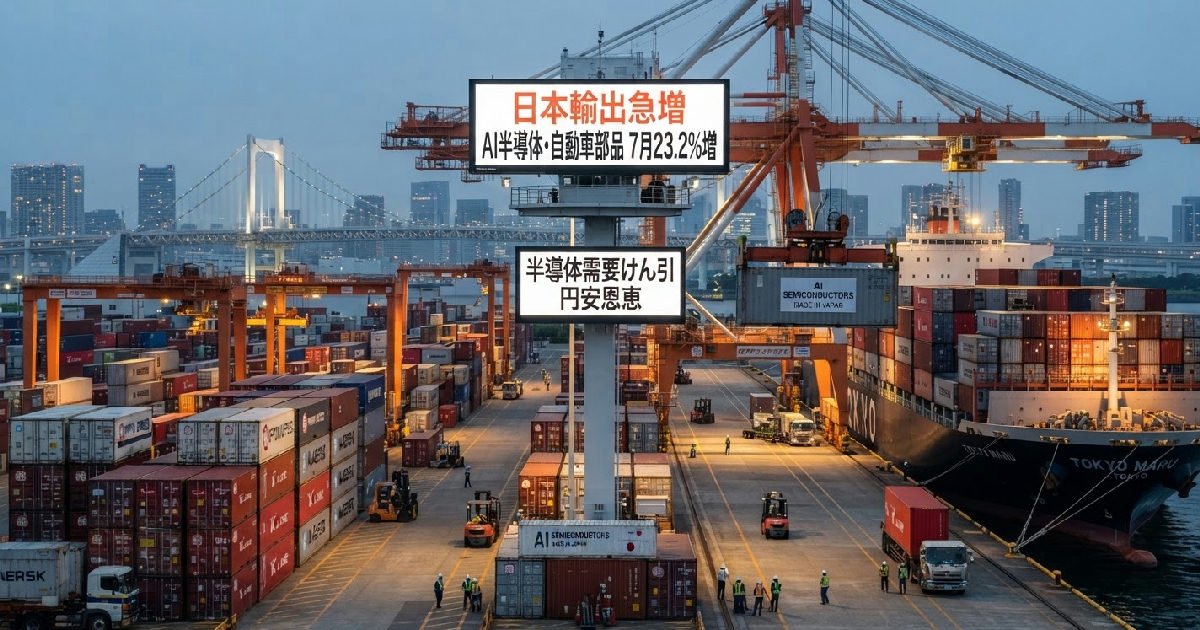
Japan’s export boom rolls on as AI chip demand fuels 23.2% July surge
Japan’s export boom continued for an eleventh consecutive month in July, climbing 23.2% from a year earlier on the back of relentless global demand for semiconductors and automobiles. The impressive performance easily outpaced market expectations and provided a powerful tailwind for the world’s fourth-largest economy.
Data released on August 20 showed the growth in exports handily beat a median forecast of 19.9% from economists in a Reuters poll. This sustained momentum underscores the critical role international trade is playing in supporting Japan’s economic expansion, which saw GDP grow 0.5% in the first quarter of 2026.
How AI and automotive sectors fuel Japan’s export boom
The global boom in artificial intelligence continues to be a significant driver of Japan’s economic performance. Shipments of semiconductor manufacturing equipment, a crucial component for the AI industry, posted a massive 49.1% jump by value in July. This reflects an insatiable appetite for the advanced technology needed to build and expand data centers worldwide.
This isn’t a new trend, but an accelerating one. In May, semiconductor-related exports had already jumped 61.2% in value terms, with integrated circuits alone contributing a ¥243 billion increase. The sustained, high-level demand for these components has become a cornerstone of Japan’s current export success story, highlighting the nation’s vital position in the global tech supply chain.
Alongside high-tech components, the automotive sector remains a powerhouse. Car exports have been a consistent engine of growth, rising 16.4% in May. The combination of high-value electronics and traditional manufacturing strength in areas like transport equipment, which accounted for 24% of total exports in June, creates a resilient and diversified export portfolio for Japan.
Shifting trade dynamics with China and the US
A closer look at the data reveals where this demand is coming from. Shipments to China, Japan’s largest trading partner, surged 25.8% in July. This indicates that despite ongoing economic headwinds in China, its demand for Japanese goods, particularly high-tech components and manufacturing inputs, remains robust. The health of this trade relationship is a key variable for Japan’s outlook.
At the same time, exports to the United States climbed a strong 22%, showcasing the importance of the American market for Japanese products. Together, the US and China account for nearly 40% of Japan’s total exports, making their economic stability crucial. The policy decisions made by central banks juggle interest rates and manage their economies have direct and immediate consequences for Japanese manufacturers.
However, Japan’s trade is not immune to global instability. Data from earlier in the year showed the impact of geopolitical conflict, with exports to the Middle East falling 32% in May amid disruptions from the U.S.-Iran war. This highlights a key vulnerability in relying on international trade, where regional conflicts can abruptly sever vital supply routes and impact demand.
The double-edged sword of rising imports and a weak yen
While the export figures paint a rosy picture, the other side of the trade ledger tells a more complicated story. Imports also jumped in July, rising 27.8% year-on-year, a pace that outstripped even the strong export growth. This was primarily driven by a sharp increase in the cost of energy resources, a critical vulnerability for Japan.
According to the International Energy Agency (IEA), Japan relies on imports for over 87% of its energy needs. The war in Iran has pushed up global oil prices, leading to an 87.8% surge in the value of Japan’s petroleum imports. This is a clear example of how external shocks can drive up costs, similar to how the UK inflation accelerates when global energy prices spike.
This situation is compounded by the persistent weakness of the yen. While a cheaper currency makes Japanese exports more competitive abroad, it also dramatically increases the cost of imports. This creates a difficult balancing act, as the benefits for exporters are offset by higher costs for businesses and consumers at home, feeding into inflationary pressures.
The result of these dueling forces was a trade deficit of 634.5 billion yen ($4.01 billion) for July. Although this was slightly narrower than the 680 billion yen deficit that analysts had forecast, it still marks a significant outflow and highlights the economic costs of the country’s reliance on imported energy and raw materials.
Implications for the Bank of Japan and future growth
This complex economic picture presents a major challenge for the Bank of Japan (BOJ). In a landmark move in June, the central bank raised its policy rate by 25 basis points to 1%, the highest level in over three decades. The decision was aimed at curbing persistent inflation and providing some support for the struggling yen.
The continued strength in exports may give the BOJ confidence that the economy can withstand higher borrowing costs. However, the fact that much of the recent inflation is driven by import costs, rather than strong domestic demand, complicates the policy response. Further rate hikes could cool the economy without necessarily fixing the external price pressures.
It’s also worth noting that while export values are soaring, the growth in actual export volumes has been far more modest. In May, for instance, export volumes increased by only 0.5%, suggesting that higher prices and the weak yen are flattering the headline figures.
This dynamic, where headline numbers can mask underlying issues, has also been seen in other economies, as some analyses of the Russia’s economy shows have indicated.
Looking ahead, Japan’s economic path will depend on whether this powerful export engine can continue to fire on all cylinders. Sustained global demand for AI technology provides a strong foundation, but the risks of a global economic slowdown, escalating geopolitical tensions, or a sharp, disorderly appreciation of the yen all pose significant threats to the outlook.