

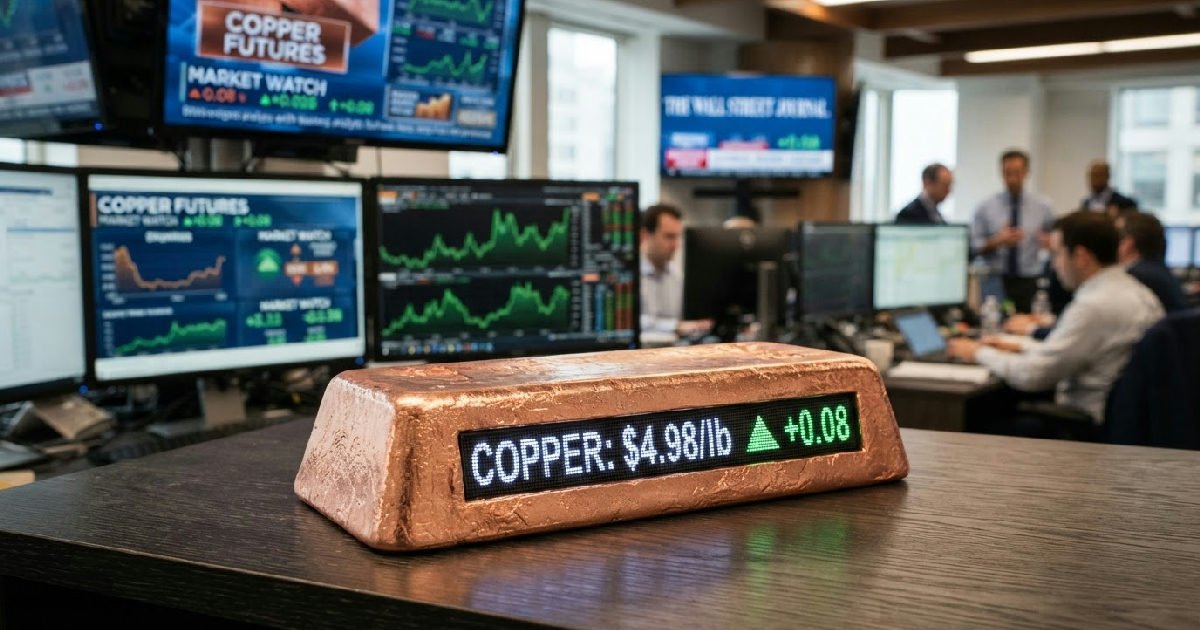
Copper price surge flashes urgent warnings for financial markets
The copper price surge in August 2026, driven by its historical ability to predict economic shifts, delivered three stark messages about financial markets. Copper” for its historical ability to predict economic shifts, has embarked on an unprecedented record run in August 2026, delivering three stark messages about the current state of financial markets. This remarkable surge isn’t merely a sign of a booming global economy.
Instead, it reflects a potent mix of inflation hedging, deepening concerns over the U.S. bond market, and burgeoning demand from the artificial intelligence sector, according to analysis by Isabel Wang.
Copper price surge challenges market norms
The rally has pushed the front-month copper futures contract in the U.S. to dizzying heights, hitting a record $6.7095 per pound on a Tuesday earlier this month. On Wednesday, Comex copper for September delivery touched an even fresher all-time high of $6.7775 a pound, equivalent to approximately $14,940 a tonne, in New York.
This latest copper price surge stands apart from previous rallies, which typically coincided with robust global economic growth. Instead, it’s happening amid widespread economic uncertainty, signaling a departure from its traditional role as a reliable economic barometer.
The iShares Copper and Metals Mining ETF exemplifies this unusual trajectory, posting a nearly 20% gain in August 2026, setting it on course for its best month on record.
Back on August 6, 2026, copper futures briefly touched an all-time high near $6.90 a pound before a slight retreat, showcasing the volatility underpinning the market. The benchmark three-month copper contract on the London Metal Exchange (LME) currently trades at $14,350 per metric ton this week, still hovering near its all-time record of $14,527.50 set earlier in 2026.
The “debasement trade” finds a new haven
One of the most compelling messages from copper’s rally is the strengthening of the “debasement trade.” Investors are increasingly moving into tangible assets like copper, gold, and digital assets like bitcoin as a hedge against the perceived erosion of purchasing power in the U.S. dollar and instability in the bond market.
This sentiment stems from growing worries over the U.S. national debt, which recently surpassed the staggering $40 trillion milestone, alongside persistent massive government deficits.
This flight to hard assets indicates a profound lack of confidence in traditional financial instruments, particularly long-term government debt. As a result, market participants are seeking alternative stores of value, driving up the prices of commodities and cryptocurrencies. Bitcoin, for instance, has also seen significant increases, as investors seek alternatives amidst currency concerns.
It’s not just copper seeing this action; other industrial and precious metals, including silver and platinum, are also rallying in August. This broad-based movement confirms a wider trend of investors diversifying their portfolios away from conventional assets, concerned about the long-term implications of current fiscal policies and geopolitical tensions.
US bond market under scrutiny as copper signals distress
Copper’s remarkable performance also broadcasts a clear signal that something is amiss within the U.S. bond market. The metal’s ascent, detached from robust global economic growth, suggests investor apprehension about the recent selloff in longer-term Treasurys. This unease reflects deeper structural issues within the bond market, where unprecedented levels of government spending and borrowing continue to raise questions about fiscal sustainability.
Traditionally, a strong copper market would suggest a confident outlook for global manufacturing and infrastructure. But today’s environment paints a different picture, one where investor concern centers on the recent selloff in longer-term Treasurys, reflecting worries about the U.S. bond market due to growing national debt and massive government deficits.
This disconnect means investors are looking beyond the immediate economic horizon, focusing instead on long-term fiscal health and broader Treasury market dynamics.
The cash metal on the LME last week fetched over $500 a tonne more than three-month futures, a stark indication of immediate supply tightness. By Tuesday’s settlements, this gap stood at $127, still reflecting premium pricing for prompt delivery. Such premiums highlight both current scarcity and the market’s expectation of continued demand.
Fuzzier signals: Copper’s role as economic predictor shifts
The third, and perhaps most significant, message from copper’s record run is the blurring of its traditional economic predictive capabilities. Nicknamed “Dr. Copper,” the metal has long been a bellwether for global economic health due to its pervasive use across industries. However, its current rally is driven by factors distinct from broad global growth, making its signal “fuzzy.”
Instead, the surge is primarily fueled by tight supply, substantial global spending on power grids, lingering U.S. tariff uncertainty, and the aggressive push for electrification, including the mushrooming of data centers vital for artificial intelligence. These specific, sector-driven demands mean copper’s price now reflects more nuanced dynamics than simple economic expansion.
The reason behind the price movement has become far more crucial than the price itself.
Global market production experienced a significant setback in the first half of 2026, losing approximately 338,000 tonnes due to various issues in key mining regions like Indonesia, the Democratic Republic of Congo, and Chile. This supply constraint has fundamentally altered market expectations, with CRU’s original forecast for a 639,000-tonne global surplus in 2026 now considered, at best, balanced.
The divergence between the LME September contract and October contract, with September trading about $100 a tonne above October on Wednesday, further underscores the immediate tightness. This is up from less than $50 at the end of last week, signaling escalating demand for near-term delivery.
Meanwhile, Comex inventories remain at a record above 675,000 tonnes after 46 consecutive daily builds, presenting a complex picture of regional supply and demand.
AI demand and looming tariffs reshape the outlook
The insatiable demand from artificial intelligence infrastructure is quickly becoming a dominant factor in the copper market. Data centers, integral to AI operations, require immense amounts of electricity and, consequently, copper for their extensive wiring and power distribution systems. This new industrial revolution is creating an unprecedented structural demand for the metal, distinct from traditional manufacturing cycles.
Additionally, the looming threat of U.S. tariff decisions continues to cast a shadow over the market. Washington’s copper tariff ruling has been pending for nearly two months, creating significant uncertainty for producers and consumers alike. Any move could dramatically alter trade flows and price stability, further exacerbating supply concerns and potentially driving prices even higher.
Such policy-driven market disruptions highlight the complex interplay of economic, technological, and political forces now dictating copper’s value. This makes forecasting its trajectory particularly challenging, moving it beyond the realm of simple supply and demand fundamentals into a more intricate geopolitical and technological equation.
The broader implications for global trade and technological development are substantial, as countries scramble to secure vital resources for their digital futures.
Looking ahead: The future of “Dr. Copper”
The current copper price surge signals a profound shift in how financial markets interpret commodity movements. No longer a straightforward indicator of global economic vitality, copper now reflects a multi-faceted narrative dominated by investor apprehension regarding monetary policy and the disruptive forces of technological advancement.
This makes it essential for investors and policymakers to delve deeper into the drivers behind the price rather than just observing the price itself.
Policymakers around the globe face increasing pressure to balance economic growth with financial stability amidst widespread global inflation trends. The copper market offers a unique lens through which to view these challenges, revealing underlying anxieties about inflation, national debt, and the infrastructure demands of a rapidly evolving technological landscape.
How these factors resolve will undoubtedly shape not just the copper market but the broader global financial ecosystem in the coming years.