

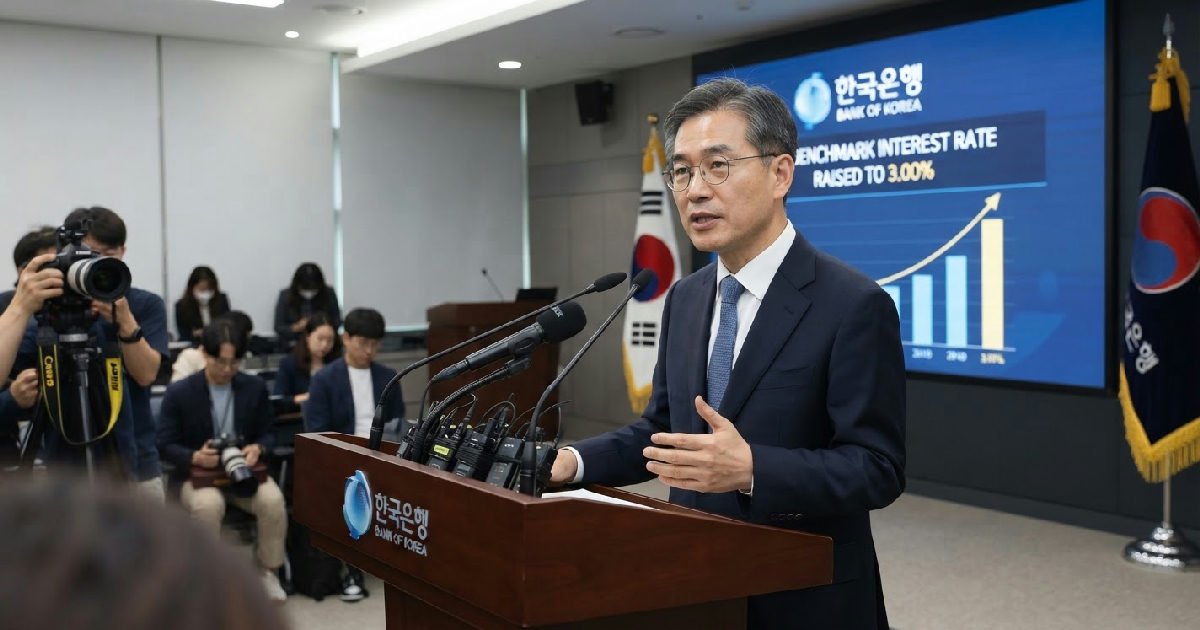
Bank of Korea lifts rates to 3% amid persistent inflation
On August 27, 2026, the Bank of Korea (BOK) moved to curb persistent inflationary pressures, raising its benchmark interest rate by 25 basis points to 3.00%. This marks the central bank’s second consecutive rate hike, pushing borrowing costs to their highest level since February 2025.
The decision, made by the seven-member Monetary Policy Board chaired by Governor Shin Hyun-song, underscores the BOK’s commitment to price stability even as South Korea’s economy demonstrates robust growth.
Bank of Korea rate hike tightens policy as prices climb
The move comes as core inflation, which strips out volatile food and energy prices, hit 2.6% in July, its highest point since December 2023. At the same time, the nation’s Gross Domestic Product (GDP) expanded by an impressive 3.7% in the second quarter of 2026, largely fueled by a strong export performance.
Concerns over financial stability, particularly soaring housing prices in greater Seoul and rising household debt, also heavily influenced the board’s action.
The 25 basis point increase brings South Korea’s benchmark rate to 3.00%, a level not seen since February 2025. This marks the first instance of back-to-back rate hikes since a sustained seven-time streak between April 2022 and January 2023.
The immediate trigger for the BOK’s latest action was the stubbornly high core inflation rate, which reached 2.6% year-on-year in July, its sharpest increase in two years and seven months.
While headline inflation cooled slightly to 2.8% in July from 3.2% in June, it continues to hover above the BOK’s 2% target. The central bank’s statement acknowledged that despite robust economic expansion, inflation is likely to remain above this target for a “considerable time.”
They also pointed to significant uncertainties from global oil prices, exchange rate movements, the pace of domestic demand recovery, and the broadening impact of wage increases.
This tightening cycle follows a period where the BOK had cut its benchmark rate by 1 percentage point between October 2024 and May 2025, holding it steady at 2.5% until July 2026. This initial hike in July marked the first in three and a half years.
It signals a definitive shift in monetary policy to combat mounting price pressures. For ordinary Koreans, persistently high core inflation means that even excluding volatile components, the cost of living remains elevated.
The BOK’s dual mandate includes both price stability and financial stability. This necessitates a careful balancing act, especially when dealing with inflation spurred by both external factors and internal demand, much like other regional bodies managing Chinese central bank reforms.
Robust economic growth fuels inflationary pressures
South Korea’s economy continued its impressive trajectory, with GDP growing 3.7% year-on-year in the second quarter of 2026. This figure significantly surpassed the BOK’s earlier projection of 3.0%, highlighting the underlying strength of the economy.
In response, the BOK revised its growth forecast for 2026 upward to 3.3% from an initial 2.6%, marking the largest such revision in five years.
Exports, particularly from the country’s booming semiconductor sector, have been the primary engine of this growth. The spillover effects of the U.S.-led AI boom have provided a significant boost to South Korean technology exports.
This strong performance, while positive for the economy overall, complicates the inflation outlook by fueling domestic demand and potentially contributing to price increases.
The BOK noted explicitly that both export and domestic demand are expected to show robust growth. This implies that inflationary pressures are unlikely to dissipate quickly, giving the central bank less room to pause its tightening efforts.
The impressive Q1 2026 growth of 1.7% quarter-on-quarter, the strongest since Q3 2020, further solidifies the view of a resilient economy.
This economic momentum, driven by global demand for Korean goods and services, presents a unique challenge for monetary policymakers. They must temper inflation without stifling the very growth that has positioned South Korea as a leading economic power in Asia. The revised 2026 GDP forecast even surpasses projections from the government and the Korea Development Institute.
Containing financial stability risks
Beyond inflation and growth, financial stability risks played a crucial role in the BOK’s decision. Rising household debt levels and an overheating housing market, particularly in the greater Seoul area, have been persistent concerns. Seoul apartment transaction prices jumped 2.50% month-on-month in June, marking the steepest monthly gain since June 2021.
This rapid appreciation in property values, coupled with accelerating household debt growth, poses a significant risk to the financial system. Luxury apartment prices in Seoul are projected to see an 11% increase in 2026, which would be the highest growth globally.
This creates an environment where a sudden market correction could have widespread economic consequences.
The BOK had explicitly stated in its last meeting that it was necessary to “continue a policy stance consistent with further rate hikes” due to elevated cost pressures and accelerating housing prices. This highlights the central bank’s proactive approach to mitigating potential financial vulnerabilities before they escalate into a crisis.
The average price of non-apartment housing in Seoul also rose 11.6% year-on-year by July 2026.
Addressing these financial stability concerns requires a delicate touch. While higher interest rates can cool the housing market by making borrowing more expensive, they can also increase the burden on existing mortgage holders. Many central banks are grappling with similar pressures, firming Federal Reserve rate bets globally.
Divergent views within the Monetary Policy Board
The decision to raise rates wasn’t unanimous, indicating the complex trade-offs faced by policymakers. Six out of the seven members of the Monetary Policy Board supported the rate hike, while Commissioner Hwang Kun-il voted against it, proposing to keep the base rate unchanged at 2.75%.
Such a split vote underscores the ongoing debate about the appropriate pace and magnitude of monetary tightening.
BOK Governor Shin Hyun-song articulated the majority’s rationale, stating, “When considering inflation remaining above the target level, improving economic growth and rising financial stability risks, it is appropriate to continue a policy stance consistent with further rate hikes.”
His comments emphasize the multifaceted nature of the BOK’s policy objectives.
The BOK Monetary Policy Board’s official statement further elaborated on this stance. It stressed the importance of “prevent[ing] inflationary pressures from becoming widespread through preemptive action,” while also highlighting the need to “continue paying attention to financial stability risks.” This signals a strong commitment to controlling inflation before it becomes entrenched.
Economists are now reassessing their projections for South Korea’s terminal rate. Kong Dong-rak, an economist at Daishin Securities, for instance, revised his terminal rate projection upward to 3.50% from 3.25%, anticipating further tightening given the current economic conditions.
This higher forecast reflects the market’s expectation that the BOK will need to do more to rein in prices.
Global factors and future rate path
The BOK’s inflation challenges aren’t solely domestic. Global events, particularly the Iran war that began in February 2026, have significantly impacted energy markets. This conflict led to the closure of the Strait of Hormuz, disrupting global oil supplies and causing Brent crude prices to surge past $120 per barrel by early March.
This external shock has been a key contributor to South Korea’s rising inflation, with headline rates increasing for four straight months after the conflict began.
The central bank explicitly stated that the future path of inflation is “subject to high uncertainties related to movements in global oil prices and the exchange rate.” These external variables make forecasting and managing inflation particularly challenging for any central bank.
The volatility of global commodity markets means that South Korea’s domestic policy responses must be adaptable and robust.
The financial markets themselves were somewhat divided on the outcome of the August meeting. A Reuters poll of economists conducted just prior to the decision showed a near-even split, with 18 out of 35 experts expecting the rate hike, while 17 predicted no change.
This narrow margin reflects the complex economic data and the differing interpretations of the BOK’s likely response.
Looking ahead, the consensus among economists suggests the policy rate will reach 3.00% or higher by year-end 2026. Kim Myeong-sil, a researcher at iM Securities, noted the urgency for action, stating, “The benefit of waiting until October to raise the rate is not significant, while the cost of delaying the increase is growing.”
This sentiment points to an ongoing hawkish stance from the BOK. Moreover, shifts in the broader financial ecosystem, such as recent Bitcoin ETF inflows, can also hint at evolving investor appetite and capital allocation trends.
The BOK’s Monetary Policy Board will update its six-month “dot plot,” indicating individual rate views, for the first time since May. In May, with the benchmark rate at 2.50%, a significant portion of the board members already projected rates reaching 3.00% or higher.
This upcoming update will provide further insight into the board’s collective outlook on the trajectory of interest rates and the future of South Korea’s monetary policy.