

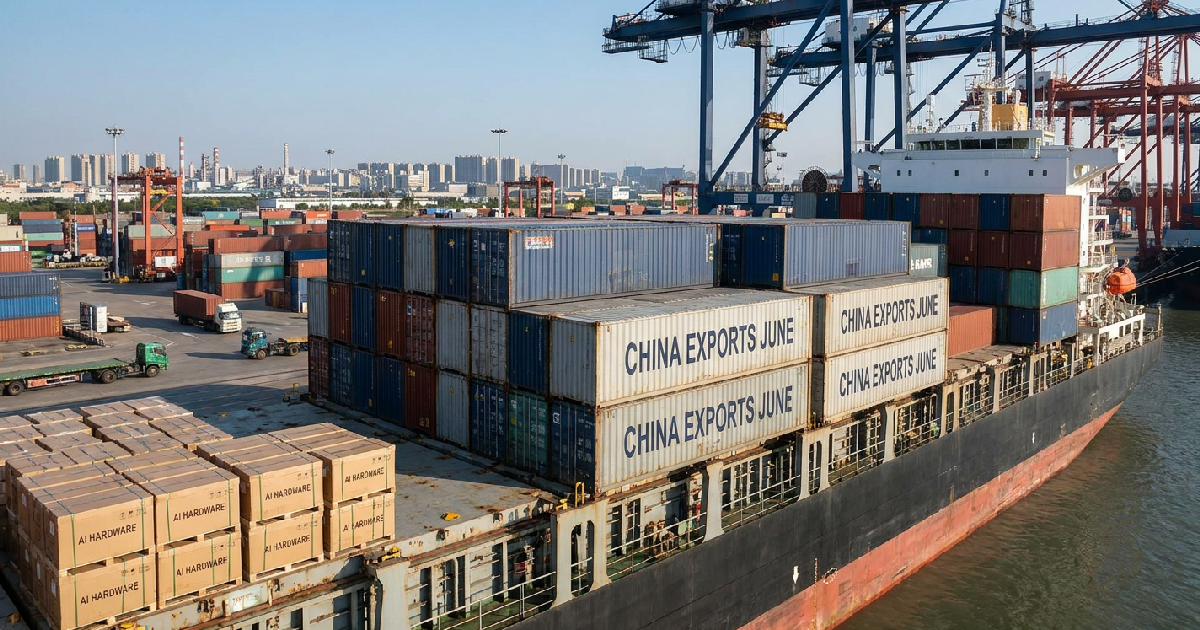
China’s June exports surge to highest since 2021 on AI hardware demand and pre-tariff rush
China’s trade performance accelerated unexpectedly in June 2026, with exports surging at their fastest pace since October 2021. This remarkable growth, driven by a booming global appetite for Artificial Intelligence (AI) hardware and a strategic rush to beat impending U.S. tariffs, significantly bolstered the country’s trade figures.
Customs data released on Tuesday, July 14, 2026, showed overall exports in dollar terms climbed an impressive 27.0% from a year earlier. This far surpassed economists’ forecasts of an 18.2% increase and quickened from May’s already strong 19.4% gain.
Artificial intelligence fuels global demand
The global investment spree in AI has proven a major boon for Chinese manufacturers. Demand for components like semiconductors, advanced computing equipment, and data center infrastructure is at an all-time high, translating directly into China’s export numbers.
This AI-driven boom has provided a critical cushion for China’s economy, especially given ongoing disruptions from the Middle East conflict and a prolonged domestic property slump. It’s reshaped the global hardware landscape, with hyperscalers pouring hundreds of billions into AI and data center infrastructure this year alone.
The boom in AI hardware and components
Chinese exports of semiconductors jumped over 110% year-on-year in May, while computer hardware exports rose 66%. AI-related products now account for a substantial 15% of China’s total export value, a notable increase from just 9% three years ago.
High-tech product exports overall climbed about 50%, with automated data processing equipment exports seeing an approximate 66% rise. These figures underscore China’s pivotal role in supplying the foundational technology for the worldwide AI revolution.
The demand is so intense that chip prices have soared as much as 700% over the past year. This isn’t just about volume; the value of semiconductor purchases (imports) grew nearly 70%, largely due to these escalating prices.
China’s critical role in the AI supply chain
China isn’t just assembling; it’s producing key components that underpin global AI infrastructure. Chinese firms, for instance, command over 60% of the global market share for optical modules, which are essential for high-speed data transfer within data centers.
Companies like Zhongji InnoLight, based in Yantai, Shandong Province, held over 40% of the global 800G optical module market in 2025. Another significant player, Eoptolink from Chengdu, ranks second worldwide in optical module manufacturing.
Even in AI chip design, Huawei stands as China’s leading company, alongside others like Cambricon and Alibaba’s T-Head. This strong domestic ecosystem reinforces China’s position as a critical supplier in the AI value chain.
Tariff tensions drive export surge
Beyond AI, the specter of increasing trade protectionism also played a significant role in June’s export performance. Manufacturers rushed to ship goods to the United States ahead of looming tariff increases, creating a temporary but potent boost.
U.S. President Donald Trump’s Section 301 probes are set to introduce additional duties, with a 10% broad-based duty potentially expiring on July 24. This prompted a strategic acceleration of shipments from China to avoid higher costs.
US and EU tariffs loom for Chinese goods
New U.S. tariffs on Chinese-made electric vehicles and other high-tech products are scheduled to come into force on August 1. Europe has already implemented higher import duties on Chinese electric vehicles earlier in July.
These impending and already active tariffs have created a narrow window for exporters to push through as much volume as possible. The effective U.S. tariff on Chinese imports averaged around 33% in May 2026, a figure that could climb higher.
Retailers front-load shipments
U.S. retailers and manufacturers were particularly proactive, bringing forward orders by four to six weeks. Their goal was to stock up for crucial sales periods like Black Friday and Christmas, anticipating the expected tariff hikes later in 2026.
This “tariff rush” strategy effectively front-loaded a significant portion of future demand into June’s export figures. The strategy mirrors similar anticipatory shipping seen in previous periods of trade uncertainty.
Domestic demand remains a drag
Despite the stellar export performance, China’s domestic economy continues to face headwinds. Weak consumption and private investment remain persistent concerns, tempering the overall economic outlook.
A prolonged property downturn and volatile global oil prices have also contributed to a deepening supply-demand imbalance within the country. This divergence between external and internal economic health presents a challenge for Beijing.
Weak consumer spending and investment
Retail sales of consumer goods fell 0.6% year-on-year in May, marking the first contraction in over three years. This highlights a struggle with consumer confidence and spending, which is crucial for a balanced economic recovery.
Urban investment is estimated to decline 4.9% in the first half of the year, deepening from a 4.1% fall in the first five months. This lack of internal dynamism stands in stark contrast to the external trade boom.
Xu Tianchen, a senior economist at the Economist Intelligence Unit in Beijing, noted that retail sales remain “pretty flat” and fixed asset investment has been negative. This suggests structural issues within the domestic economy that exports alone can’t fully resolve.
The Chinese government has long grappled with how to stimulate domestic demand effectively. This ongoing challenge underscores the need for comprehensive internal reforms to complement export-led growth.
Broader economic indicators
Looking at broader economic health, China’s factory activity did return to expansion in June, with the official manufacturing purchasing managers’ index (PMI) rising to 50.3 from 50.0 in May. This beat median forecasts, indicating some resilience in the manufacturing sector.
Moreover, the sub-index for new export orders returned to expansion, rising to 50.1 from 48.6. This suggests that the external demand driving June’s export surge wasn’t a one-off but points to continued momentum.
However, economists polled by Reuters expect China’s gross domestic product growth to have slowed to 4.5% in the second quarter, down from a solid 5.0% in the first. Industrial output and retail sales for June are projected to expand 4.7% and shrink 0.1%, respectively, indicating continued unevenness in the economy.
This shows that while external trade is strong, other areas like share price correction and broader investment still need support.
Global trade dynamics and future outlook
The robust June trade data paints a complex picture for China, balancing external strengths against internal weaknesses. The interplay between technological advancements, geopolitical trade tensions, and domestic policy will shape its trajectory for the remainder of 2026.
Policymakers in Beijing are keenly observing these trends, with an expected Politburo meeting in late July. Investors are looking for clues on potential stimulus measures, though significant action may only materialize if growth slows more sharply.
Shifting export destinations and product mix
China’s export patterns are evolving, with a notable increase in trade with the Global South. Exports to these regions rose from approximately $60 billion a month to $140 billion a month.
Exports to Southeast Asia grew 13% year-on-year in the first half of 2025, with specific jumps to Thailand (22%), Vietnam (nearly 20%), and India (more than 18%). Trade with Europe also climbed 6.6% during the same period, indicating diversified market engagement.
The product mix also reflects Beijing’s strategic shift from lower-end manufacturing to higher-value industries. This focus on technology and advanced manufacturing, exemplified by the “AI Plus” initiative, aims for AI-related industries to exceed 10 trillion yuan by 2030.
While the AI boom generates significant capital, other sectors like Bitcoin (BTC) price drops suggest a diversion of investment in some areas. The emphasis on high-tech exports is a deliberate strategy to upgrade China’s industrial base.
Beijing’s balancing act
The trade surplus, which widened to $125.62 billion in June and stands as the second-biggest ever, offers Beijing considerable room for maneuver. This financial strength can help offset domestic vulnerabilities and fund strategic initiatives.
However, the focus on curbing excess factory capacity to combat deflation means that major domestic stimulus may be restrained. Beijing seems content to ride the wave of resilient exports for now, even as China trading curbs remain a concern for some financial analysts.
The trade data underscores a complex reality: China’s external engine is firing on all cylinders, but its internal combustion needs more fuel. How this imbalance is managed will be crucial for both China and the global economy in the coming months.