

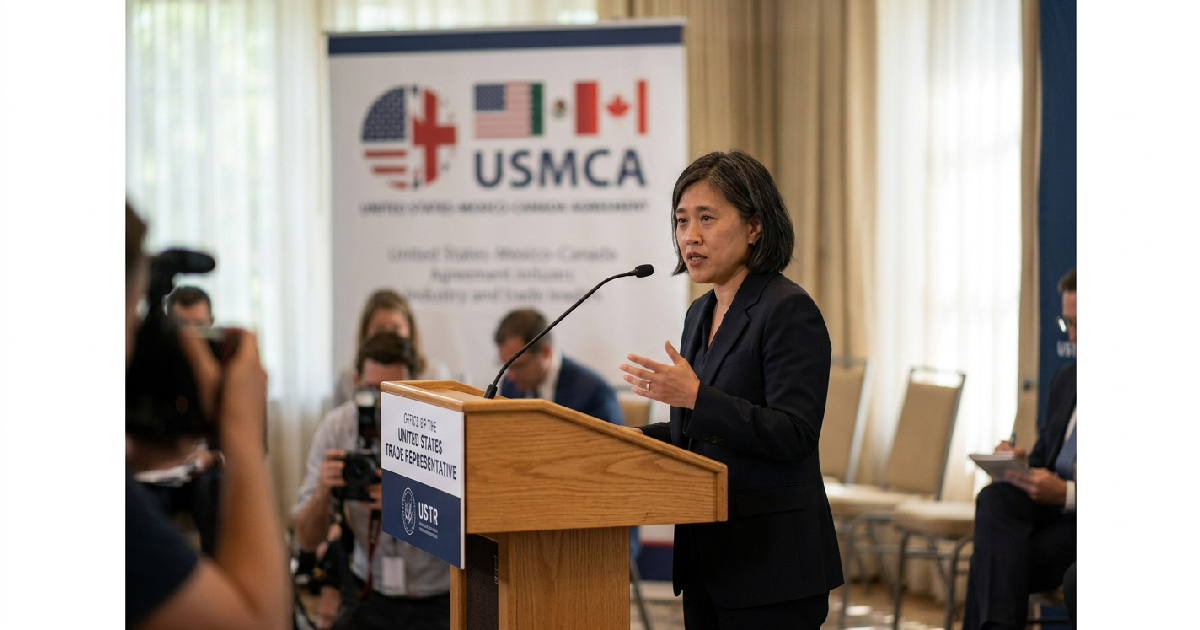
Ambassador Katherine Tai confirms USMCA auto rules need strengthening
Ambassador Katherine Tai and the USTR consider the current North American automotive trade framework to be in good standing, despite identifying several pressing vulnerabilities. S. Trade Representative (USTR) have reaffirmed the “good” standing of the current North American automotive trade framework while identifying several “pressing vulnerabilities.”
According to the biennial report on USMCA automotive rules of origin, originally released on July 1, 2024, and updated on July 10, 2024, the agency aims to use upcoming negotiations to strengthen these regulations.
Stricter regional value content for North American vehicles
The goal is to further incentivize the use of regional content and ensure that the United States-Mexico-Canada Agreement (USMCA) continues to drive domestic manufacturing investment.
The USTR’s assessment serves as a critical progress report for an industry that has undergone a shift toward electric vehicle (EV) production since the agreement replaced NAFTA on July 1, 2020. This statutory review is not merely a technicality; it outlines the requirements for duty-free status as global competition in the automotive sector intensifies.
The USTR suggests that while the existing rules have been effective, there is an opportunity to move from “good” to “very, very good” by closing gaps that might allow non-regional competitors to benefit from North American trade preferences.
This focus on regional stability comes as other markets face volatility, such as recent disruptions that saw U.S. naval forces redirect commercial vessels during maritime blockades. Within the USMCA territory, the USTR is doubling down on the automotive sector as the core of its labor and production goals.
By signaling the need for upcoming revisions, trade officials are setting a standard for high-value components, including advanced batteries for EVs and traditional engines.
The biennial report focuses heavily on Regional Value Content (RVC) requirements, which are designed to ensure that the majority of a vehicle’s value is created within North America. For passenger vehicles and light trucks, the RVC threshold is set at 75% under the Net Cost Method, a requirement that was fully phased in through 2023.
This forces manufacturers to source a significant majority of parts from the three member nations to qualify for preferential tariffs.
The rules differ slightly depending on the class of vehicle. Heavy trucks are required to meet a 70% RVC threshold. The USTR continues to monitor how these targets are met, particularly as the supply chains for light and heavy vehicles begin to overlap with the introduction of modular EV platforms.
The objective remains clear: to ensure the “origin” of a vehicle reflects a genuine North American manufacturing ecosystem rather than just final assembly.
The report card also details a tiered system for various automotive components to ensure high-value parts are made locally.
These include:
- Core Parts: Requires 75% RVC for engines, transmissions, chassis, axles, and advanced EV batteries.
- Principal Parts: Requires 70% RVC for clutches, compressors, air conditioners, and electronic brake systems.
- Complementary Parts: Requires 65% RVC for pipes, locks, windshield wipers, and catalytic converters.
Labor value content and the minimum wage floor
A defining feature of the USMCA is the Labor Value Content (LVC) requirement, which mandates that a specific percentage of a vehicle’s content be produced by high-wage labor. For passenger vehicles, 40% of the content must be produced by workers earning at least $16 USD per hour. For light trucks and heavy trucks, this requirement is even higher, rising to 45% of the vehicle’s content.
This measure was crafted to narrow the wage gap between North American partners and prevent a “race to the bottom” regarding manufacturing costs. The U.S. Department of Labor assesses facility eligibility, while U.S. Customs and Border Protection (CBP) determines the final value of the parts and the LVC.
While compliance has been noted throughout the region, the USTR’s “pressing vulnerabilities” include ensuring these wage standards are correctly enforced across complex sub-contracting layers.
Failure to adhere to these labor standards results in the loss of duty-free trade status, which can significantly alter the cost structure for manufacturers. As North American logistics providers and transport firms navigate varying compliance costs, the LVC remains a primary tool for trade officials to ensure that the economic benefits of the automotive trade reach the workforce directly.
Raw material procurement and steel requirements
Beyond finished components, the report card addresses the sourcing of raw materials. To qualify for USMCA benefits, vehicle producers must ensure that 70% of their steel and aluminum purchases originate within North America. This rule supports regional smelters and reduces reliance on global imports that may be subsidized or face high carbon costs.
This is particularly relevant as the U.S. looks to build new rare earth plants to secure various critical mineral supply chains.
The USTR report highlights that maintaining these thresholds is vital for regional economic security. Concerns remain regarding the transparency of secondary metal markets, where non-regional materials could potentially enter the supply chain. Trade officials are looking toward future review opportunities to potentially tighten tracking for these metals, ensuring that “melted and poured” requirements are strictly observed to benefit North American miners and processors.
Alternative staging regimes and upcoming expiration deadlines
During the transition from NAFTA to the USMCA, the agreement allowed for “Alternative Staging Regimes” (ASRs). These were temporary provisions that gave manufacturers additional time to meet the rigorous new RVC and LVC targets. Under an ASR, a producer could import vehicles using a different set of requirements while they reconfigured their regional manufacturing footprints to align with the higher 2020 standards.
These temporary protections are now approaching a deadline. According to the USTR report, many of these Alternative Staging Regimes are scheduled to begin expiring in July 2025. This expiration will serve as a final test for manufacturers, as they will no longer have the luxury of intermediary rules and must meet the full 75% RVC and 40-45% LVC requirements to avoid standard tariffs.
The end of the ASR era signals a new phase of USMCA enforcement. USTR Katherine Tai and other trade officials have indicated that these upcoming changes are essential to “strengthen” the automotive rules.
By removing these temporary buffers, the treaty partners expect to see a full realization of the agreement’s original intent: a more integrated, high-wage, and self-sufficient North American automotive industry. As the July 2025 date nears, the focus will remain on whether regional producers have done enough to secure their duty-free status under the permanent rules.