

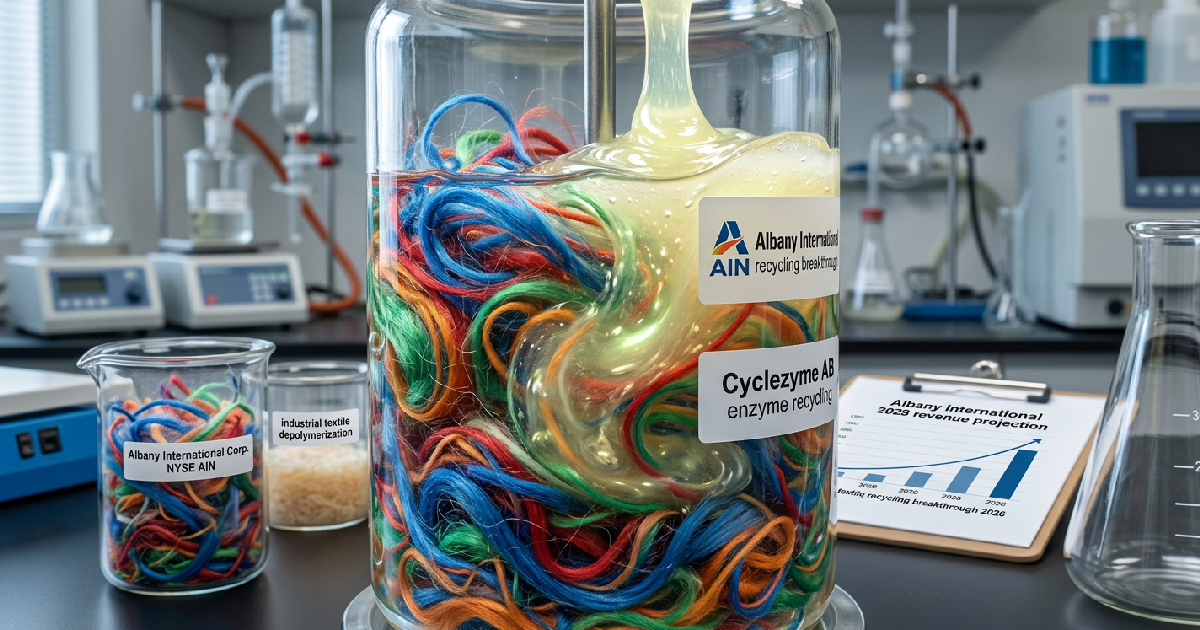
Albany International Corp. and Cyclezyme AB confirm enzyme breakthrough for textile recycling
Albany International Corp. (NYSE: AIN) and Sweden-based Cyclezyme AB have reported a technological milestone in enzyme-based recycling of industrial textiles after successful depolymerization trials and the development of nylon-degrading enzymes. The progress targets complex industrial materials primarily consisting of polyester and polyamide, providing a potential closed-loop solution for textiles that are typically resistant to standard recycling methods.
The collaboration aims to establish enzymatic processes for the breakdown of technical textiles back into their chemical building blocks for reuse in new production. Unlike many existing technologies that focus on a single material, the enzymes developed by Cyclezyme AB have proven capable of depolymerizing both polyester and nylon.
Albany International targets sustainability in industrial textiles
This development aligns with Albany’s push into advanced circular material solutions as industries face increasing regulatory pressure to reduce landfill use and incineration of industrial fibers.
The breakthrough arrives as Albany International Corp. works to offset pressure in its traditional Machine Clothing business and address uneven earnings within its aerospace operations. By pivoting toward higher-value, sustainability-focused materials and composites, the company is positioning itself to meet the growing demand for innovative circular solutions in the manufacturing sector.
This shift is critical as sustainability becomes a core bottom-line concern for global industrial customers.
Internal corporate transitions of this scale often reflect broader industrial movements toward securing material lifecycles. For instance, while Albany focuses on textile circularity, other firms like Posco International are addressing different supply chain needs through the development of rare earth processing facilities. These separate but parallel efforts demonstrate a widespread industrial focus on decoupling production from volatile raw material chains.
Existing recycling technology frequently struggles with the durability of polyamides. However, Cyclezyme has successfully optimized degradation efficiency for selected material samples and developed several unique nylon-degrading enzymes. These results strengthen the view that enzymatic recycling can become a primary solution for advanced technical materials that current methods cannot easily process, offering a path for high-performance industrial fabrics to be diverted from waste streams.
Financial outlook and 2029 revenue projections
Investors are weighing this innovation against a complex financial backdrop. Albany International (AIN) has seen a year-to-date share price return of 35% as of June 11, 2026, reaching a price of US$70.95. However, analyst fair value estimates sit at US$56.67, suggesting a potential 20% downside.
This disparity highlights the challenge of valuing early-stage projects like the Cyclezyme partnership against current operational risks and uneven aerospace performance.
The company has set ambitious long-term goals, projecting revenue of US$1.3 billion and earnings of US$346.8 million by 2029. Reaching these targets will require a significant turnaround, as Albany needs to increase earnings by US$406.2 million from its current position of -US$59.4 million.
Key details
While the stock’s 90-day return has been a robust 31.17%, the one-year total shareholder return is a more modest 7.65%, reflecting market caution regarding near-term profitability.
This cautious sentiment is also visible in other sectors where extreme market movements have triggered re-evaluations. Recent share price corrections in the international markets serve as a reminder that valuation often struggles to keep pace with rapid industrial or technical shifts.
For Albany, the current Price-to-Sales (P/S) ratio of 1.7x remains lower than the US Machinery industry average of 2.1x, indicating that the market has not yet fully priced in the potential of its advanced materials pivot.
Next steps for industrial scaling and development
Following the successful depolymerization trials, Albany International and Cyclezyme have initiated discussions regarding the next phase of the project. The focus will now shift toward scaling the technology for future industrial applications and evaluating how the enzymatic process can be integrated into high-volume manufacturing environments. Scaling is a significant hurdle, as the transition from laboratory optimization to factory-floor implementation requires precise execution.
Ongoing technical work is concentrated on two primary areas:
- Developing analytical methods to evaluate enzyme activity more effectively.
- Further optimizing the degradation technology to ensure consistency across different textile types.
The ability to handle both polyester and nylon within a single platform is a distinct advantage. If the partnership can effectively scale this technology, it could provide Albany with a defensive moat in the Machine Clothing market, where recycling capability is becoming a priority for paper manufacturers and industrial clients.
Key details
This expertise could help the company reach the 3.2% yearly revenue growth required to meet its 2029 projections.
Despite the technical promise, Albany’s near-term guidance for Q2 2026 remains between US$335 million and US$345 million. This range reflects a business still working to stabilize margins amidst program concentration risks in aerospace.
While the move toward sustainability is a core part of the bull case for the stock, the company must manage these immediate operational pressures to ensure that innovation projects like Cyclezyme have the necessary runway to reach commercial viability.