

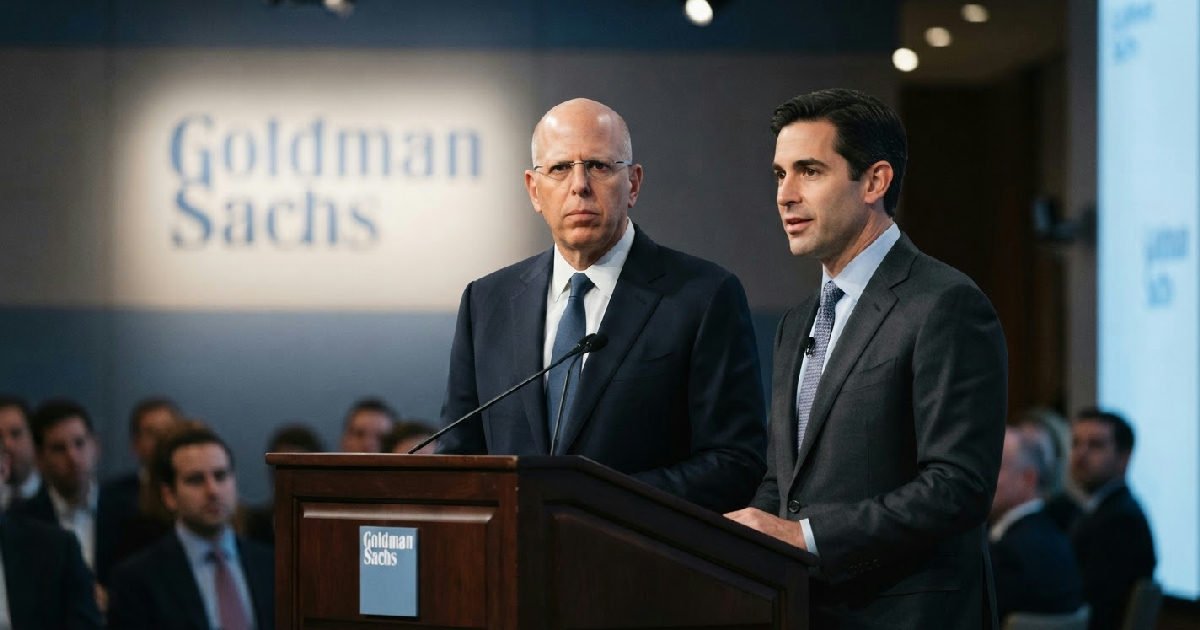
Goldman Sachs denies David Solomon CEO succession timeline
Goldman Sachs has pushed back against reports detailing a timeline for Chief Executive Officer David Solomon to step down, specifically regarding Goldman Sachs CEO succession. The investment banking giant called the idea of a fixed departure date mere “speculation,” even as reports circulate about a transition of power in the coming years.
The statement came in response to a Wall Street Journal story, citing people familiar with the matter, that suggested the board had discussed a plan for Solomon to exit. The rumored plan would see him replaced by President and Chief Operating Officer John Waldron around the end of 2027 or in 2028.
Goldman Sachs CEO succession reports persist
A spokesperson for Goldman Sachs, Tony Fratto, directly addressed the rumors, confirming that succession is a regular topic for the board but denying any set schedule. “Of course the board regularly discusses succession, as we disclose in our filings,” Fratto stated. “But there is no definitive timeline for succession at Goldman Sachs.”
Fratto concluded that “any assertions about timing are just speculation.” This firm denial contrasts sharply with the detailed report from journalists AnnaMaria Andriotis and Emily Glazer. Their reporting suggests a scenario where the 64-year-old Solomon could transition to an executive chairman role for one to two years after stepping down as CEO.
The tension between the official denial and sourced reporting highlights the intense scrutiny on leadership at the influential firm, which has wide-ranging impacts on global markets. Such situations often spark discussions about broader market trends and their underlying causes.
The public back-and-forth injects a dose of uncertainty into the bank’s future leadership, a critical issue for investors and employees alike. While succession planning is routine, the emergence of specific timelines, even if denied, often signals that high-level conversations are indeed taking place. The focus now shifts to how long the official stance can hold against persistent inside reports.
This dynamic places every public statement and strategic move by the bank’s leadership under a microscope. For a firm with a market capitalization of over $266 billion, leadership stability is paramount, and any perceived ambiguity can create ripples throughout the financial sector.
The heir apparent waiting in the wings
At the center of the succession narrative is John Waldron, the 57-year-old President and Chief Operating Officer. He is widely considered the natural heir to Solomon. Waldron is a long-time associate of the current CEO, having been recruited by Solomon to join Goldman back in 2000. Their professional relationship has been a cornerstone of the firm’s leadership for over two decades.
When Solomon ascended to the CEO position in October 2018, he promptly named Waldron as president, solidifying his status as the bank’s number two executive. This close partnership has been instrumental in navigating the firm through both its challenges and its recent successes. However, Waldron’s ambitions have also been a factor in the ongoing corporate drama.
A few years ago, when it appeared Solomon intended to remain CEO for an extended period, Waldron reportedly explored opportunities outside the firm. Sources indicate he held serious discussions with Apollo Global Management, a clear sign of his desire to take the top job somewhere. This history adds a layer of complexity to the current situation, suggesting Waldron may not be content to wait indefinitely.
In a potential sign of groundwork being laid for a future transition, some of Waldron’s COO duties have reportedly been shifted to Denis Coleman, Goldman’s finance chief. Such moves are often interpreted as freeing up a designated successor to focus on broader strategic initiatives and client relationships, which are central to the CEO role.
A turbulent but ultimately profitable tenure
David Solomon’s nearly eight-year tenure as CEO has been a study in contrasts, marked by strategic missteps, internal discord, and ultimately, a soaring stock price. He took the helm from Lloyd Blankfein with a vision to diversify the bank’s revenue streams, most notably through an aggressive expansion into consumer banking.
This move, however, proved to be a significant challenge. The firm’s attempt to build a mainstream digital bank resulted in approximately $7 billion in pre-tax losses since the beginning of 2020. Goldman Sachs is now in the final stages of unwinding this consumer-lending business, a tacit admission that the ambitious pivot away from its core competencies was a costly error.
Public image and internal friction
Beyond the strategic stumbles, Solomon’s leadership style and personal activities have drawn criticism. His high-profile hobby as a DJ, performing at major music festivals, was viewed by some partners and Wall Street veterans as a distraction that didn’t fit the buttoned-up culture of Goldman Sachs. This contributed to a narrative of a culture clash within the storied institution.
His tenure has also been marked by a notable exodus of senior partners, fueling reports of internal dissatisfaction with his management. While partner turnover is a feature of Wall Street life, the rate and profile of departures during certain periods raised questions about morale and agreement with his strategic direction.
A return to core strengths fuels success
Despite these headwinds, Solomon’s leadership has delivered for shareholders. After pivoting back to its traditional strengths in investment banking and trading, the firm has thrived. Goldman’s stock has surged approximately 180% over the past three years, trading near record highs and rewarding investors who backed his ability to right the ship.
For many, individual stock picking in a name like Goldman has paid off handsomely under his watch.
This rebound has largely silenced the most vocal critics and solidified his position, making the timing of his eventual departure a matter of his choosing, in consultation with the board. The success of the core business provides a stable platform from which to execute a smooth transition, whenever it may occur.
Financial incentives and the broader wall street context
The conversation around Solomon’s departure is also framed by significant financial incentives designed to ensure stability. At the start of 2025, both Solomon and Waldron were granted five-year retention bonuses, each valued at a substantial $80 million. These awards were structured to keep the leadership team in place during a critical period for the bank.
Crucially, the terms of the bonus do not require Solomon to remain as CEO for the entire five-year duration to receive his payout. This flexibility allows the board to execute a succession plan without creating a financial penalty for the outgoing chief, a key detail that makes the reported 2027 or 2028 timeline more plausible. It provides a golden parachute that facilitates a graceful exit.
The situation at Goldman is not unique. CEO succession is a major focus for investors across Wall Street, with long-tenured leaders at other major banks.
The industry is closely watching the plans for Jamie Dimon at JPMorgan Chase and Brian Moynihan at Bank of America, both of whom have led their respective firms for well over a decade. This broad focus on succession planning underscores how critical leadership continuity is to these systemically important financial institutions.
For investors, a clear and well-communicated succession plan is a sign of a healthy, forward-looking board. The current ambiguity at Goldman, with its conflicting reports and official denials, creates a narrative that the firm will be under pressure to clarify in the months ahead.
The ultimate goal is to avoid the market shock that can accompany a sudden or poorly managed leadership change, a factor often considered by those watching market catalysts for various sectors.