

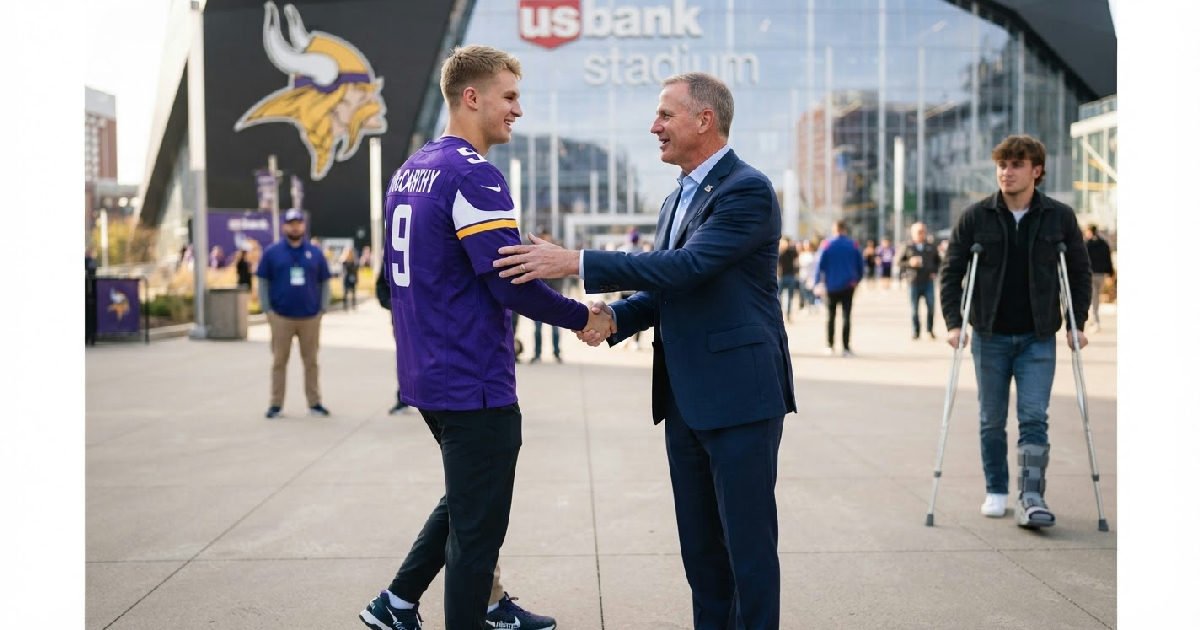
Vikings send McCarthy to Giants for pick
The Minnesota Vikings send J.J. McCarthy to the New York Giants on Monday, September 28, 2026, in a trade for a 2027 fifth-round pick. J. McCarthy, trading the former first-round pick to the New York Giants on Monday, September 28, 2026.
This significant move sends McCarthy, the 10th overall selection in the 2024 NFL Draft, to New York in exchange for a 2027 fifth-round draft pick. The trade is contingent upon McCarthy successfully passing a physical exam with the Giants.
This transaction signals the Vikings’ acknowledgment of McCarthy’s struggles and comes as the Giants urgently sought quarterback depth following a season-ending knee injury to their starting signal-caller, Jaxson Dart. Dart, also a former first-round selection, will miss the remainder of the regular season after sustaining a meniscus and MCL injury in Week 2, creating an immediate void for New York.
Why the Vikings send McCarthy to the Giants
The decision to trade J.J. McCarthy marks a clear end to the Minnesota Vikings’ ambitious plan for the young quarterback. Drafted with high hopes from Michigan, where he had just led his team to a national championship, McCarthy was expected to become the franchise signal-caller for years to come. However, his tenure in Minnesota proved challenging and ultimately disappointing.
McCarthy’s rookie season was derailed by a meniscus injury, keeping him off the field. His second year saw him struggle considerably, failing to consistently connect with star wide receiver Justin Jefferson and proving unable to master Head Coach Kevin O’Connell’s complex system. The team’s coaching staff couldn’t elevate his performance to a proficient level.
A Bust from the 2024 Draft Class
J.J. McCarthy was part of a highly touted 2024 NFL Draft class, which saw six quarterbacks selected within the first 32 picks.
While many of his peers, such as Caleb Williams, Jayden Daniels, Drake Maye, Bo Nix, and even Michael Penix Jr., have shown flashes of brilliance or sustained success, McCarthy’s career trajectory has diverged sharply.
Daniels earned Rookie of the Year honors in his first season, and Maye led the New England Patriots to the Super Bowl last year, finishing second in MVP voting.
McCarthy amassed just 1,632 passing yards, 11 touchdowns, and 12 interceptions across 10 starts over two seasons with the Vikings. These statistics starkly highlight his struggles and contribute to his early designation as a draft bust. The financial commitment to a top-10 pick typically demands far greater return on investment for an NFL franchise.
Kyler Murray’s Ascension and McCarthy’s Bench Role
McCarthy’s fate in Minnesota was sealed heading into his third season when he lost a key quarterback competition to Kyler Murray. Murray, who helped propel the Vikings to a strong 3-0 start in Week 3, firmly established himself as the team’s starting quarterback. This competition loss solidified McCarthy’s diminished role within the organization.
Even when Murray was briefly unavailable, Carson Wentz stepped up as the backup, demonstrating more proficiency than McCarthy and further pushing the former first-rounder down the depth chart. The Vikings, now in a strong position, ultimately decided that acquiring a 2027 fifth-round pick for McCarthy represented good value, acknowledging that his future contributions in Minnesota were unlikely.
Giants Secure Depth Following Jaxson Dart Injury
For the New York Giants, the acquisition of J.J. McCarthy is a direct response to a sudden and critical need for quarterback depth. Their starting quarterback, Jaxson Dart, suffered a season-ending knee injury in Week 2, forcing the team to pivot quickly.
Dart, a promising talent, had displayed immense potential as a rookie but has also battled a history of early-career injuries, creating an ongoing concern for the Giants.
The Giants had already anticipated potential quarterback issues, having signed Jameis Winston to a contract extension just before the regular season began. Winston was brought in with the understanding that he could be one of the league’s better backup quarterbacks. However, losing Dart for the entire regular season was a scenario they hadn’t fully prepared for, necessitating further action.
The Urgency of Quarterback Depth
With only Jake Haener as the other active quarterback on the roster behind Winston, the Giants faced a precarious situation. Winston, while talented, is known for a high-risk, high-reward playing style that can sometimes lead to turnovers. This makes having a reliable backup, or even another developmental option, crucial for navigating a long NFL season, especially given Dart’s injury history.
The trade for J.J. McCarthy provides an additional layer of security and a potential long-term project. While he doesn’t immediately solve their current starting quarterback dilemma if Winston were to falter or get injured, he offers a young player with significant draft capital invested in him, suggesting untapped potential.
Low-Risk, High-Reward Potential
The Giants only gave up a 2027 fifth-round draft pick to acquire McCarthy. This relatively low cost makes the move a low-risk, potentially high-reward gamble for the franchise. Even with his struggles in Minnesota, McCarthy is still just 23 years old, suggesting there’s ample time for him to develop under new coaching and in a different environment.
As a former first-round pick, McCarthy’s contract includes a fifth-year option, providing the Giants with control over him for this season and two additional years at a manageable cost. This offers them a cheap, developmental asset, a strategic advantage particularly given Dart’s recurring health concerns, even if Dart remains the team’s undisputed future.
The Wider Implications for Both Franchises
This trade carries significant implications for both the Minnesota Vikings and the New York Giants. For the Vikings, it represents a clean break from a failed high-round draft investment.
While admitting a mistake on a top-10 pick is never easy for an NFL franchise, moving on allows them to fully commit to Kyler Murray as their starter and avoids the potential locker-room distraction of a high-profile former starter on the bench.
The acquired fifth-round pick in 2027 provides the Vikings with additional draft capital, which can be leveraged to address other roster needs in the future. This kind of asset management is critical in the modern NFL, where economic factors often influence team building decisions. It enables them to continue building around their established talent without the overhang of McCarthy’s unfulfilled potential.
For the Giants, the trade doesn’t immediately transform their season, but it addresses a glaring hole in their quarterback depth chart. It also provides a young player with pedigree who could potentially benefit from a change of scenery. This pragmatic approach to team construction underscores their commitment to navigating the challenges presented by player injuries effectively.
McCarthy’s Rocky Road from Michigan to New York
J.J. McCarthy’s journey through the NFL has been tumultuous since his standout collegiate career at Michigan. His arrival in the league was met with considerable hype, bolstered by his national championship victory and his position as one of the top prospects in a historically strong quarterback class. This pressure, combined with unforeseen injuries and competitive struggles, defined his initial years.
His rookie season was a non-starter, thanks to the meniscus injury. Then, in his second year, he found himself under intense scrutiny as he struggled to adapt to the professional game’s speed and complexity. The inability to consistently involve Justin Jefferson, one of the league’s premier receivers, highlighted his difficulties in commanding the offense and making crucial plays.
The competition with Kyler Murray further exposed these challenges, ultimately leading to his demotion. His stint with the Vikings concluded with modest numbers across 10 starts, leading many analysts to label him a draft bust. Now, at just 23, he receives a fresh start with the Giants, away from the immediate pressure of being a top-10 pick for his drafting team.
This fresh start provides McCarthy a chance to reset his professional narrative. He moves to a team where the immediate expectation is not to be a franchise savior, but a developmental backup and insurance policy. The reduced pressure could be beneficial for him to refine his skills and potentially recapture the form that made him a first-round prospect.
Looking Ahead: Future for Both Teams and McCarthy
The Minnesota Vikings are now fully invested in Kyler Murray as their starting quarterback, and their 3-0 start to the season reinforces that decision. The immediate future looks stable, with a strong roster and clear direction at the most crucial position. The added draft capital from the McCarthy trade will aid their long-term strategy for sustained competitiveness.
The New York Giants face a more immediate challenge with Jaxson Dart out for the season. Jameis Winston will step into the starting role, and his performance will heavily influence the team’s playoff aspirations.
McCarthy, meanwhile, will likely serve as a developmental project, learning the Giants’ system without the immediate burden of significant playing time expectations. His progression over the next year or two will be closely watched.
The trade also highlights the volatile nature of quarterback evaluations in the NFL Draft. Even highly touted prospects from strong collegiate programs can struggle to transition, while others unexpected talents emerge. For J.J.
McCarthy, this move is a critical juncture in his young career, offering him a new opportunity to prove his capabilities and defy the early “bust” label. The landscape of player contracts and team valuations remains a dynamic business challenge for NFL general managers.
Ultimately, both teams made moves they believe will benefit their respective futures. The Vikings solidified their commitment to their current successful path, while the Giants addressed an urgent need with a potentially valuable long-term asset. How McCarthy adapts to his new team will be a key storyline in the coming seasons, determining if this “bust” can indeed be transformed into a valuable NFL player.