

Treasury Yields Spike as Mideast Tensions Fuel Oil Surge
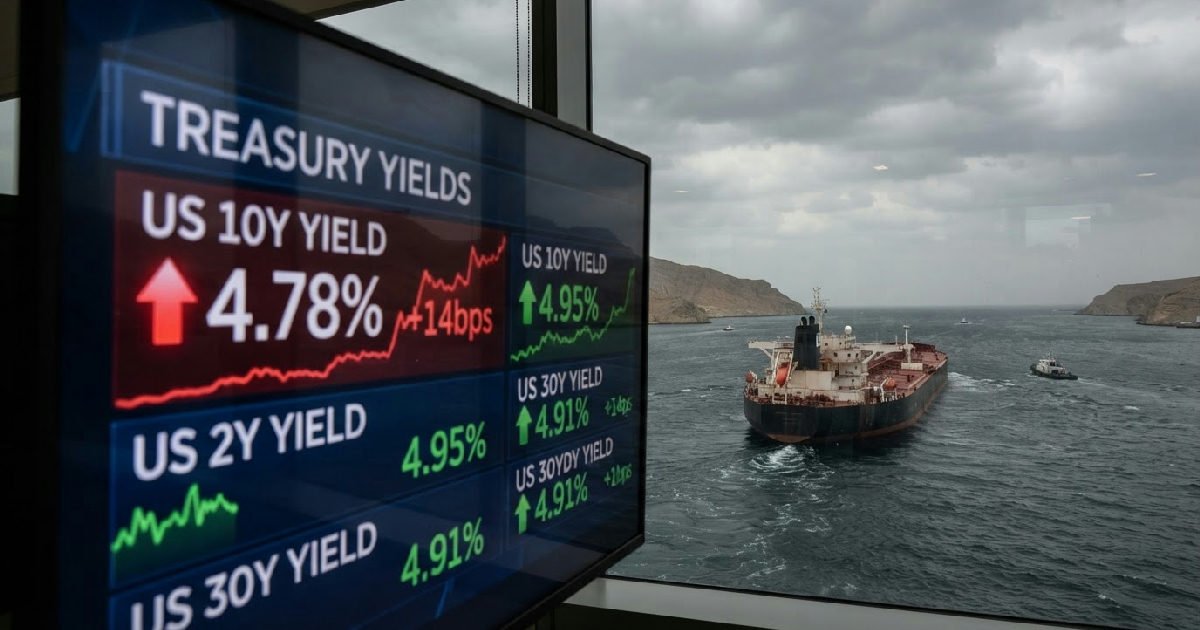
US Treasury yields surged dramatically on Tuesday, September 1, 2026, with the benchmark 10-year Treasury note hitting its highest level since January 2025. This sharp increase in borrowing costs came as renewed geopolitical tensions in the Middle East drove crude oil prices significantly higher, intensifying global inflation worries. These factors collectively led to a significant Treasury yields spike.
The escalation, marked by fresh US military strikes against Iran and a tanker attack in the Strait of Hormuz, rattled financial markets worldwide. Investors are now grappling with the potential for prolonged supply disruptions, forcing them to demand greater returns amidst heightened economic uncertainty.
Treasury Yields Spike Amid Geopolitical Instability
The 10-year Treasury note yield, a critical benchmark for various consumer loans, climbed 3 basis points on Tuesday to settle at 4.788%. This marks its highest point since January 14, 2025, signaling growing apprehension among investors.
This yield directly influences the cost of mortgages, auto loans, and credit card debt for households and businesses across the country. Its upward trajectory signals a more expensive borrowing environment that could cool economic activity.
Longer-dated maturities also experienced significant movement, reflecting broader concerns. The 30-year Treasury bond yield, which often tracks long-term economic growth and geopolitical risks, rose more than 2 basis points to 5.272%.
This figure brings the 30-year yield perilously close to a 19-year high recorded just last month. Such a rise underscores deep-seated worries about the future economic landscape and the erosion of purchasing power.
Broader Bond Market Movement
Meanwhile, the 2-year Treasury note yield, typically aligned with the Federal Reserve’s short-term interest rate decisions, advanced more than 1 basis point to 4.362%. This indicates market expectations for further monetary policy tightening in response to persistent inflationary pressures.
Other Treasury yields also showed upward pressure on September 1, 2026. The 1-month yield stood at 3.752%, the 3-month at 3.867%, and the 6-month at 4.023%. The 1-year yield reached 4.156%.
This widespread increase reflects a broad bond market sell-off, where investors are demanding higher returns for holding government debt. It implies a shifting risk perception in fixed-income assets globally.
Middle East Tensions Drive Oil Prices Higher
The immediate catalyst for Tuesday’s bond market volatility was a renewed surge in Middle East tensions. US forces launched fresh strikes against Iran, exacerbating regional instability.
Further escalating the situation, a tanker was reportedly struck by unknown projectiles off the coast of Oman in the strategically vital Strait of Hormuz. President Donald Trump has also warned Iran of more potential strikes, indicating a prolonged period of conflict.
This renewed hostility sent global oil prices soaring, directly impacting inflation expectations. Energy costs are a significant component of inflation metrics, and their rise often translates to higher prices across the economy.
West Texas Intermediate (WTI) crude futures were seen more than 1% higher, trading above $87 per barrel. Brent crude, the international benchmark, also advanced by over 1% to surpass $92 per barrel on Tuesday.
Major oil contracts had already settled up nearly 3% on Monday, August 31, 2026, as markets reacted to initial reports of the escalating conflict. This sustained increase suggests traders are pricing in continued supply risks from the region.
Mounting Inflationary Pressure and Fed Response
Persistent inflation worries, exacerbated by surging oil prices, are keeping central banks firmly in focus. Ulrike Hoffmann-Burchardi, UBS Chief Investment Officer of the Americas and global head of equities, noted that “Yield volatility is likely to persist in the near term.”
She highlighted the ongoing uncertainty over the Federal Reserve’s policy outlook, fiscal concerns, and rising AI-related debt issuance as key factors. The lack of a clear path to reopening the Strait of Hormuz after six months of conflict also contributes significantly to elevated inflation worries.
Sean Simko of SEI Investments Corp., who oversees fixed-income investment management, suggested the Fed is “ready to act when needed.” He cautioned that a steady labor market combined with elevated inflation would likely compel the Federal Reserve policy to lean into raising interest rates further.
Alyce Andres, Macro Strategist at Markets Live, echoed these concerns, stating that the bond market is signaling that rates will continue to climb this week. This surge is largely attributed to the confluence of rising oil prices, supply chain issues, and upcoming economic data releases.
The commentary from these experts underscores a growing consensus that the economic environment is becoming more challenging. It also suggests that central bankers face difficult decisions in balancing growth against inflation.
Federal Reserve’s Policy Crossroads
Federal Reserve Chairman Kevin Warsh’s recent appearance at the Jackson Hole Symposium previously sent short-maturity yields jumping. He pointed to a higher likelihood of rate hikes aimed at curbing price pressures.
Following Warsh’s remarks, prominent financial institutions like Barclays and Societe Generale shifted their forecasts. They are now calling for rate hikes this year that they hadn’t previously expected, reflecting a more hawkish outlook for monetary policy.
Economic Watch: G20 Meeting and Key Data
Beyond geopolitical events and oil markets, investors are closely monitoring several critical economic data releases and meetings. The G20 finance ministers’ meeting in Asheville, North Carolina, is set to conclude later on Tuesday, September 1, 2026.
The agenda for the G20 meeting included modernizing financial regulation, strengthening understanding of global imbalances, and facilitating debt restructuring. US Treasury Secretary Scott Bessent had also announced intentions to sanction another Iranian bank, part of “Operation Economic Outcast.”
Upcoming domestic economic data includes the ISM Manufacturing PMI print and the Job Openings and Labor Turnover Survey. Nonfarm payrolls figures are expected on Friday, providing crucial insights into the labor market’s health.
The August jobs report and consumer prices, due on September 11, are considered pivotal in shaping market sentiment. These figures will heavily influence expectations for the Federal Reserve’s next policy decision on September 16.
The broad market sell-off in bonds saw nearly 244,000 December 10-year note futures change hands in a single minute. Options desks also saw significant demand for protection in long-duration Treasuries, including an estimated $6.5 million buy of December options as global bond yields continue to rise.
The confluence of Middle East instability, soaring oil prices, and hawkish signals from central bankers paints a complex picture for the global economy. As borrowing costs climb, the challenge for policymakers will be to manage inflation without stifling economic growth.
Investors remain on edge, awaiting further developments on both geopolitical and economic fronts. The expectation is for continued market volatility as these powerful forces play out in the coming weeks and months.