

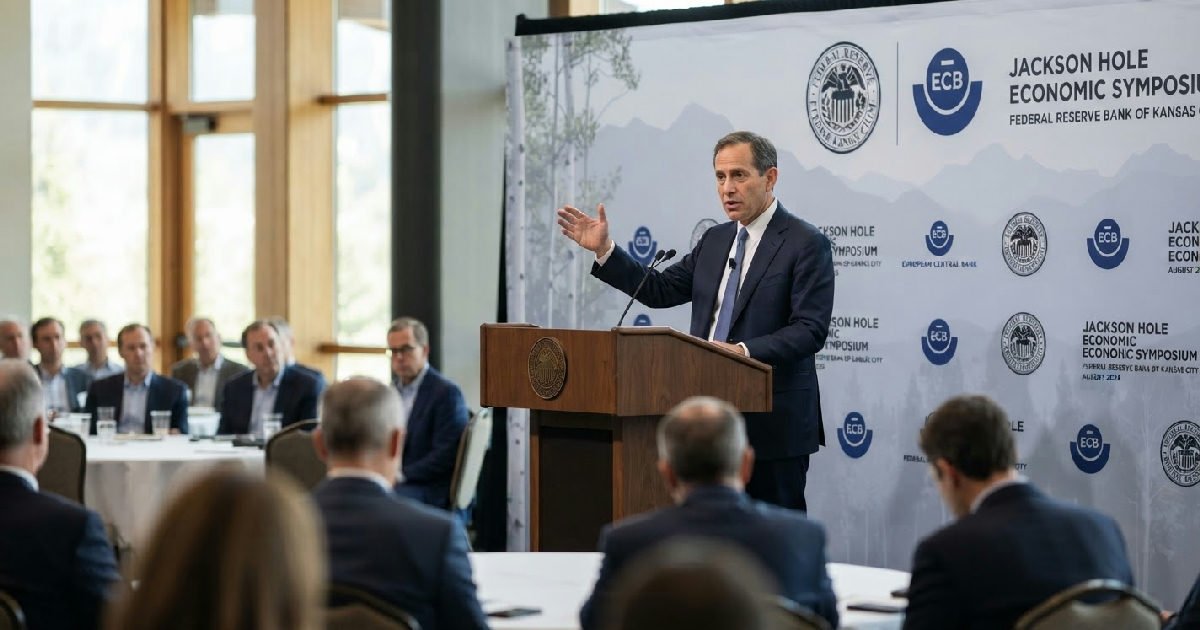
Fed Chair Kevin Warsh signals end to forward guidance, warns on inflation
Federal Reserve Chairman Kevin Warsh signaled a significant shift in the central bank’s communication strategy in his first major address. He expressed deep concern about persistent inflation and called for an end to the era of detailed forward guidance for markets.
Speaking Friday at the annual Jackson Hole Economic Symposium in Wyoming, Warsh made it clear that taming high prices is his top priority. This approach pivots the Fed away from the explicit policy signaling that defined his predecessor’s tenure.
A firm stance on persistent inflation
The speech was the most anticipated event at the symposium, an exclusive gathering of about 120 officials and economists from over 70 countries. The high-stakes test for Warsh comes just over 100 days into his term, which began amid a challenging economic environment of stubborn inflation and rising bond yields.
While acknowledging that recent inflation readings were better than expected, Warsh pushed back against any notion that the fight against rising prices was over. He stated that the summer data did not convince him that “underlying trends have meaningfully improved.” Current 12-month Personal Consumption Expenditures (PCE) inflation sits at 3.7%, well above the Fed’s 2% target.
Warsh was resolute in his commitment. “We must be confident that underlying inflation is moving to our objective, clearly and at sufficient speed. Otherwise, we have work to do,” he declared.
“That’s our job, our mandate and our charge to keep.” This hawkish tone reinforces comments he made in July to the House Financial Services Committee. He stated then that policymakers have “no tolerance for persistently elevated inflation.”
The data underscores his concern. Even with some cooling, 54% of goods and services in the PCE basket still show price increases above 3% over the last year.
While this is down from post-pandemic highs, it remains significantly above the 32% average observed in the two decades before the pandemic. Following his speech, Treasury yields moved higher. Traders increased the probability of a September rate hike.
Fed Chair Kevin Warsh’s call for a quieter central bank
The most significant policy departure outlined by Warsh is his desire for a central bank that is quieter and more purposeful in its communications. He directly criticized the practice of forward guidance—verbal cues about the Fed’s future intentions—which became a staple of central banking after the 2008 financial crisis.
“You can call it an outline. You can call it a trail map, just don’t call it forward guidance,” he quipped, suggesting the practice has overstayed its welcome.
His predecessor, Jerome Powell, spoke at last year’s event. Warsh, however, is charting a significantly different course.
His argument is that excessive hand-holding encourages a dependency that is unhealthy for markets and the economy. “We should not indulge a regime in which market participants are looking primarily to the Fed for their next trade,” Warsh argued. The goal is to force investors to focus on underlying economic data, not on parsing the Fed’s every word for clues.
A departure from the norm
This approach marks a return to a pre-financial crisis style of central banking, where the Fed was more guarded in its public statements. Warsh believes that outside of a crisis, explicit guidance can increase the risk of policy errors and distort the relationship between the market and the central bank. The shift aims to restore a more traditional dynamic.
Resisting pressure for a new rulebook
Since taking the helm, Warsh has been criticized by some market participants for being cagey about his policy framework. Investors, accustomed to clear signals, have been looking for a “reaction function”—a specific set of economic conditions that would trigger a policy response, such as a rate hike or cut. Warsh directly addressed and rejected this call.
“Surely, he should tell us his interest rate path—if, say, the data were to come in hot or cold,” he said, acknowledging the criticism.
He specifically asked whether the Fed should provide a specific rule it would follow. Warsh asserted, however, that “our knowledge just doesn’t extend that far—at least not yet.”
He noted that factors relevant to monetary policy change over time.
He defended his position by emphasizing the limits of economic forecasting. “Our knowledge just doesn’t extend that far—at least not yet,” he stated.
He added that with global geopolitics, supply chains, and technology changing so fast, it’s wise to be modest about what can and cannot be known.
This refusal to commit introduces a level of uncertainty that markets haven’t faced in years, potentially leading to varied outcomes.
The economic backdrop and internal reforms
Warsh inherits a complex economic situation. The unemployment rate is at 4.1%.
In his first two policy meetings, the Fed has held interest rates steady in a 3.50% to 3.75% range. The rate-setting Federal Open Market Committee (FOMC) appears sharply divided.
Roughly half of its 19 members forecast higher rates by year-end, with the other half favoring no change or even cuts.
External factors complicate the picture further, including a renewed conflict in the Middle East that has driven up oil prices. This threatens to reverse recent progress on inflation.
At the same time, Warsh indicated the economy appears to have strengthened, citing resilient business and consumer spending. He also pointed to the economic benefits from AI investment.
To navigate this landscape, Warsh has already initiated significant internal reviews. He has launched five task forces to examine the Fed’s functions.
These functions include communications, data analysis, inflation modeling, and its massive balance sheet. “I am not waiting to introduce innovations at the Fed to make us fit for purpose,” he said.
This signals his intent to remake the institution from within.
What this means for markets and the global economy
The Warsh doctrine represents a new chapter for the world’s most powerful central bank. For investors and corporate executives, it means the training wheels are off.
The heightened uncertainty will require a much deeper focus on fundamental economic indicators rather than simply anticipating the Fed’s next move. Volatility may increase as markets learn to operate with less direct guidance.
The shift could also have a profound impact globally. For years, central banks around the world have often moved in lockstep with the Fed. A less vocal and predictable Fed might empower other monetary authorities to chart their own courses based on local conditions, potentially leading to a greater divergence in global monetary policy.
Ultimately, Warsh is betting that a more disciplined, data-driven, and less talkative Federal Reserve will be more effective in the long run.
His primary message from the mountains of Wyoming is that the central bank’s credibility rests not on its promises, but on its results. For him, the first and most important result is delivering price stability. The work, as he noted, is far from over.