

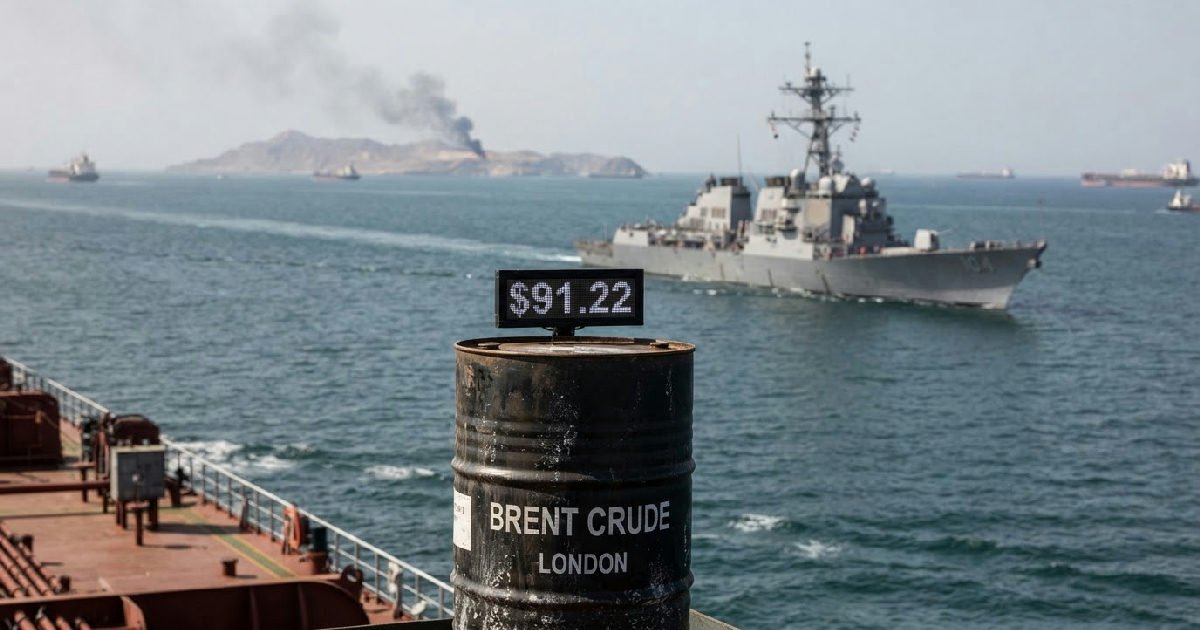
Global Oil Prices Hit $91 After US, Iran Clash in Hormuz Strait
Global oil prices surged on Monday, August 31, 2026, with Brent crude climbing past $91 a barrel, after direct military engagements between the United States and Iran. This first confrontation in a month reignited fears over energy supply stability in the vital Strait of Hormuz.
The escalation began on Sunday, August 30, with U.S. forces striking Iranian rocket launchers on Larak Island. Iran retaliated on Monday by launching missiles at U.S. bases in Jordan and the United Arab Emirates. Brent crude futures rose 3.4% to $91.22 per barrel, with WTI up 3.4% to $86.20, injecting significant geopolitical risk.
The escalation unfolds and its impact on global oil prices
The latest flare-up commenced when the U.S. military launched missile and drone attacks on Larak Island, located within the Strait of Hormuz. U.S. Central Command (CENTCOM) confirmed the strikes on Sunday, August 30, targeting what they described as Iranian Revolutionary Guard Corps (IRGC) forces preparing to deploy sea mines.
U.S. Central Command (CENTCOM) justified the preemptive strike, stating that Iranian Revolutionary Guard Corps (IRGC) forces were observed preparing to launch rockets with sea mines into the Strait of Hormuz. Capt. Tim Hawkins serves as a CENTCOM spokesperson, and Admiral Brad Cooper is the CENTCOM commander. Such geopolitical instability often creates ripple effects, with broader market movements sometimes influencing long bond yields.
Iran, however, quickly condemned the U.S. action, claiming it resulted in military and civilian casualties. The Iranian Revolutionary Guard Corps announced its retaliation on Monday, August 31, firing ballistic missiles at U.S. bases in Jordan, specifically King Hussein and Al-Azraq airbases.
Reports also indicated that Iran deployed drones against Al Minhad airbase in the United Arab Emirates. Jordan’s army confirmed intercepting eight missiles aimed at its territory, preventing further escalation of direct impact.
Economic Pressures and Geopolitical Dynamics
The recent exchange of fire underscores the fragility of relations between Washington and Tehran, perpetually strained by economic sanctions and regional proxy conflicts. U.S. Treasury Secretary Scott Bessent suggested that Iran’s aggressive posture was largely a response to sustained economic pressures.
Iranian Foreign Minister Abbas Araghchi, conversely, stated that diplomacy had become impossible due to perceived U.S. intransigence and demands. This stalemate leaves little room for de-escalation through diplomatic channels in the immediate term.
President Donald Trump has maintained a firm stance against Iran, frequently citing the need to curb its nuclear ambitions and regional influence. Iranian President Masoud Pezeshkian is a key figure in Iran’s leadership.
The broader geopolitical landscape in the Middle East remains tense, with various regional actors watching the U.S.-Iran dynamic closely. Any miscalculation could easily draw in other nations, further destabilizing global energy markets and supply chains.
Impact on Global Energy Markets
The Strait of Hormuz, where the U.S. strikes occurred, is the world’s most strategically critical maritime chokepoint. It links the Persian Gulf with the Gulf of Oman, making it indispensable for the transit of a significant portion of global crude oil.
A significant portion of global crude oil passes through this narrow waterway daily. Disruptions here send immediate shockwaves through the global economy, directly impacting prices for Brent crude oil, a leading international benchmark.
The oil market remains highly sensitive to any perceived threats to supply, especially from the Middle East. News of renewed conflict quickly translates into higher prices as traders factor in potential shortages and insurance costs for shipping.
The Organization of the Petroleum Exporting Countries and its allies (OPEC+) have long aimed to stabilize the market through supply adjustments. However, geopolitical events of this magnitude often override their efforts, highlighting the inherent volatility of energy prices.
The interconnectedness of the global economy means that such geopolitical events can create ripple effects across diverse financial instruments. While not directly tied to oil price movements, broad market instability often spurs investor caution, even impacting emerging assets like those in Ethereum exchange reserves.
Outlook: What Comes Next for Oil Markets
The immediate aftermath of this U.S.-Iran confrontation points to continued volatility in crude oil prices. Investors and analysts will closely watch for any further military actions or diplomatic overtures from either side.
Any prolonged period of heightened tensions could push Brent crude well beyond its current $91 mark. The primary concern is that the Strait of Hormuz could become a flashpoint, leading to restrictions or even temporary closures of shipping lanes.
Such a scenario would have severe implications for energy importers worldwide, driving up costs for consumers and businesses alike. Countries heavily reliant on Middle Eastern oil would be particularly vulnerable to these supply disruptions.
While both Washington and Tehran have historically shown a reluctance for full-scale conflict, the current exchange of fire represents a dangerous escalation. The risk of unintended consequences remains high, especially in such a strategically vital region.
This renewed instability highlights the persistent challenges in global energy security. Diversification of global energy sources often arises as a key strategy to mitigate such risks, though current geopolitical events underscore the immediate focus on Middle Eastern dynamics. International diplomacy frequently explores options for oil agreements to stabilize supply.
Market participants will now look for clearer signals regarding the political will to de-escalate. Without a significant reduction in tensions, global oil prices are likely to remain elevated and subject to abrupt changes.