

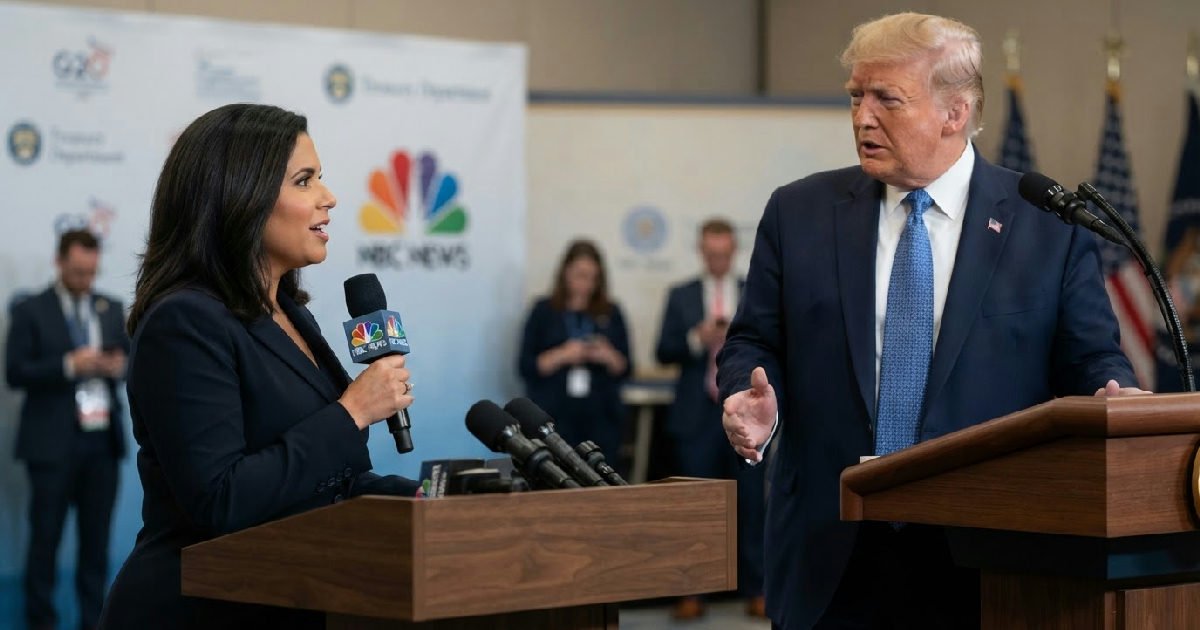
Donald Trump threatens FCC action against Kristen Wel
President Donald Trump launched a fresh offensive against the news media on Sunday, August 30, threatening federal action against NBC News host Kristen Welker for her election commentary. This escalation coincided with the U.S. Department of the Treasury’s controversial decision to deny G20 credentials to several prominent economics reporters. The moves collectively highlight the administration’s continued adversarial stance towards independent journalism.
The former president’s criticism of Welker centered on her remarks concerning his endorsed candidates’ electoral performance. Meanwhile, the Treasury Department’s actions prevented journalists from The New York Times, The Wall Street Journal, and Bloomberg News from covering crucial G20 finance meetings in Asheville, North Carolina. Both incidents underscore persistent tensions between the administration and major news outlets, challenging long-held norms of press access.
Trump targets NBC over Kristen Welker’s election commentary
Donald Trump publicly lambasted Kristen Welker, host of NBC News’ “Meet the Press,” over comments she made about his endorsed candidates. On Sunday, August 30, Trump took to Truth Social. He called Welker “the Unpopular ‘Hostess’ of” the program and suggested her remarks constituted a “deliberate inaccuracy” warranting intervention.
Welker had stated that Trump experienced “mixed results” with candidates he supported in this election cycle. The former president disputed this claim, asserting a “99% SUCCESS Rate on Endorsements.” He also specifically claimed “100% on Senatorial Endorsements,” citing Darlene Graham’s U.S. Senate primary victory and Mike Mazzei’s success in the Republican primary for the Oklahoma governor nomination as examples.
But reports also showed some of his endorsements faltered. Florida Congressman Cory Mills lost his Republican primary to Ryan Elijah, a television host. Similarly, Tennessee Congressman Andy Ogles was defeated by former state agriculture commissioner Charlie Hatcher. Amir Hassan of Michigan also failed to secure a House seat despite Trump’s backing, highlighting a mixed electoral landscape.
Trump’s ire led him to threaten reporting Welker to the Federal Communications Commission (FCC) for “rebuke or punishment.” He stated Welker would be “referred” to the FCC for a reprimand or punishment, urging FCC Chair Brendan Carr and other commission members to take the matter seriously. This public threat extends his pattern of challenging media narratives and his broader stance on press access.
The FCC’s role in media scrutiny
Trump urged FCC Chair Brendan Carr and other commission members to seriously consider his complaint. This isn’t the first time Trump has called for FCC intervention against networks critical of his administration. Last year, he threatened NBC and ABC with fines or even removal from the airwaves over their coverage and polling results.
Critics argue that the FCC has become increasingly politicized during Trump’s second term. Brendan Carr has shown a willingness to act on perceived media bias, contributing to these concerns. Disney and ABC previously sued the FCC, alleging an unconstitutional “retaliatory campaign” by the Trump administration, further underscoring the politicization.
Treasury Department curbs G20 reporting
Concurrently with Trump’s public broadside, the U.S. Department of the Treasury denied credentials to several economics reporters. Journalists from The New York Times, The Wall Street Journal, and Bloomberg News were barred from attending this week’s G20 meetings. These critical finance meetings are taking place in Asheville, North Carolina, and attract global attention.
Alan Rappeport, a New York Times economic policy reporter who covers the Treasury, was among those excluded. He has routinely attended G7 and G20 meetings since 2017, participating in nearly a dozen such events without issue. Matt Grossman, an economics reporter for The Wall Street Journal, also faced credential denial, prompting questions about transparency.
Nicole Taylor, a spokesperson for The New York Times, sharply condemned the decision. She called it “not just another disturbing effort by the administration to undermine independent journalism.” Taylor added that it was “a blatant attempt to evade public scrutiny” of the G20 proceedings, impacting essential reporting.
Treasury officials have not offered a clear explanation for these denials. However, approximately 200 journalists from dozens of countries are still expected to cover the gathering of finance ministers and central bank governors from the world’s largest economies. The news organizations themselves were not barred outright, but specific reporters were denied credentials.
Treasury market activity and G20 discussions are typically covered by a wide array of financial journalists. The move sparked further criticism from commentators. Jack Marsh, via Facebook, characterized the selective exclusion as “another attack on a free and independent press.” He emphasized its impact on “the public’s right to know,” particularly if no legitimate reasons are provided for the denials.
A pattern of press antagonism
These latest incidents fit within a broader history of President Trump’s combative relationship with the news media. Throughout his political career, he has frequently labeled critical outlets as “fake news.” He has often attacked individual journalists and news organizations directly, shaping public perception of the press.
The administration has also consistently sought to limit media access and control narratives. Trump has long had an adversarial relationship with the press, repeatedly attacking journalists and news organizations and seeking to limit media access. This continuous tension marks a defining characteristic of his public engagement with journalism.
Early in his first term, Trump also faced scrutiny over his administration’s approach to the media. His repeated challenges to established journalistic practices set a precedent for future interactions. This environment often forced news organizations to adapt their reporting strategies, emphasizing the ongoing struggle for unobstructed reporting. The administration’s approach to international diplomacy has also seen direct challenges to established norms.
The administration’s ongoing disputes with the media are not isolated. For example, Trump previously threatened NBC and ABC with fines or going off the air over coverage of his administration and polling results. These instances underscore the heightened tensions and challenges faced by media organizations attempting to cover the Trump administration.
Implications for media freedom
The actions taken on August 30 raise serious questions about press freedom and government transparency. Denying access to specific reporters, without clear justification, could establish a troubling precedent. It suggests a potential for politically motivated exclusion, which jeopardizes public insight.
Such measures could deter critical reporting from other journalists and news organizations. Reporters might feel pressured to self-censor to maintain access, undermining their independence. This chilling effect undermines the media’s essential role in holding power accountable and informing citizens.
Moreover, threatening federal agencies like the FCC against news outlets poses a threat to free speech. The FCC, traditionally focused on technical regulations, has seen its role expand under political pressure. This shift fuels concerns about government overreach into editorial decisions and broadcast content.
The ongoing disputes also highlight broader societal divisions regarding media credibility. Public trust in institutions, including the press, remains a contentious issue in the current political climate. These events deepen existing polarization around media narratives and challenge the very definition of objective journalism.
The road ahead for press relations
The current climate suggests a continued struggle for unobstructed press access, impacting how critical information reaches the public. Journalists will likely face ongoing challenges in covering official events and obtaining vital information. Their ability to scrutinize government actions could remain constrained, affecting public oversight.
The push for transparency from media organizations will persist despite these obstacles. They will continue to advocate for open access and defend the role of independent reporting vigorously. Legal and ethical challenges to access restrictions are probable, as news outlets seek to uphold their mandate.
For the public, discerning credible information will remain paramount in this contentious environment. The administration’s approach forces news consumers to critically evaluate sources and narratives. This demands greater media literacy in an increasingly complex information landscape, making informed decisions more challenging. The debate over the media’s role in a democratic society shows no signs of abating.