

China Blocks G20 Communiqué Consensus, US Acts
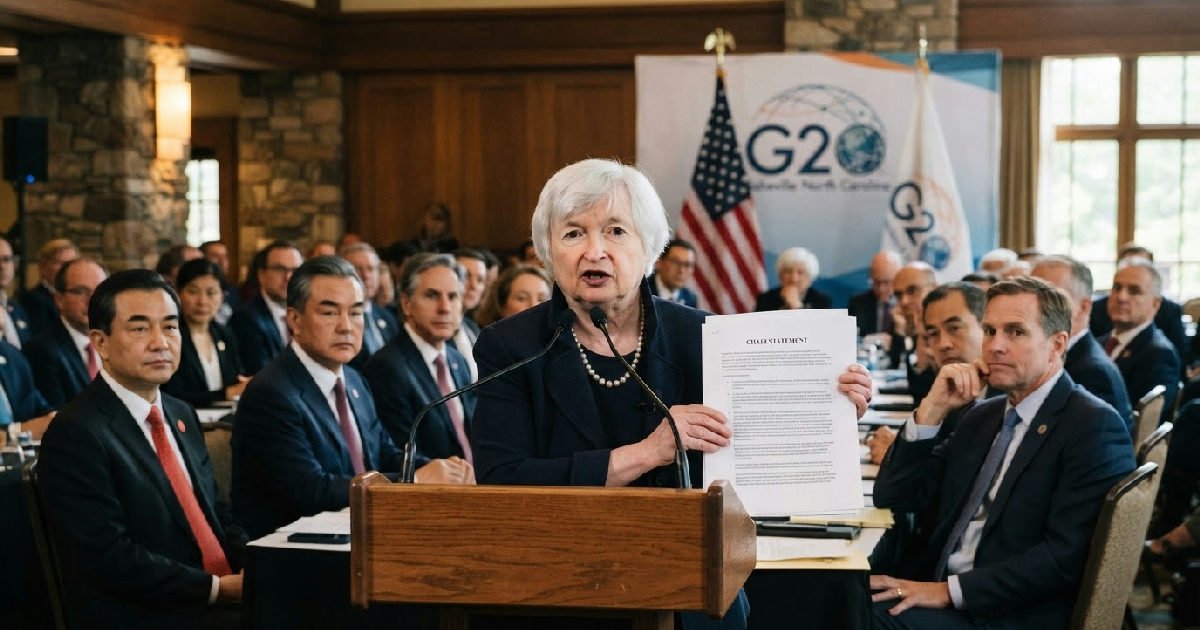
China thwarted efforts to achieve a joint communiqué at the G20 finance ministers and central bank governors meeting, held recently in Asheville, North Carolina. This diplomatic snag, which unfolded on September 1, 2026, forced the United States, as host, to issue its own “chair statement” rather than a consensus document from all members.
The move by Beijing underscores deepening global divisions over economic policy and trade practices. The core disagreements centred on language addressing China’s “non-market policies and practices” and its substantial trade surpluses, which other nations view as contributing to global imbalances.
Quan điểm Trung Quốc trong China G20 communiqué
The G20 gathering at the Omni Grove Park Inn concluded with 19 out of 20 member countries endorsing the U.S. chair statement. China, however, remained the lone dissenter, effectively blocking the traditional joint communiqué.
U.S. Treasury Secretary Scott Bessent, alongside Federal Reserve Chairman Kevin Warsh, presided over the meeting. Bessent expressed his initial hope for a “unanimous joint communiqué,” acknowledging that “one member” prevented a complete consensus.
Beijing’s objections were broad, targeting several key areas within the draft document. China specifically opposed wording that called for concrete steps to eliminate “non-market policies and practices.” Many G20 members argue these policies exacerbate global trade imbalances, creating unfair competitive advantages.
Furthermore, China resisted language on ensuring the smooth functioning of global supply chains for essential goods. This included energy, food, fertilizer, and critical minerals, areas of increasing geopolitical and economic concern.
The Chinese delegation also pushed back against calls for the International Monetary Fund (IMF) and the Organisation for Economic Co-operation and Development (OECD) to improve data used for analyzing these non-market policies.
Escalating Trade Imbalance Concerns
A major point of contention was China’s significant trade surplus. U.S. Treasury Secretary Scott Bessent was unequivocal in his assessment, stating that “The world cannot have a China with a $1.2 trillion trade surplus.”
This figure highlights the scale of the economic imbalance at the heart of the dispute. Beijing’s trade surplus with the European Union alone is projected to reach 360 billion euros in 2025.
Bessent emphasized that “A durable global economy cannot rest on beggar-thy-neighbor acts that stifle fair market-based competition.” He stressed the unsustainability of “non-market based economies pushing out a never-ending stream of cheap exports.”
An unnamed senior U.S. official echoed this sentiment, questioning why China resisted the proposed language. “They are guilty,” the official remarked, adding that “If we are worried about persistent distortions, they are the worst offenders.”
Geopolitical Undercurrents and Supply Chain Friction
Beyond trade, geopolitical sensitivities also played a role in the impasse. China objected to references regarding “predictable navigation through the Strait of Hormuz.”
Observers suggest this resistance likely stems from concerns over the implications for other strategic waterways, such as the Taiwan Strait and the South China Sea. These maritime routes are crucial for global trade and are frequently at the center of international disputes.
Beijing additionally pushed back on language related to export overcapacity. It also opposed support for the Common Framework on debt treatment and specific wording concerning sovereign debt restructuring.
The continuous efforts by China to “slow things down and methodically change the nomenclature” were noted by a senior U.S. official. Such tactics indicate a strategic approach to shaping international economic discourse.
A senior European Commission official described the outcome as a “lost opportunity for the global economy.” This sentiment underscores the frustration among nations seeking unified approaches to complex economic challenges.
The Stakes for Global Economic Stability
The failure to reach a consensus on the G20 communiqué signals growing tensions that could impact global economic stability. While 19 nations agreed to the chair statement, China’s outright rejection limits the collective force of the G20 as a forum for economic policy coordination.
This impasse could complicate efforts to address pressing global issues, from climate finance to emerging market debt. The G20 traditionally aims for unanimous declarations, and a splintered outcome weakens its perceived authority.
The U.S. Treasury Secretary highlighted the unified stance of the other 19 nations. “I think that the fact that 19 countries did want to address this shows the sheer enormity of the problem and that we agree,” Bessent noted.
This robust agreement among the majority of G20 members indicates a broad understanding of the challenges posed by China’s economic practices. The consensus suggests widespread concern, even without Beijing’s official endorsement.
The discord also raises questions about the future effectiveness of multilateral economic forums in a increasingly multipolar world. When major economic powers cannot agree on foundational principles, finding common ground on complex challenges becomes much harder.
Path Ahead for G20 Diplomacy
Despite the setback in Asheville, the G20’s schedule of meetings will continue throughout 2026. These gatherings will offer further opportunities for dialogue and potential resolution, though the path promises to be difficult.
Key upcoming events include the G20 Foreign Ministers’ Meeting in Atlanta, Georgia, from October 30-31. Following this, the G20 Leaders’ Summit is slated for December 14-15 at the Trump National Doral Miami in Florida.
Other ministerial meetings also dot the calendar, including the G20 Innovation Ministerial in Raleigh-Durham, North Carolina, and the G20 Energy Abundance Ministerial in Houston, Texas, both in September. The G20 Trade Ministerial will take place from September 30 to October 1 in Milwaukee, Wisconsin.
The U.S. decision to issue a chair statement, rather than allowing the meeting to conclude without any formal declaration, shows a determination to move forward. This approach maintains a record of the majority’s position, even in the face of persistent economic tensions.
The challenge for these upcoming G20 sessions will be to bridge the widening chasm exposed by this latest communiqué failure. Without China’s participation in a joint statement, the G20’s ability to project a unified front on global economic governance remains severely hampered.
The incident also puts pressure on other major economies to reassess their strategies for engaging with China on trade and economic policy. It marks a clear indication that traditional consensus-building mechanisms are under strain.