

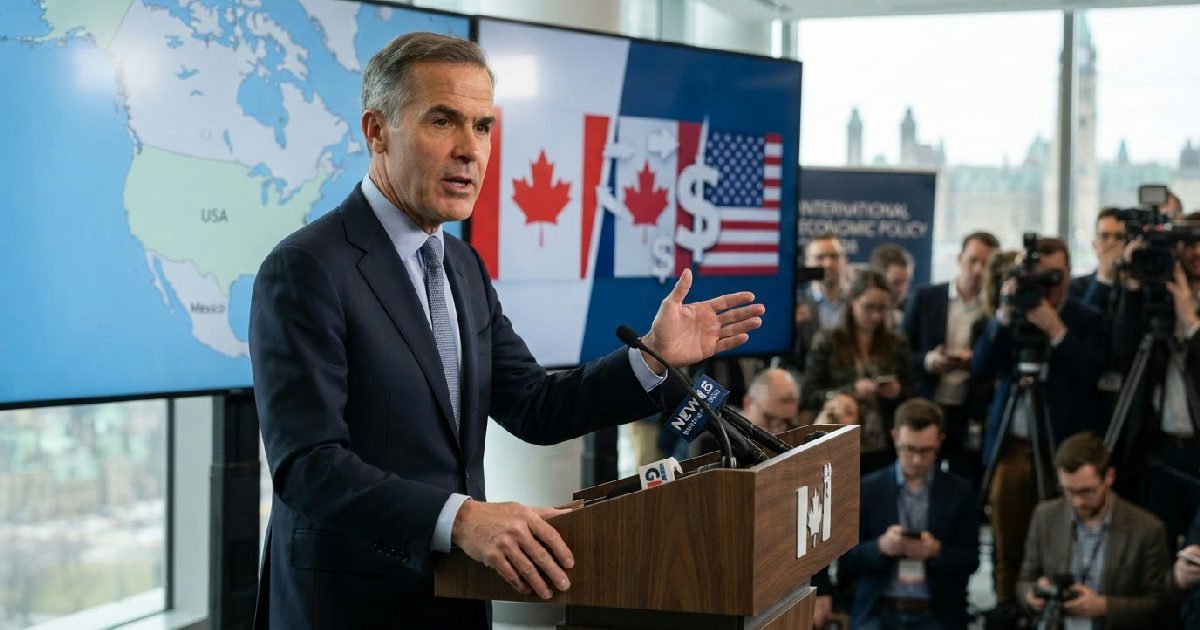
Canada Hits Back with ‘Dollar for Dollar’ Tariffs as US Trade Talks Collapse
Canada will impose retaliatory, “dollar for dollar” tariffs on American goods after last-ditch trade talks with the United States collapsed late Friday night. The move came after the Trump administration proceeded with a new 50% tariff on roughly C$28 billion (US$20 billion) worth of Canadian exports, which took effect at midnight on Saturday, August 22, 2026.
Canadian Prime Minister Mark Carney announced the suspension of negotiations and recalled his chief negotiators from Washington, D.C., on Friday, August 21, 2026. He blasted the U.S. for proposing “last-minute changes” that he deemed “unfair, uneconomic, and called into question the reliability of any deal.” The breakdown marks a severe escalation in trade hostilities between the two closely allied neighbours.
Understanding the Canada US Tariffs
The decision to walk away from the table followed nearly two weeks of intense but ultimately fruitless negotiations in the American capital. Canada-U.S. Trade Minister Dominic LeBlanc and chief negotiator Janice Charette had been trying to find a compromise to avert the new wave of duties. President Donald Trump had initially paused the tariffs for three days to allow talks to continue.
In his statement, Prime Minister Carney made it clear that Canada felt it was being strong-armed into an unacceptable agreement. “In recent weeks, we made important progress toward improving Canada’s position,” he said, adding, “However, that progress has not been enough to meet our objectives for Canadians.”
He specifically cited “last-minute changes in the US proposed terms” as the reason for the failure. The U.S. administration, however, presented a starkly different narrative. U.S. Trade Representative Jamieson Greer accused Canada of sabotaging a near-final agreement.
“Tonight, Canada declined to finalise the trade deal under the terms agreed earlier this week,” Greer stated late Friday. He claimed “new demands and walkbacks of other commitments by Canada have upended the careful balance reached in the past days,” calling it a “missed opportunity for Canada.”
This sharp divergence in accounts highlights the deep erosion of trust between the two administrations, unlike the successful conclusion of some last-minute trade targets in other arenas.
Economic fallout from new tariffs
The new 50% tariff imposed by the U.S. is a significant blow, targeting a wide range of Canadian goods. The punitive rate threatens to cripple specific industries and the communities that depend on them.
While the US$20 billion in affected exports represents only about 5% of what Canada ships to its southern neighbour annually, the two nations traded a colossal $880 billion in goods and services in 2025, making them one of the world’s most integrated economic partnerships.
Before talks imploded, negotiators were reportedly closing in on a deal that would have seen significant concessions. Reports suggested the U.S. was considering reducing its tariffs on Canadian steel and aluminum from 50% down to 25%, and on automobiles from 25% to 15%.
That a potential compromise was in sight makes the final collapse all the more jarring for businesses caught in the crossfire. Canada has not yet released a specific list of U.S. products that will be hit with retaliatory duties.
However, former finance minister and current Liberal leadership contender Chrystia Freeland gave a clear indication of the country’s strategy in January 2025. She stated, “Being smart means retaliating where it hurts… Our counterpunch must be dollar-for-dollar.” This approach suggests Canada will target politically sensitive products to maximize pressure on Washington.
Canadian unity in response to tariffs
The aggressive stance from the United States has produced a rare moment of political unity in Canada. Shortly after the Prime Minister’s announcement, Ontario Premier Doug Ford, often a political rival, offered his unqualified backing. “The prime minister has my full support for a strong response—tariff for tariff, dollar for dollar,” Ford declared.
Ford added, “As we fight to protect Canadian sovereignty and economic security, everything needs to be on the table. Ontario is ready to do its part.” This cross-party solidarity strengthens the federal government’s hand, signalling to Washington that Canada will not be easily divided.
Public anger in Canada is also palpable. A petition to expel U.S. ambassador to Canada, Pete Hoekstra, has gathered approximately 248,000 signatures. This reflects a widespread sense of frustration with the Trump administration’s approach.
An irreversible shift in relations
For many observers, this latest trade battle is more than just a temporary dispute; it signals a permanent recalibration of the Canada-U.S. relationship. The notion of a predictable and stable partnership, long the bedrock of North American prosperity, has been shattered. The Trump administration’s use of tariffs as a primary negotiating tool has repeatedly sparked chaos in various trade sectors.
President Trump’s history of applying beef import tariffs, for instance, illustrates this broader pattern of aggressive trade tactics. Such actions highlight a significant shift in U.S. trade policy towards key partners.
Prime Minister Carney himself seemed to acknowledge this new reality, remarking that “America has changed” and that the two countries would not be returning to their old, more collegial relationship. This sentiment suggests future dealings will be more guarded and transactional, a stark departure from decades of close cooperation on economic and security matters.
The immediate path forward is one of uncertainty and economic pain for both nations. With negotiations suspended indefinitely, businesses on both sides of the 49th parallel are now forced to navigate a landscape of escalating costs and unpredictable supply chains. The “dollar for dollar” fight is on, and it’s unclear when, or how, it will end.