

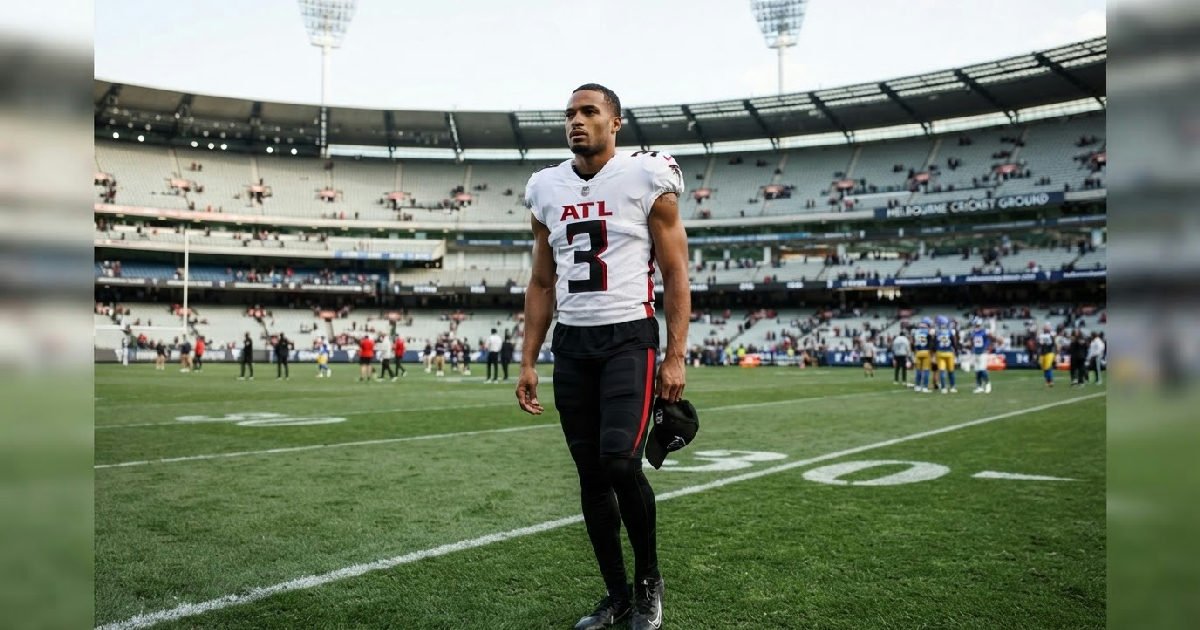
49ers Last-Minute Trade Targets All-Pro Safety Jessie Bates III
The San Francisco 49ers are exploring a potential 49ers last-minute trade to acquire All-Pro safety Jessie Bates III from the Atlanta Falcons before the 2026 NFL regular season kicks off. General Manager John Lynch wants to bolster the secondary before the team opens against the Los Angeles Rams on September 10 in Melbourne, Australia.
This defensive urgency intensified as star pass rusher Nick Bosa recovers from a second ACL reconstruction. Although Head Coach Kyle Shanahan described Bosa’s recent practice absence as soreness and tendinitis, orthopedic specialists warn that revision recoveries can be unpredictable. Consequently, management continues to handle 49ers injury concerns with extreme caution.
Resolving the 49ers last-minute trade target puzzle
Recently, ESPN proposed a trade framework sending Bates and a 2028 sixth-round pick to the Bay Area in exchange for a 2027 third-rounder. While the Falcons have not officially placed Bates on the trade block, his expiring contract makes the hypothetical deal highly logical for both franchises.
Financially, taking on the final year of Bates’s contract would cost the 49ers roughly $13 million for the 2026 campaign. This price tag is highly manageable for a front office chasing another Super Bowl appearance. It allows the team to maximize its current championship window without incurring long-term salary cap penalties.
Furthermore, his pending free agency prevents his trade value from skyrocketing. Teams usually pay a premium for elite defensive backs under long-term control. A future third-round selection represents a fair compromise for an immediate defensive upgrade.
Why Jessie Bates III fits the Raheem Morris defense
The primary catalyst for this trade proposal is defensive coordinator Raheem Morris, who joined the 49ers in February 2026. Morris previously served as the head coach of the Atlanta Falcons. During his tenure there, he worked closely with Bates and built a strong professional relationship with the veteran safety.
This prior connection would help Bates bypass the typical adjustment period that stymies late-summer roster additions. Safety is a mentally demanding position requiring flawless communication and rapid pre-snap adjustments. Learning Morris’s terminology beforehand ensures Bates can contribute immediately.
Bates earned second-team All-Pro honors in 2023 after recording six interceptions and three forced fumbles. NFL coaches and executives still ranked him fifth among all safeties entering the 2026 season. His veteran presence would instantly stabilize a secondary that needs elite playmaking.
Addressing the San Francisco 49ers roster needs
Last season, the 49ers struggled against the pass, finishing 25th in expected points added allowed per dropback. While young safeties Ji’Ayir Brown and Malik Mustapha have bright futures, they lack veteran experience. Inserting Bates into the lineup provides Morris with tactical flexibility in deep coverage.
This secondary upgrade would also relieve pressure on the defensive line while Bosa regains his form. A stronger back end naturally gives the pass rush more time to reach opposing quarterbacks. This strategic synergy is crucial for a team facing a demanding early-season schedule.
The front office is already shuffling depth to accommodate key contributors. They recently drafted wide receiver De’Zhaun Stribling and signed veterans Mike Evans and Christian Kirk to boost the passing game. Meanwhile, rookie receiver Ricky Pearsall remains sidelined on the season-ending injured reserve list.
Other teams are also evaluating young talent, as seen when receiver Caleb Douglas dazzled with a spectacular catch in his Dolphins preseason debut. Lynch must decide if the 49ers have enough veteran depth to navigate a highly competitive NFC West.
Balancing the backup quarterback market and trade assets
While defense remains the priority, the 49ers’ quarterback depth chart has created unexpected trade flexibility. Former first-round pick Mac Jones was initially viewed as the clear backup to Brock Purdy. However, rookie Kurtis Rourke turned heads in the preseason opener by completing 12 of 14 passes for 101 yards.
Rourke’s impressive performance has sparked speculation that Lynch could trade Jones to recoup draft capital. While these discussions are currently analytical rather than imminent, Jones’s trade value remains high. The front office could use assets acquired from Jones to offset the draft picks traded for defensive help.
Roster depth remains a fragile commodity, and teams must handle player health with extreme care. In college football, Jaxson Dart’s blue tent complaint recently drew heavy criticism from analysts, highlighting how quickly injury storylines can escalate. San Francisco must carefully weigh the risks of trading away reliable backup depth.
Navigating the Atlanta Falcons strategic dilemma
For this blockbuster trade to materialize, Atlanta must decide on its long-term direction. The Falcons are preparing for their own campaign under new leadership. However, they may prefer to extract value from Bates now rather than risk losing him in free agency next spring for nothing.
Trading Bates would also clear the runway for young safety Xavier Watts to gain valuable starting experience. If Atlanta experiences an early-season slide, maximizing draft assets becomes a priority. Still, parting with an All-Pro safety before Week 1 remains a difficult decision for Falcons management.
San Francisco cannot afford to wait for the trade deadline to address their defensive flaws. Lynch has historically favored aggressive moves when the team’s championship window is open. Making a preemptive strike for Bates would signal to the entire locker room that the franchise is entirely focused on a Super Bowl run.
Assessing alternative defensive targets like Vita Vea
Bates is not the only high-profile defender linked to the Bay Area in recent weeks. Rumors have also circulated regarding San Francisco’s interest in Tampa Bay Buccaneers defensive tackle Vita Vea. Vea’s elite run-stopping power and legitimate interior pass-rush ability would transform an already formidable defensive front.
However, acquiring Vea would require a significantly larger package of draft capital. Reports suggest Tampa Bay would demand at least a second-round pick plus an active player. For a front office that traded out of the first round in the 2026 draft to conserve assets, that price tag may prove too steep.
Bates represents a much more surgically precise and cost-effective acquisition. While a dominant defensive tackle is always valuable, the secondary is where the immediate statistical weakness lies. Prioritizing Bates allows Lynch to patch the most glaring hole on the roster without mortgaging the team’s future.
High stakes for the season opener in Melbourne
The decision to pursue a major defensive upgrade is amplified by the unique nature of the upcoming opener. Playing the Rams in Melbourne, Australia, presents unprecedented travel and logistical challenges. Starting the season on the global stage leaves no room for early-season coordination mistakes in the secondary.
With rivals in the NFC West continuously improving, every single game carries immense weight. The 49ers cannot afford a slow start while waiting for younger players to develop. Securing a veteran of Bates’s caliber provides immediate stability when the eyes of the sporting world are on them.
Ultimately, Lynch’s legacy has been defined by his willingness to pull off bold trades when the roster needs it most. The pieces are in place for another deep postseason run. Pulling the trigger on Bates could be the final touch that transforms this elite defense into a championship unit.