

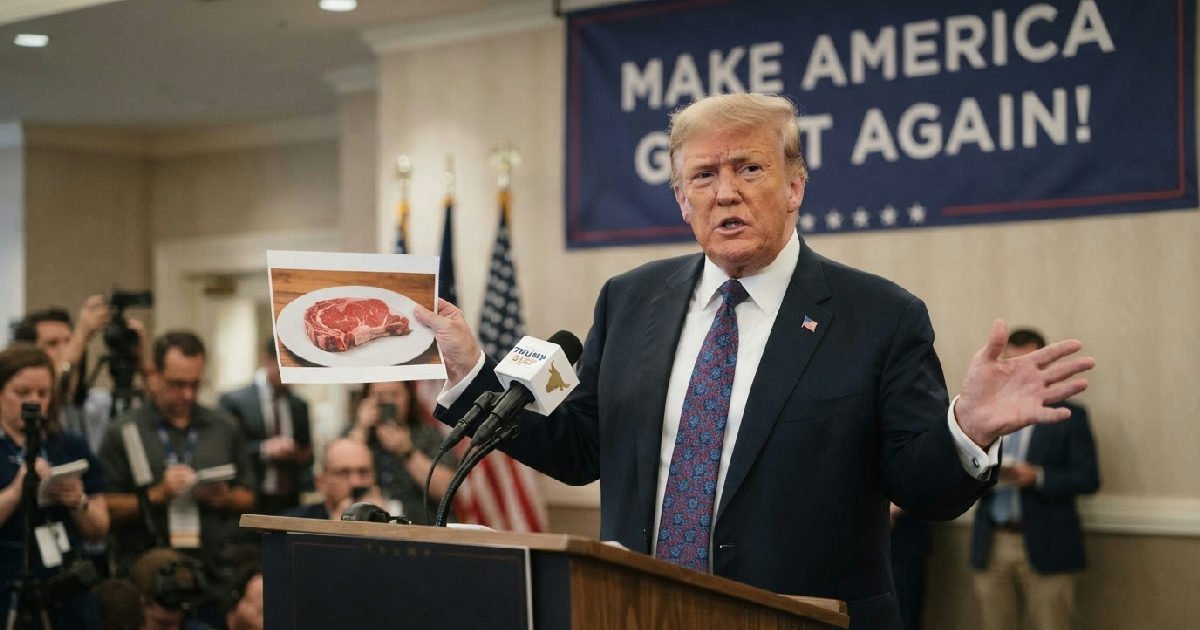
Trump waives beef tariffs to cut prices, sparking fury from US ranchers
President Donald Trump announced a plan on Friday to temporarily waive tariffs on 300,000 metric tons of ground beef imports, a dramatic intervention aimed at lowering record-high prices for American consumers. The move, however, immediately triggered a firestorm of criticism from the nation’s cattle ranchers and even some of the president’s staunchest Republican allies.
Announced via a post on his Truth Social platform on August 21, the policy will suspend out-of-quota tariffs for 90 days. Trump claimed he secured a commitment for this beef to be sold at 25% below current market prices, a detail that could provide relief at the grocery store but has left industry advocates deeply concerned.
Backlash Over Trump Beef Import Tariff
The reaction from the agricultural community was swift and severe. The National Cattlemen’s Beef Association (NCBA), a powerful industry lobby, condemned the decision. CEO Colin Woodall warned the move prioritises a short-term political message over the long-term health of the American beef industry, which is already facing immense pressure.
“Cattle markets have already turned sharply lower this morning, to the detriment of farmers and ranchers,” Woodall said in a statement. He argued that “flooding the market with government-subsidized, below-market beef is not the way to rebuild the American cattle herd,” adding the announcement throws “cold water on the prospect of herd expansion.”
The criticism wasn’t limited to industry groups. Republican senators from major cattle-producing states voiced their strong opposition, creating a rare public split with the president. Senator Deb Fischer of Nebraska called the decision “extremely disappointing,” stating that relief for consumers cannot come at the expense of American producers. “Flooding the market with foreign beef hurts our livestock industry,” she said.
Similarly, Senator Tim Sheehy of Montana revealed he had advised Trump against this policy for a year. “American ranchers have been struggling against the packer monopoly for decades, and this will further harm them,” Sheehy tweeted. While acknowledging the president’s good intentions, he argued the action would ultimately make it harder to rebuild the domestic herd and lower prices sustainably.
The economic reality behind soaring beef prices
The president’s action comes as ground beef prices have hit historic highs, becoming a symbol of the cost-of-living pressures facing American families. According to data from the U.S. Bureau of Labor Statistics, the average price for a pound of ground beef reached a record $6.89 in July 2026.
This figure is up more than 10% from the previous year and has surged 18% since Trump returned to office in January 2025.
The root cause of the price surge is a historically small U.S. cattle herd. As of early 2025, cattle supplies in the United States were at their lowest level in 74 years, numbering just 86.7 million head.
This dramatic reduction is the result of years of drought in key cattle regions, which drove up feed costs and forced many ranchers to sell off their animals rather than absorb the losses.
Rebuilding a cattle herd is a slow and expensive process, taking years of favorable conditions and financial stability. Ranchers must be confident in future market prices to justify the significant investment required to retain heifers for breeding instead of selling them for immediate processing. The president’s tariff waiver, critics argue, injects massive uncertainty into that very market.
The move’s potential impact on corporate financial results is another area of concern. The interplay between tariffs, consumer prices, and company performance is complex, as seen recently when a major retailer’s Walmart stock tumbles despite otherwise positive news that included a tariff-related windfall. How major beef processors and grocery chains will fare remains an open question.
Unpacking the tariff waiver and price commitment
The policy specifically targets what are known as “out-of-quota tariffs.” The U.S. operates a tariff-rate quota (TRQ) system for beef, which allows a certain volume of imports from various countries at a low tariff rate—around 4.4 cents per kilogram. Once that quota is filled, imports are subject to a much steeper 26.4% tariff, which Trump’s order will waive.
The 300,000 metric tons of beef represents a significant volume, equivalent to about 12,000 shipping containers. However, in the context of the vast American market, it amounts to only about 2% of the country’s average annual beef consumption. This has led some analysts to question whether it’s enough to meaningfully move the needle on nationwide prices.
Furthermore, skepticism surrounds the president’s claim of a commitment to sell the imported beef at a 25% discount. Trump’s announcement on Truth Social did not specify which importers or foreign exporters had agreed to this condition. Without a clear enforcement mechanism or named partners, industry watchers are uncertain how this price reduction will be guaranteed for consumers.
PMI Foods President Darin Parker characterized the situation as a “politically sensitive issue” and called the tariff waiver a “Band-Aid approach.” He stressed that the move fails to address the fundamental problem. “A more durable, structural solution is to incentivize American ranchers to rebuild and expand the domestic herd,” Parker stated.
Will the plan actually lower grocery bills?
While the stated goal is to reduce costs for “working American families,” some experts are skeptical that the benefits will be widespread or long-lasting. Altin Kalo, an economist at Steiner Consulting Group, pointed out that imported beef already trades at a steep discount to domestic product, and the out-of-quota tariff has not been a major barrier for importers recently.
Kalo also noted a critical distinction in the beef supply chain. Much of the imported beef trimmings, typically arriving frozen from countries like Australia or Brazil, is destined for the food service industry, particularly fast-food chains. It’s less commonly sold directly to consumers at grocery stores, where fresh ground beef is preferred.
This could mean any price relief is felt more by large corporations than by families buying groceries.
The situation highlights a fundamental tension between consumer prices and producer viability. Industries must often adapt to changing economic pressures, sometimes leading to unexpected strategic shifts. In a different sector, for example, some miners shift to AI infrastructure to find new revenue streams when their primary business faces headwinds.
For American ranchers, however, the options are far more limited and grounded in long-term biology and market cycles.
The core of the issue is that rebuilding domestic supply is the only sustainable solution to high prices. The president’s plan, while politically appealing in the short term, may paradoxically delay that very recovery by disincentivizing the investments ranchers need to make today to grow their herds for tomorrow.
Political calculations and the road ahead
The timing of the announcement is impossible to separate from the political calendar, with crucial congressional elections looming in November. The administration has faced persistent criticism over inflation and the cost of living, with polls showing a majority of voters feel worse off financially. This beef import plan appears to be a direct attempt to demonstrate action on a highly visible consumer issue.
A recent Financial Times/Focaldata poll found that over 53% of registered voters felt their financial situation had worsened during Trump’s second term, putting his approval rating on the economy “underwater.” An executive action that promises lower prices on a staple food item like ground beef provides a tangible talking point for Republican candidates on the campaign trail.
According to the White House, a formal executive order implementing the tariff waiver will be signed within the next two weeks. The key question will be what happens when the 90-day period expires. If domestic herd rebuilding has not accelerated and prices remain high, the administration could face pressure to extend the waiver, further angering the domestic agricultural industry.
Ultimately, the move encapsulates a classic political dilemma: a choice between immediate relief for consumers and the long-term stability of a vital domestic industry. For now, the president has sided with the consumer, but the political and economic fallout from that decision is only beginning to unfold.