

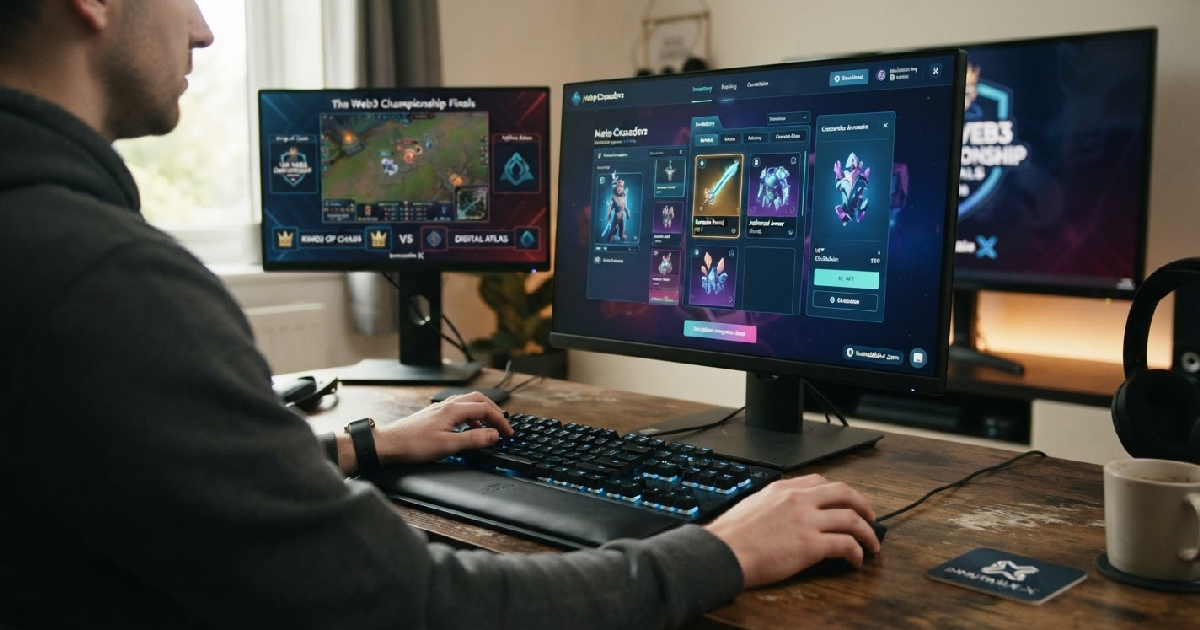
Blockchain Gaming in Esports: Redefining Digital Ownership and Competition
Blockchain gaming in esports is fundamentally changing how players interact with digital assets and how competitive video gaming operates. It leverages decentralized ledger technology to offer true player ownership, bolster competitive fairness, and unlock novel ways for fans to engage and for organizations to generate revenue.
This integration marks a significant departure from traditional gaming models, addressing long-standing challenges within the esports ecosystem through transparency and immutability.
Understanding Blockchain Gaming in Esports
Blockchain gaming, often known as crypto games, NFT games, web3 games, or metaverse games, involves video games built upon or administered using blockchain technology. Unlike conventional titles, these games provide decentralized control and transparency, granting players genuine ownership of their in-game items and achievements.
Esports, or electronic sports, refers to organized multiplayer video game competitions, typically featuring professional players or teams. These events often boast substantial monetary prizes and a significant spectator following, centered on competitive human-versus-human gameplay.
Core Technologies Powering Web3 Esports
The convergence of blockchain and esports relies on several critical technological mechanisms. These tools create a new paradigm for digital interaction and economic models within competitive gaming.
Non-Fungible Tokens (NFTs) Enable True Ownership
NFTs are unique digital assets stored on a blockchain, meaning they can’t be copied, altered, or replaced. In blockchain games, NFTs represent distinct in-game items like characters, skins, weapons, or virtual land.
Players gain genuine ownership of these assets, which reside on the blockchain. This allows them to sell, trade, or utilize these items across various games or platforms, even if the original game eventually ceases operation.
Beyond tradable assets, NFTs can provide token-gated access to exclusive game features. Non-transferable “Soulbound NFTs” can also serve as immutable records of player achievements, proving mastery or participation without being speculative assets.
Cryptocurrencies Fuel In-Game Economies
Fungible tokens, like ERC-20 tokens on Ethereum, commonly function as in-game currencies for transactions and rewards. Players can earn these digital assets through gameplay, which they can then exchange on decentralized marketplaces for fiat money or other digital currencies.
This latest esports trends integration transforms playtime into a potential income stream, fundamentally shifting the value proposition for dedicated players.
Smart Contracts Automate Rules and Payouts
Smart contracts are self-executing computer programs stored on a blockchain, programmed to automatically carry out predefined conditions. In esports, they play a crucial role in maintaining integrity and efficiency.
They can automatically distribute prize pool money to players, teams, and organizers based on preset rules, ensuring prompt and fair payouts. Smart contracts also facilitate transparent and enforceable player contracts, automating terms related to salaries and obligations.
Crucially, these contracts record match results on the blockchain, providing unalterable records. This transparency helps prevent match-fixing and bolsters the overall competitive integrity of tournaments.
DAOs and Play-to-Earn Models
Decentralized Autonomous Organizations (DAOs) represent a community-owned structure without centralized leadership, maintained by its independent blockchain members. This framework grants players greater control over game development and governance through voting rights, often exercised via governance tokens.
The Play-to-Earn (P2E) model is another blockchain-based innovation where players earn cryptocurrencies or NFTs simply by playing games. These digital assets hold real-world value and can be traded, offering significant monetization opportunities.
Blockchain’s Impact on the Esports Ecosystem
The integration of blockchain technology brings several transformative benefits and applications to the broader esports ecosystem. It’s reshaping how teams operate, how fans participate, and how competition is managed.
Enhanced Fan Engagement and New Revenue Streams
Blockchain allows for the creation of fan tokens, which fans can purchase to unlock exclusive rewards, discounts, and content. These tokens can even grant voting rights in team decisions, fostering a more interactive and fan-centric ecosystem.
This approach provides esports organizations with rich engagement metrics through immutable data, generating new revenue models. The sale of fan tokens and NFTs, representing digital collectibles or access passes, can be a significant income source for teams and leagues.
Boosting Competitive Integrity
Smart contracts are proving invaluable for enhancing transparency within esports, tracking match results and effectively preventing match-fixing. They provide verifiable records for all participants and viewers, building greater trust.
Decentralized competition platforms further reduce fraud risks. This bolsters user confidence and helps uphold fair play across all levels of competitive gaming.
Player Empowerment Through Asset Ownership
Players in blockchain-integrated esports gain true ownership of their in-game assets as NFTs. These assets can be freely traded or sold outside the game’s original environment, providing real-world value for their efforts.
This stands in stark contrast to traditional games, where publishers typically lock items within their proprietary ecosystems. The shift offers players unprecedented control and monetization options.
Blockchain also holds the potential for greater interoperability, where digital assets might be usable across multiple games and platforms. This expands their utility and market reach considerably.
Pioneering Projects in Blockchain Esports
Several notable projects are already making waves in the future of esports through blockchain integration. These companies showcase the diverse applications of the technology within the competitive gaming landscape.
Axie Infinity and the P2E Revolution
Axie Infinity stands as a pioneer in blockchain gaming, widely popularizing the Play-to-Earn model with its use of NFTs. Its skill-based battle system has naturally lent itself to competitive play and esports, featuring tournaments with cryptocurrency prizes.
The game has hosted significant events, including the Axie Classic Guilds World Cup. It has also forged partnerships with established esports organizations such as Cloud9 for tournament support, highlighting its legitimacy in the competitive scene.
Gala Games and Miracle Play
Gala Games operates a blockchain gaming platform, enabling players to earn cryptocurrencies and NFTs across its varied portfolio of titles. The platform runs on GalaChain, its custom blockchain designed for high transaction volumes and minimal gas fees.
GalaChain has partnered with Miracle Play, a web3 esports tournament platform, to further advance blockchain-backed esports. Their collaboration focuses on transparency, fairness, and a “Skill to Earn” (S2E) revenue mechanism, rewarding players for their competitive prowess.
Immutable X and Gods Unchained
Immutable X serves as a Layer-2 scaling solution for NFTs on Ethereum, providing gas-free and instant trading for blockchain-based gaming assets. This technology is vital for making NFT transactions practical and affordable for a mass audience.
Games like Gods Unchained, a popular tradeable card game where every card is an NFT, leverage Immutable X. It ensures a seamless and efficient experience for players managing their digital collections.
Other Notable Platforms
Mobile game developer Legendary Play built “Esports Heroes,” an idle role-playing game that integrates blockchain technology and NFTs. This offers players true ownership of their in-game items and characters, a key differentiator in mobile gaming.
Chain Games is another platform dedicated to blockchain-based esports, offering skill-based games. It also allows users to bet on esports matches, adding another layer of engagement and monetization for its community.
Moving Beyond Speculation: A Broader Vision
A common misconception is that blockchain gaming is solely about “play-to-earn” and financial speculation. While P2E is indeed a significant model, its scope extends far beyond mere earning potential.
The reality is that blockchain gaming also emphasizes true digital ownership, enabling community governance through DAOs, and creating enhanced player experiences. Many NFT games prioritize collectibility and verifiable ownership over token earning, signaling a deeper integration of these technologies into gaming culture.