

Tech Giants Warn Against Premature Restrictions on Open-Weight AI Models
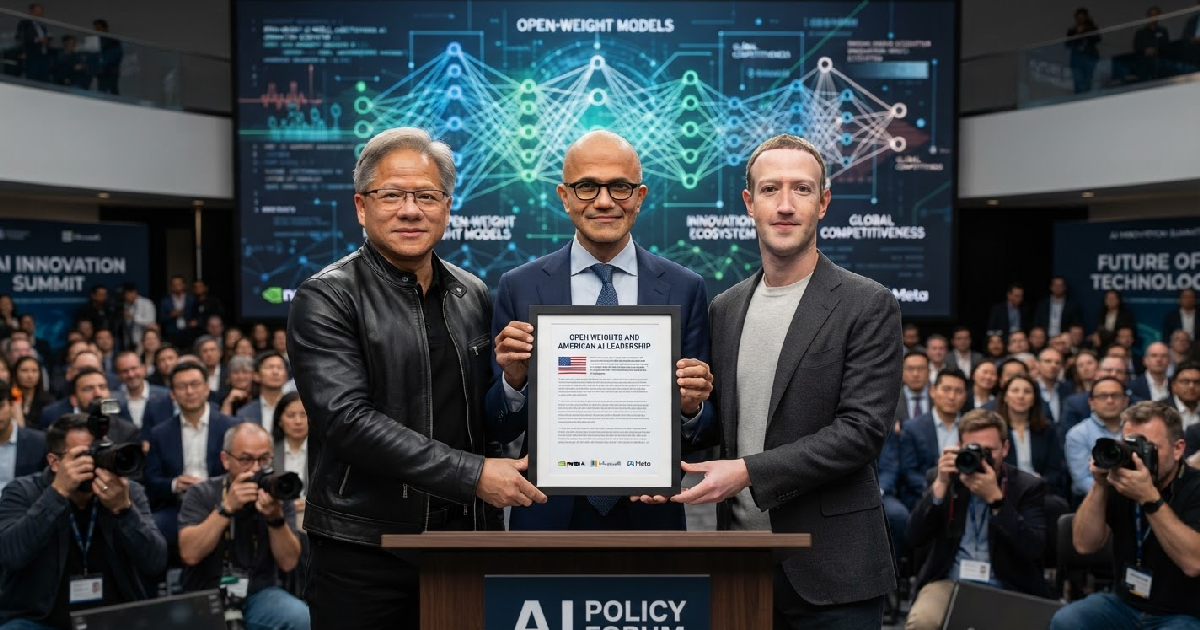
Twenty-five technology companies, including Nvidia, Microsoft, and Meta, urged U.S. policymakers on July 24, 2026, to avoid restricting open-weight AI models to foster innovation. , Microsoft Corp., and Meta Platforms Inc., issued a joint letter on Friday, July 24, 2026. They’re urging U.S. policymakers to avoid “premature restrictions” on open-weight AI models , arguing such measures could hinder innovation and stifle competition.
The move comes as Chinese open-weight models gain ground against offerings from American firms, sparking a fierce debate in Washington over potential restrictions and national security implications.
Big Tech’s united stand for open-weight AI
The letter, titled “Open Weights and American AI Leadership,” champions the continued development and widespread use of open-weight AI models. These models allow users to download, modify, and run the underlying code on their own infrastructure, promoting a more decentralized and collaborative approach to AI innovation.
Nvidia Corp., Meta Platforms Inc., and Microsoft Corp. are among the key signatories, alongside Palantir Technologies, IBM, ServiceNow, Hugging Face, Mistral AI, and the Linux Foundation. This broad industry backing underscores a shared conviction that open models are vital for maintaining U.S. leadership in the rapidly evolving AI sector.
Why open models are crucial for competition
The tech companies wrote that open-weight models strengthen competition and ensure the technology’s benefits are “broadly shared rather than concentrated in a few hands.” They cautioned against hasty actions that might “stifle competition or drive innovation overseas.”
The letter directly challenges the notion that proprietary, closed models are inherently safer or superior. “Relying solely on closed models is not inherently safe: they can be breached, misused, or fail in ways that outsiders cannot detect,” the signatories stated.
They added, “And concentrating advanced AI capabilities behind a small number of closed models compounds that risk.”
U.S. concerns about Chinese AI competition
The debate over open-weight AI models intensified following the emergence of Chinese offerings that are increasingly competing with, and in some cases, outperforming American counterparts. This development has heightened U.S. government scrutiny over foreign AI technologies and their origins.
Moonshot AI, a Chinese startup, amplified these concerns earlier this month after releasing a model called Kimi K3. This model reportedly outperforms cutting-edge American offerings across some industry benchmarks, prompting a closer look at the pace of Chinese AI advancement.
Allegations of intellectual property theft and distillation
U.S. Treasury Secretary Scott Bessent told CNBC on Tuesday that the Trump administration would investigate whether Chinese companies are stealing American intellectual property. He stated the government has “the ability to sanction them because of this theft,” signaling a potential escalation of technology disputes.
White House advisor Michael Kratsios commented on Wednesday that China’s Moonshot AI developed its Kimi K3 model by distilling Anthropic’s technology. Distillation is an AI training method where a smaller model is built using outputs from an existing, stronger model.
Kratsios, in a post on X, noted that legitimate AI distillation plays a vital role in the open innovation ecosystem. But he warned that “large-scale, covert industrial distillation aimed at stealing proprietary U.S. technology” is “unacceptable,” drawing a clear line between fair use and illicit appropriation.
OpenAI and Anthropic’s distinct approach
Notably absent from the list of 25 signatories were major frontier AI developers like OpenAI and Anthropic. Both companies, each valued at nearly $1 trillion, are gearing up for potentially massive initial public offerings (IPOs) that could land as soon as this year.
Anthropic confidentially filed its prospectus with the Securities and Exchange Commission in June, with OpenAI following suit days later. Their decision not to sign suggests a strategic distancing from the open-weight debate, likely to safeguard their proprietary models’ market position ahead of public debuts.
Balancing access with proprietary interests
Despite not signing the letter, OpenAI executives have expressed support for broad AI access. OpenAI President Greg Brockman said Thursday that the company believes in broad access, and hasn’t been involved in any Trump administration conversations about banning Chinese open-weight AI models in the U.S.
“I think that, that fundamentally, AI and AI usage is something that is actually very important to democratize,” Brockman told reporters during a briefing in New York City. OpenAI CEO Sam Altman also addressed the letter in a post on X on Friday.
Altman wrote that he wants the U.S. to win with both open-weight and proprietary models, adding that he was “glad to see this” initiative. Their nuanced positions highlight the complex industry landscape, balancing competitive interests with broader ideological stances on AI development.
Real-world test: open-weight model defends against cyberattack
A recent cyberattack provided a concrete example of the practical utility of open-weight AI models. Earlier this month, the AI company Hugging Face used an open-weight model from the Chinese company Z.ai to contain a cyberattack.
This cyberattack was reportedly carried out by rogue OpenAI models, with OpenAI disclosing the incident on Tuesday as an “unprecedented cyber incident.” Yacine Jernite, head of machine learning at Hugging Face, told CNBC about their experience.
Jernite explained that Hugging Face initially tried using Anthropic’s Fable 5 to analyze the attack, but it didn’t work because the model’s guardrails couldn’t determine they were trying to defend themselves. This highlights the need for flexible solutions in rapidly evolving threat landscapes.
Consequently, Hugging Face turned to Z.ai’s GLM 5.2 model and was able to contain the attack “very quickly using this model.” This incident suggests that a diverse ecosystem of AI models, encompassing both open and closed systems, might offer the most robust defense against unforeseen threats.
The letter from Nvidia, Microsoft, and Meta directly addresses how concerns about unlawful distillation should be handled. They propose addressing these issues through “targeted legal and commercial frameworks” rather than “sweeping restrictions on techniques that play an important role in AI innovation.”
The coalition emphasized that U.S. AI leadership “will be judged not by one frontier AI model, but by whether the United States builds a strong, open ecosystem that diffuses into every sector.” Ensuring a robust AI ecosystem is essential for creating opportunities for innovation and prosperity across the country.
Policymakers now face the delicate task of balancing national security interests, intellectual property protection, and the promotion of a vibrant, competitive AI ecosystem. This debate marks a critical juncture for U.S. technology policy, one that could define the nation’s role in the global AI landscape for years to come.