

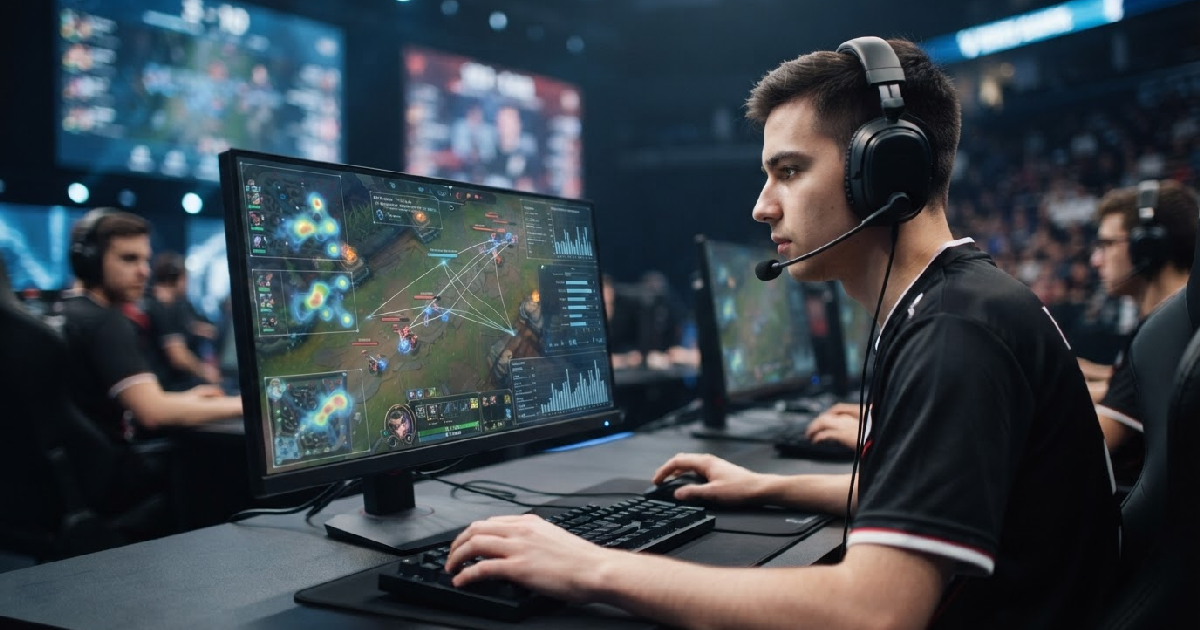
How AI is Impacting Esports: A Comprehensive Explainer
Artificial intelligence, or AI, is fundamentally transforming the competitive gaming landscape, redefining virtually every aspect of the industry. This technological integration is profoundly impacting esports by enhancing competitive integrity, optimizing player performance, revolutionizing game development, enriching the spectator experience, and streamlining crucial operational processes.
It leverages AI’s inherent capabilities for real-time data analysis, pattern recognition, and predictive modeling, creating a more dynamic, fair, and engaging ecosystem for players and fans alike.
Understanding AI and the esports landscape
To grasp the full scope of AI’s influence, it helps to first define the key terms at play. Artificial intelligence encompasses computer systems designed to perform tasks typically requiring human intelligence.
These tasks include learning, reasoning, solving problems, making decisions, and even perception, as outlined by authoritative sources like 15 U.S. Code § 9401. This broad field includes specialized domains such as Machine Learning (ML), where computers learn from data without explicit programming, and Computer Vision, which enables them to interpret visual information.
What artificial intelligence means for gaming
At its core, AI refers to a machine-based system capable of making predictions, recommendations, or decisions that influence real or virtual environments. In gaming, this means systems that can adapt, learn, and react in complex ways, moving beyond simple programmed responses.
The distinction between AI and traditional programming lies in this adaptive capacity. AI allows systems to evolve their behavior based on new data, a critical factor in dynamic environments like esports.
The competitive world of esports
Esports, or electronic sports, are organised competitive video gaming events that see amateur and professional players or teams vie for prizes. Unlike casual gaming, esports emphasizes human-versus-human competition, mirroring the structure and intensity of traditional sports.
These events often feature significant monetary rewards and draw massive spectator numbers. The highly competitive nature makes any technological edge, like AI, incredibly valuable.
How AI is impacting esports: enhancing performance
One of the most immediate and tangible ways AI is impacting esports is through advanced player training and performance analysis. AI tools provide granular data and personalized coaching that was previously unimaginable, offering players and teams significant competitive advantages.
These systems analyze vast amounts of gameplay data, meticulously tracking player movements, aiming precision, reaction times, and critical in-game decisions. This deep analysis identifies patterns, highlights strengths, and uncovers weaknesses, leading to highly specific, actionable insights.
Advanced player training and analytics
AI-powered platforms are revolutionising how players hone their skills. For instance, Aimlabs utilises AI data analysis to craft customised training routines, directly targeting individual player weaknesses to enhance overall performance.
Similarly, Omnic.AI’s Forge employs computer vision and deep learning to analyse gameplay videos. It provides personalised AI coaching insights, detailed advanced analytics, precise aim analysis, and even automatic highlight generation, effectively saving countless hours of manual review.
Strategic coaching for teams
AI isn’t just for individual improvement; it’s becoming indispensable for team strategy. Programs like SenpAI, developed by Falcon AI, analyse gameplay to suggest optimal playstyles and offer in-game guidance, providing real-time strategic support.
Top professional teams, including OG and Fnatic, now deploy machine learning algorithms to dissect game patterns and predict opponent behaviour. This sophisticated approach significantly enhances their strategic preparation for major tournaments, offering a critical edge in high-stakes competition.
Safeguarding integrity with AI anti-cheat systems
The integrity of competitive esports is paramount, and AI is transforming anti-cheat measures from reactive responses to proactive interventions. AI-powered anti-cheat engines are designed to analyse player behaviour in real-time, within complex distributed network architectures.
These systems leverage advanced machine learning models, including Graph Neural Networks (GNNs), to map player interactions and identify suspicious patterns or even collusion networks. This enables immediate intervention during gameplay, maintaining remarkably low false positive rates.
Real-time detection of foul play
Unlike older systems that relied on cheat signatures and applied bans retrospectively, AI-driven solutions detect issues as they unfold. They analyse unnatural aiming patterns, unusual movement, and interactions with external software.
Valve’s VAC Live for CS2 exemplifies this shift, evolving from its VAC Net predecessor into an AI-driven real-time anti-cheat system. Activision’s Ricochet Anti-Cheat, used in Call of Duty: Warzone, also employs machine learning to pinpoint subtle cheating behaviours that might otherwise go unnoticed.
Adapting to new cheating techniques
The cat-and-mouse game between cheaters and anti-cheat developers is constant, but AI offers a significant advantage. Machine learning algorithms can detect irregularities indicative of cheating, such as impossibly precise aiming from ‘aimbots’ or the ability to ‘see through walls’ using ‘wallhacks’.
Crucially, these AI systems continuously refine their models based on the massive volumes of match data processed daily, allowing them to adapt quickly to newly emerging cheating techniques. Esports sponsorship trends increasingly hinge on maintaining this competitive fairness.
AI’s role in game development and balance
Beyond the competitive arena, AI is actively assisting game developers in crafting more dynamic, engaging, and fundamentally fair gaming experiences. AI agents can simulate thousands of matches and player journeys, analysing extensive gameplay data from millions of sessions.
This process helps developers pinpoint balance issues and test diverse scenarios long before players encounter them. It allows for precise adjustments to game mechanics, character abilities, and reward systems, leading to a much more polished final product.
Streamlining virtual playtesting
One of the most significant applications is virtual playtesting. AI agents can simulate a wide array of in-game scenarios, effectively serving as tireless testers. This accelerates the testing of game mechanics and balancing, leading to more robust and enjoyable games.
Furthermore, AI algorithms can generate vast amounts of content, from environmental assets to character animations. This capability drastically reduces development time and resource expenditure, freeing human developers to focus on higher-level creative tasks.
Creating fair and engaging gameplay
AI plays a critical role in ensuring competitive fairness. It analyses win/loss ratios, skill levels, item usage, and progression speed to identify mechanics that are either too strong or too weak. This analysis facilitates quicker adjustments, maintaining a level playing field.
Akira AI agents, for example, continuously monitor leveling curves, difficulty, in-game economies, and rewards to guarantee fair progression and competitive integrity. This helps prevent imbalances that could frustrate players and undermine competitive legitimacy.
Revolutionizing the spectator experience and broadcasting
AI is also profoundly changing how fans consume and interact with esports content, making broadcasts more engaging and personalised. By analysing viewer preferences and in-game data, AI can tailor content delivery to individual tastes.
This personalization creates a richer, more immersive experience, allowing fans to follow the action in ways that resonate most deeply with them. It marks a significant evolution from traditional, one-size-fits-all broadcasting.
Personalized viewing and content creation
AI enables highly customisable streams, giving fans the power to focus on their favourite players, specific teams, or even particular in-game roles. This level of control enhances viewer engagement and loyalty, offering a bespoke experience for every fan.
Automated content creation is another major benefit, with AI capable of generating highlight reels, match summaries, and social media content. This capability significantly reduces the workload for human content creators, allowing for more rapid and extensive content dissemination.
Real-time insights for fans
During live streams, AI provides real-time statistics, detailed player biographies, and other relevant information. This continuous flow of data enriches the viewing experience, keeping fans informed and engaged with every critical moment. Latest esports trends show a clear demand for more data-rich broadcasts.
These real-time insights allow spectators to delve deeper into the strategic nuances of the game. They can understand player decisions, track performance metrics, and gain a more comprehensive appreciation for the competitive skill on display.
The strategic advantage of AI in talent and betting
Beyond the direct gameplay, AI’s influence extends to the foundational elements of the esports ecosystem, notably in talent acquisition and the increasingly sophisticated world of betting strategies. Its capacity for predictive modeling offers unique advantages in these areas.
AI helps organisations make more informed decisions about who to recruit and how to manage the significant financial stakes involved in competitive gaming. This brings a new level of analytical rigor to previously subjective domains.
Optimizing talent acquisition processes
Identifying the next esports superstar is a complex task, but AI tools are streamlining this process. They can analyse performance data across numerous potential recruits, identifying emerging talent based on raw skill metrics and growth potential.
This objective, data-driven approach minimises bias and maximises the chances of recruiting players who will genuinely contribute to a team’s success. Teams like Team Liquid, utilising SAP’s HANA cloud for AI systems, are at the forefront of this data-centric scouting.
Informing sophisticated betting strategies
The esports betting market is growing rapidly, and AI is playing a crucial role in informing more sophisticated betting strategies. By analysing historical match data, player performance, and team dynamics, AI models can predict outcomes with greater accuracy.
These predictive capabilities provide bettors with advanced insights, moving beyond anecdotal evidence to data-backed probabilities. This trend reflects the broader impact of data science on competitive analysis across all sports.
The future trajectory of AI in esports
The integration of AI into esports is far from complete; it’s an ongoing evolution. As AI technologies become more advanced and accessible, their role will only expand, embedding deeper into every layer of the competitive gaming world. This promises continued innovation and new challenges.
We can expect AI to drive even greater levels of personalisation, further refine anti-cheat measures, and unlock entirely new possibilities for training and strategic development. The continued future of esports will undoubtedly be intertwined with AI advancements.
Ultimately, AI isn’t just a tool in esports; it’s becoming an integral partner. It helps foster a more equitable, exciting, and highly competitive environment, pushing the boundaries of what’s possible in electronic sports.