

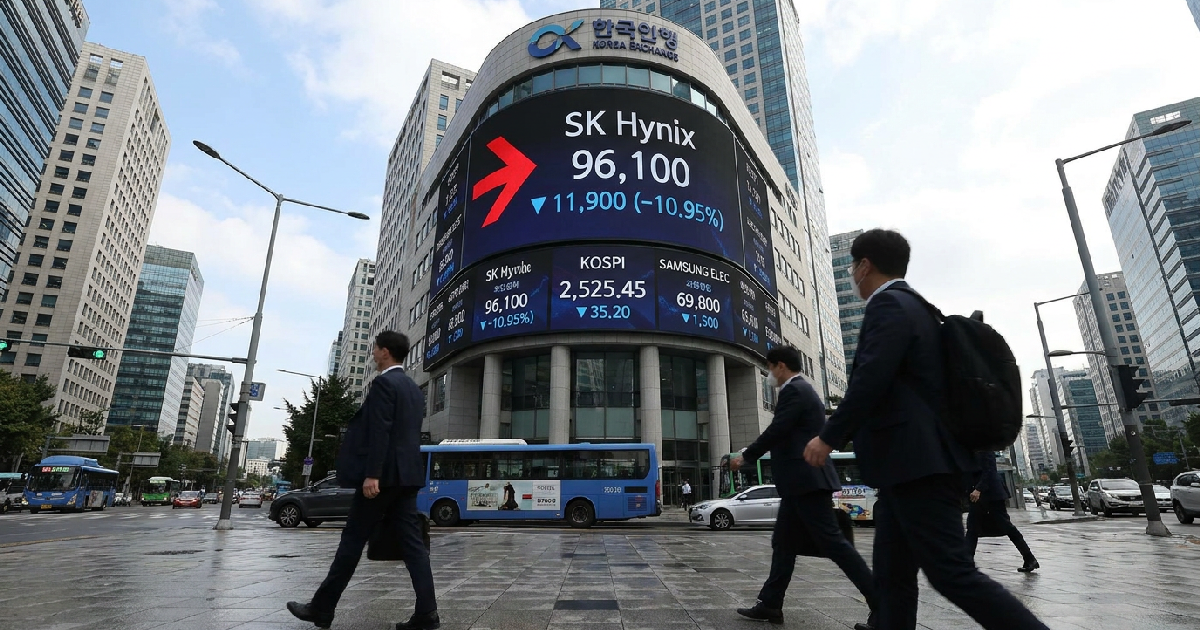
SK Hynix shares plunge 10.95% as Asia’s tech market reels from US chip losses
SK Hynix shares tumbled 10.95% in Seoul on July 16, 2026, sparking a broad tech sell-off in Asia. shares tumbled a dramatic 10.95% in Seoul today, July 16, 2026, triggering a widespread tech rout across Asia and reflecting a significant sell-off in U.S. semiconductor stocks. This latest drop reverses an 8% rally from the previous session, intensifying concerns about investor confidence in the red-hot artificial intelligence (AI) sector.
The South Korean memory-chip giant, which made its Nasdaq debut just last week, has experienced considerable volatility, indicative of a broader recalibration within the global chip market. This downturn comes after a period of explosive growth for chipmakers, largely fueled by aggressive investments in AI infrastructure.
SK Hynix shares lead Seoul’s tech sector decline
SK Hynix’s 10.95% plunge in Seoul today, July 16, wasn’t an isolated incident; it marked a sharp reversal of an 8% rally from the previous session. Its domestic rival, Samsung Electronics Co. Ltd., saw its shares fall 7.33% in the same trading session, contributing to the broader market unease.
Just this Monday, July 13, SK Hynix’s Seoul-listed shares had already plummeted more than 15%, marking their steepest one-day decline in nearly two decades. The company’s U.S.-listed shares also dropped 7.9% to $154.7 in early trading that day.
Kospi index volatility and SK Hynix’s trajectory
The rapid depreciation of SK Hynix shares, coupled with Samsung’s losses, sent South Korea’s Kospi index into a tailspin on Monday, July 13, plunging 9% and triggering a 20-minute trading halt. Today, the Kospi hit its 37th “sidecar” of 2026, opening down 4.45% at 6,960.50 before deepening losses to an early morning low of 6,753.
SK Hynix’s recent share performance has indeed been a roller coaster for investors. The company’s American Depositary Receipts (ADRs) began trading on the Nasdaq under the ticker SKHY on July 10, priced at $149 apiece. They opened 14% above the offer price at $170 and closed their debut session up 12.8%.
Before this week’s turbulence, the Korean-listed stock had surged an incredible 174% over the past six months and a staggering 634% over the past year. Now, just days after its U.S. listing, SK Hynix shares are down 34% from their recent peak, reaching a low of 1.823 million won today.
US chipmakers set a bearish tone for Asia
The sell-off in Asian semiconductor stocks on Thursday largely tracked a similar decline in U.S. chipmakers overnight, indicating how interconnected global markets have become. This pattern suggests that sentiment in one major tech hub can quickly ripple across continents, affecting investment decisions worldwide.
Micron Technology Inc. (MU) sank 8% on July 15, closing with a trading volume of $49.2 billion. Intel Corp. lost more than 4%, while Lam Research Corp. and Advanced Micro Devices Inc. each fell about 3%. These significant drops in prominent U.S. firms signaled a broader market reevaluation.
Philadelphia Semiconductor Index sees a steep correction
The Philadelphia Semiconductor Index (SOX), a key benchmark for the sector, gained nearly 65% in the first half of 2026. However, it has now shed more than 20% from its 52-week high territory since late June, reflecting a substantial correction. The SOX lost 3.6% on July 13 alone and declined 4.2% in the week leading up to July 3.
This widespread weakness extended to Japan, where key AI-linked equipment makers felt the pressure. Advantest Corp. fell more than 6%, SoftBank Group Corp. slid nearly 7%, and Tokyo Electron Ltd. lost over 5%. Renesas Electronics Corp. also saw a decline of 4%, underscoring the regional impact.
Behind the market’s retreat
While some analysts initially attributed the declines to profit-taking after an extended rally, deeper concerns about AI spending and valuations are clearly at play. Investors are starting to question whether the massive investments flowing into AI infrastructure can deliver returns quickly enough to justify current stock prices.
Rolf Bulk, Head of Semiconductor & Infrastructure Equity Research at Futurum Group, commented that the latest weakness mainly reflects profit-taking following a sharp rally. He maintains that the structural demand for AI infrastructure and memory chips remains robust, suggesting that the underlying industry fundamentals haven’t deteriorated.
Overcrowded trades and valuation scrutiny
Louis Kondratev, a trader at XFUNDs, noted that semiconductor trades have become “incredibly crowded” following a prolonged AI-driven rally. He pointed out that semiconductors now comprise roughly 20% of the S&P 500 Index, a level historically difficult to sustain.
For context, semiconductors made up just over 8% of the index during the dot-com bubble of 2000 and have historically averaged between 2% and 5%. While earnings momentum for chipmakers has remained robust, Kondratev cautioned that the pace of gains might become harder to maintain as investors reassess “lofty valuations.”
This reassessment suggests that AI and quantum tech might divert capital or change investment flows, impacting traditional tech valuations.
Regulatory headwinds and supply dynamics
External factors are also adding to market jitters. New York Governor Kathy Hochul recently ordered a temporary halt to new large-scale data center projects, with the state planning to develop stricter standards for energy, water, and environmental impacts. This could signal future headwinds for infrastructure expansion.
Reports also indicate that CoreWeave Inc. is exploring hedges against future declines in memory prices, which served as a marginally negative signal. These developments suggest a growing awareness of potential risks and a more cautious approach to future growth prospects.
Furthermore, broader geopolitical tensions, such as renewed U.S.-Iran tensions and rising oil prices, have contributed to a more risk-averse investor sentiment, leading to actions like US naval forces redirecting commercial vessels.
Outlook: recalibrating market expectations
The current market correction in the semiconductor sector could signal investors adjusting their expectations after a period of intense speculative growth. The extraordinary gains seen over the past year have led to a concentration of wealth and attention in a few key areas, particularly those tied to AI.
Despite the recent market turmoil, the fundamental demand drivers for high-bandwidth memory (HBM) chips, crucial for AI applications, remain strong. Industry experts largely agree that demand continues to outstrip supply, particularly as cloud providers aggressively build out their AI infrastructure.
This ongoing imbalance is expected to allow leading memory manufacturers like SK Hynix and Micron Technology Inc. to maintain robust pricing power for the foreseeable future.
However, this market adjustment is forcing a more disciplined analysis of intrinsic value, moving away from the speculative fervor that characterized much of the AI boom, and highlighting the need for vigilance even in high-growth sectors. This correction in semiconductor stocks reflects a broader re-evaluation across the tech industry.