

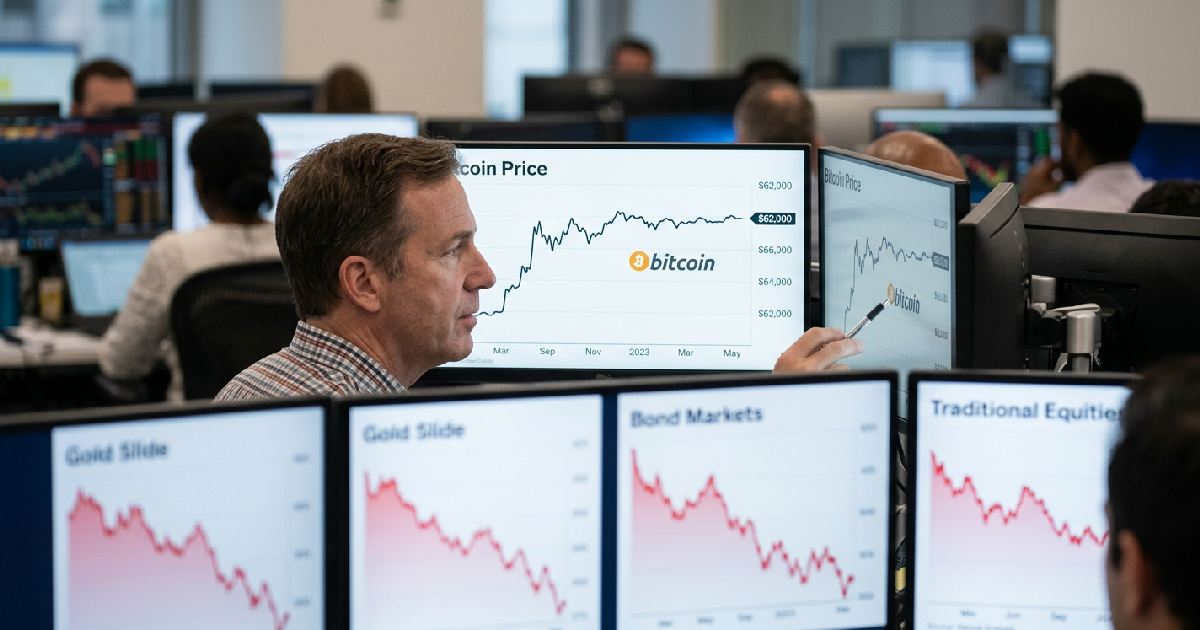
Bitcoin holds above $62,000 as gold slides for fourth day
Bitcoin established a firm hold above the $62,000 mark on Thursday, July 9, 2026, as geopolitical tensions in the Middle East prompted a divergent reaction across global asset classes. While the U.S. military recently completed a new round of strikes against Iran following a period of heightened friction, the cryptocurrency market remained relatively flat.
This stability stands in stark contrast to traditional safe-haven assets, with gold extending a four-day slide and government bonds facing a significant selloff.
How Bitcoin holds above $62,000 despite rising interest rate expectations
The muted response from major digital assets suggests that markets are increasingly viewing regional conflict as a driver for monetary policy shifts rather than a trigger for panic.
Brent crude oil climbed 1% to $78.80 a barrel, marking its third consecutive session of gains, as both sides raised the prospect of closing the Strait of Hormuz. Despite the energy shock, Bitcoin traded at $62,009, declining just 1.2% over 24 hours while maintaining a 1.6% gain for the week.
Ether mirrored this resilience, holding at $1,730 even as traditional markets braced for renewed inflation concerns.
The escalation has reignited fears regarding persistent inflation, leading to a sharp repricing of U.S. Federal Reserve expectations. Money markets shifted their bets on Wednesday for the next interest rate hike, moving the projected timeline from December to October. This hawkish turn has historically weighed heavily on non-yielding assets.
Gold, which often serves as a sanctuary during geopolitical crises, fell to approximately $4,060 an ounce for its fourth straight day of losses. Higher rates increase the opportunity cost of holding the precious metal when cash and Treasuries offer better returns.
Global fixed-income markets also reflected this shift in sentiment. Government bonds in Australia, Japan, and New Zealand fell on Thursday, extending a global selloff that began earlier in the week. Two-year Treasury yields moved toward their 2026 highs, a move that would typically put downward pressure on riskier assets.
However, Bitcoin appears to be breaking its traditional correlation with commodities like crude oil and gold, instead tracking the front end of the yield curve more closely as a “rates-sensitive” asset.
This decoupling is a significant development for the asset’s market profile. If Bitcoin continues to absorb escalations in the Middle East without a sharp break lower, it supports the thesis that the market is evolving.
While a US-Iran deal expectation might have buoyed stocks in the past, the current focus of the crypto market has turned toward how the Federal Reserve will manage the resulting economic fallout.
Bitcoin defends the $60,000 support floor
Traders and market participants are now identifying $60,000 as the critical psychological and technical level for the market’s next phase. Bitcoin has managed to claw back from multi-month lows to maintain a range through a week defined by war escalation and bond market volatility.
Sentiment has slightly improved, with the Fear and Greed index rising to 27. While this remains in “fear” territory, it marks an exit from the extreme fear zone that the market occupied for the past 40 days.
Holding above this floor amidst the threat of maritime blockades in the Strait of Hormuz indicates a potential rotation. If Bitcoin holds while gold slides, it reinforces the narrative of a shift toward digital assets as a rates-hedging tool.
However, analysts warn that a sharp move below $60,000 would suggest that the recent period of calm was merely a function of low trading volume rather than a fundamental change in how the market interprets geopolitical risk.
Investors are also watching other tokens, such as Hyperliquid (HYPE), which added 5.9% on the week despite the broader market’s cautious stance.
Weekly performance of major altcoins
Ether remained steady on Thursday, off 1.2% on the day but boasting a 5.7% gain over seven sessions. Other tokens showed more volatility; Solana (SOL) was the laggard of the major coins, trading at $77.25 and shedding 1.8% daily and 1.7% on the week.
XRP slipped 0.7% to $1.09, while TRON managed to add 4% over the same seven-day period. These movements occur against a backdrop where Brian Armstrong warns finance must move on-chain to stay relevant in a global economy increasingly dictated by digital liquidity.
The resilience of the crypto market comes at a time when traditional signals are flashing warning signs. The AI-driven rally in equities earlier this year has left valuations elevated, making markets particularly sensitive to higher borrowing costs.
If the Fed does indeed move forward with an October rate hike to combat oil-driven inflation, the coming weeks will serve as a definitive test for whether Bitcoin is truly maturing into a macro-driven asset class or remains vulnerable to sudden liquidity drains.
Analyzing the potential for a July price recovery
Despite the current tension, some historical patterns offer a degree of optimism for the remainder of the month. Bitcoin has notoriously struggled during June, and that remained true in 2026 as it hit fresh 21-month lows toward the end of that month. However, July has historically seen positive seasonality.
The current consolidation above $62,000 is being watched by some as a phase that could precede further gains if selling pressure continues to ease.
Demand for the asset has shown signs of stabilization following a tumultuous start to the summer. The transition from extreme fear suggests that the initial shock of the Middle East military strikes has been priced in. For the crypto sector, the focus remains on the “rates event” unfolding in Washington and the bond markets.
As long as the $60,000 level remains intact, the narrative of Bitcoin as a resilient, rates-sensitive alternative to traditional gold and debt remains the dominant theme for institutional and retail traders alike.