

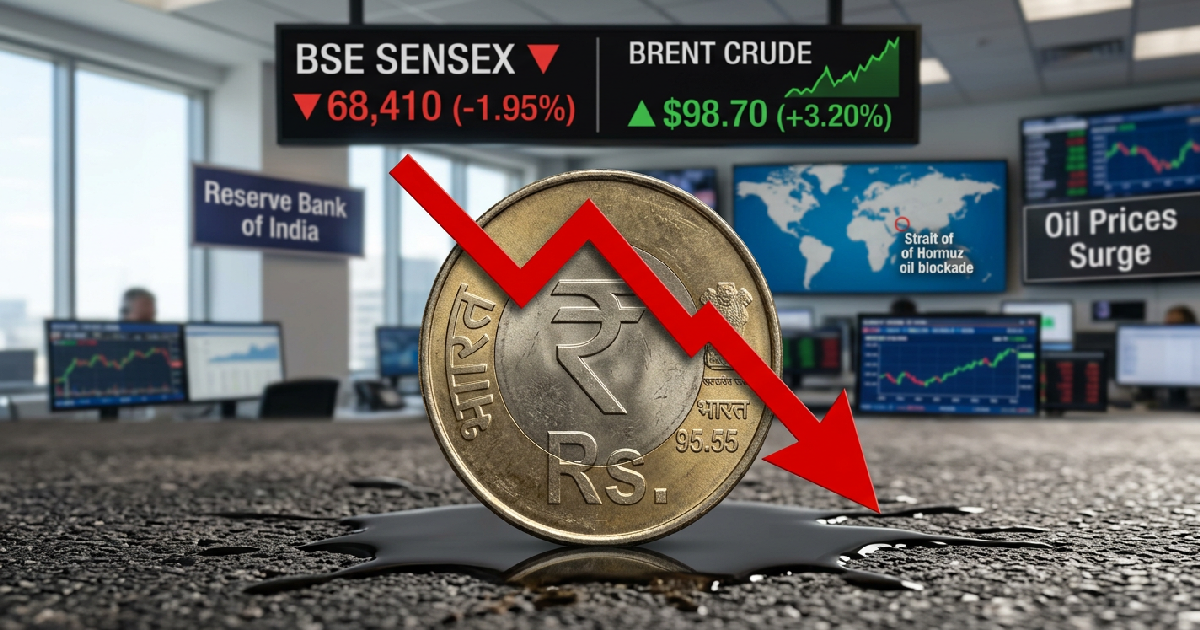
Indian rupee plunges to 95.55 against dollar amid escalating US-Iran tensions
The Indian rupee plunged to a near-record low of 95.55 against the US dollar on Wednesday, July 8, 2026. 55 against the US dollar on Wednesday, July 8, 2026, as escalating military tensions between the United States and Iran sparked a fresh surge in global crude oil prices.
The currency’s decline, representing a 59-paise drop in a single session, coincided with a massive sell-off in domestic equities that saw the BSE Sensex crash 1,677 points. Investors are reacting to a series of retaliatory U.S. strikes on over 80 targets in Iran and the subsequent revocation of oil export licenses by the U.S.
Oil price volatility hammers the Indian rupee
Treasury’s Office of Foreign Assets Control (OFAC), which has severely heightened fears of a prolonged supply disruption in the Strait of Hormuz.
For India, which imports more than 80% of its crude oil requirements, the geopolitical flare-up represents a significant threat to its macroeconomic stability. The Ministry of External Affairs is reportedly weighing emergency options, including direct talks with Iranian officials to secure safe passage for at least nine laden tankers currently stranded in the Persian Gulf.
With Brent crude futures jumping to $78.80 a barrel on Thursday morning and West Texas Intermediate (WTI) trading at $74.26, the Indian economy faces the immediate prospect of a widening current account deficit and imported inflation that could derail recent recovery efforts.
The Indian rupee has effectively surrendered the gains it managed to claw back after the Reserve Bank of India (RBI) implemented support measures last month. While the currency reached a brief high of 94.96 on Tuesday, July 7, the momentum shifted violently once the scale of the U.S. military action became clear.
The currency touched a session low of 95.61 on Wednesday, its weakest level since June 11, coming dangerously close to the all-time high of 99.82 recorded in March 2026. This volatility is a direct response to the energy market’s reaction to the U.S.
Treasury’s decision to revoke temporary licenses that previously allowed for the sale of Iranian-origin crude and petrochemical products.
Market analysts suggest that the RBI’s recent policy interventions are proving less effective than the central bank’s actions during the 2013 “taper tantrum.”
Although the State Bank of India (SBI) has successfully raised over $1.5 billion through a special foreign-currency deposit program for overseas citizens, these inflows have not been sufficient to offset the massive demand for dollars by oil importers.
The sudden spike in the Brent three-month spread to $2.36 per barrel indicates deep backwardation, a sign that the physical market for oil is incredibly tight as traders scramble for immediate supply.
Equity markets suffer steepest drop in months
The carnage on Wednesday was not limited to the currency markets. The Nifty 50 benchmark index plummeted by more than 500 points to settle at 23,887.45, while the India VIX, a popular gauge of market volatility, surged by over 28%. This represents the steepest single-day drop in domestic stocks in over three months.
Large-cap stocks across banking, energy, and manufacturing sectors Bore the brunt of the selling pressure, as investors feared that sustained energy prices above $75 would squeeze corporate margins and reduce consumer spending power.
Despite the panic, provisional exchange data indicated that foreign institutional investors were net buyers of 20 billion rupees in the last session, suggesting that some global funds are viewing the correction as a buying opportunity.
Lincoln International valuation data recently highlighted how sharp price corrections in global markets can lead to significant asset repricing, a trend now manifesting in Mumbai’s trading pits. Today, traders are keeping a close watch on the 23,800 level for the Nifty, as the index tests its critical 50-day moving average.
Strait of Hormuz blockade risks energy security
The core of the current crisis lies in the Strait of Hormuz, where U.S. naval forces have increased their presence following attacks on three tankers earlier this week. Iran’s top negotiator, Mohammad Bagher Ghalibaf, has accused Washington of violating the previous Memorandum of Understanding (MoU) signed to end hostilities, leading to retaliatory strikes against U.S.
military installations in Bahrain and Kuwait. These developments have forced commercial vessels to seek alternative routes or wait in high-risk zones, creating a maritime logjam that directly affects India’s supply chain.
The situation mirrors previous incidents where US naval forces redirected commercial vessels to prevent them from entering contested waters during blockades. For India, the nine stranded tankers represent a vital portion of its weekly energy intake.
If a truce is not reached and the Persian Gulf remains a theater for active military strikes, the cost of insurance and shipping for Indian refiners will skyrocket, further devaluing the rupee as the trade balance deteriorates.
Refining sector impacts and inflationary pressure
Indian refiners are already feeling the pinch of the OFAC license revocation. The U.S.
government’s decision to tighten the noose on Iranian oil exports means that India must look to more expensive alternatives from the spot market or increase its reliance on Russian and Middle Eastern grades that may not be available on favorable credit terms.
On the Multi Commodity Exchange (MCX), crude oil surged over 7% to near 7,200 on Wednesday, the highest level in two weeks.
The inflationary implications are severe for a government trying to manage food and fuel costs. A weaker rupee effectively makes every imported barrel of oil more expensive in domestic currency terms, creating a double-whammy effect.
If the currency continues to slide toward the 96-97 range, the RBI may be forced to hike interest rates or deplete its foreign exchange reserves to defend the rupee, despite the potential cooling effect such moves would have on industrial growth.
Forecasting the rupee and market recovery
Looking ahead, currency strategists expect the rupee to remain under extreme pressure as long as the U.S.-Iran conflict persists. Current forecasts suggest the INR could trade at 94.79 by the end of the third quarter of 2026, though this assumes a relative de-escalation of hostilities.
If the conflict widens to include direct hits on oil production infrastructure in southern Iran—where power outages and explosions have already been reported—the rupee could easily test the 100-mark against the dollar for the first time in history.
However, some analysts point to the resilience of the Indian banking sector as a stabilizing factor. The success of the TFI International and other global logistical firms in navigating previous supply chain shocks provides a blueprint for how Indian companies might adapt.
If the State Bank of India continues to attract foreign currency deposits through its special programs, it may create a sufficient buffer to prevent a total currency freefall.
Next steps for Indian policymakers
- Monitoring the 23,800 Nifty support level to prevent a broader equity market collapse.
- Negotiating with regional partners in the Middle East to diversify shipping routes away from the Strait of Hormuz.
- Evaluating the need for the RBI to intervene in the spot and forward currency markets to manage volatility.
- Assessing the impact of IT sector earnings, with bellwether TCS scheduled to report results post-market on Thursday.
The coming days will be critical for the Indian economy. While global funds are currently bottom-fishing in the equity market, a sustained climb in Brent crude past the $80 mark would likely trigger a secondary wave of capital outflows.
The interplay between geopolitical aggression in the Persian Gulf and the domestic monetary response in Mumbai will determine whether the rupee can claw back its dignity or if it is destined for a historic breach of the 100-per-dollar threshold.
And so, the focus shifts back to Washington and Tehran. The Indian government’s attempts to secure safe passage for its tankers will serve as a bellwether for the broader international community’s ability to keep global trade flowing amidst active conflict.
For now, the rupee remains a hostage to headlines from the Persian Gulf, a stark reminder of India’s continued vulnerability to a world addicted to volatile energy sources.