

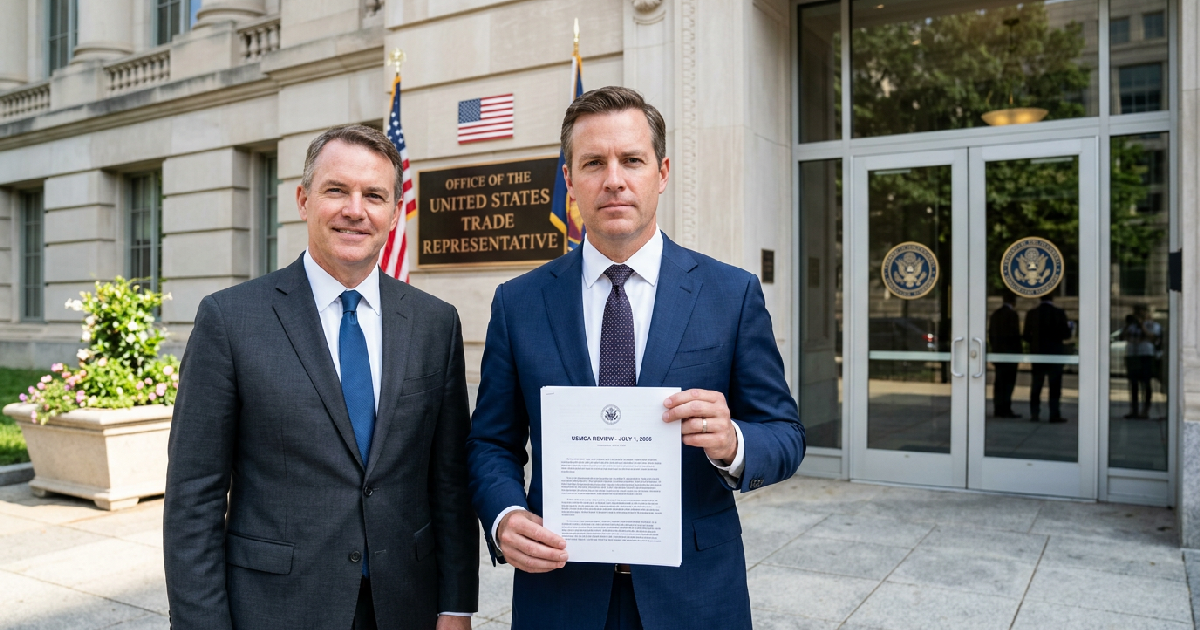
Jamieson Greer triggers first USMCA review on July 1, 2026
United States Trade Representative Jamieson Greer officially triggered the first mandatory joint review of the U.S.-Mexico-Canada Agreement (USMCA) on July 1, 2026, simultaneously declining an automatic extension of the trilateral pact. This formal decision shifts the three nations into a cycle of annual reviews to address what Ambassador Jamieson Greer described as significant shortcomings and trade deficits in the current North American trade architecture.
Daniel Watson, the Assistant U.S. Trade Representative for the Western Hemisphere, remains at the center of this technical process as the official responsible for developing and implementing policy with Mexico, Canada, and Latin America.
Status of the Office of the United States Trade Representative leadership
Recent reports suggesting his retirement ahead of the July review appear to be unfounded, as Daniel Watson continues to serve in his long-standing role. He remains a key figure in the USTR’s Western Hemisphere office, having previously signed the public hearing notice for the agreement’s operation in late 2025.
The leadership structure at the Office of the United States Trade Representative (USTR) remains stable as negotiations intensify. Jeffrey Goettman, who joined the agency in late 2025, continues his tenure as the Deputy United States Trade Representative. His extensive portfolio covers Africa, the Western Hemisphere, Europe, the Middle East, the Environment, Labor, and Industrial Competitiveness.
This wide-ranging remit places him in a critical oversight position for the USMCA renegotiations alongside Ambassador Jamieson Greer.
While some veteran diplomats in related agencies have moved on, such as Brian A. Nichols, the former Assistant Secretary for the Bureau of Western Hemisphere Affairs at the State Department who retired on December 31, 2024, the USTR’s core Western Hemisphere team remains intact.
This continuity is essential as the agency manages complex international manufacturing and trade discussions involving automotive rules of origin and steel production. The USMCA will remain in force while these issues are debated in Mexico City and Washington.
Critical friction points in the 2026 USMCA joint review
The first round of bilateral talks, concluded in late May 2026, focused heavily on economic security and the role of China in the North American market. U.S. negotiators are increasingly concerned that diverse industrial sectors are being used as backdoors for non-market economies.
This includes worries about materials and components originating from China entering the North American supply chain, potentially undermining the agreement’s stated goals of regional competitiveness. Just as Lincoln International valuation data reflects shifting sentiments in the private sector, the U.S. is seeking a “valuation correction” of its own regarding trade benefits granted to partners.
A second round of negotiations held from June 15 to 17, 2026, in Washington, D.C., was dedicated to high-priority agricultural issues. U.S. seasonal producers are currently advocating for the implementation of tariff-rate quotas to protect domestic markets from import surges during critical harvest periods.
These agricultural disputes are mirrored by technical disagreements in the digital space, including Canada’s unsatisfactory patent term restoration policies and Mexico’s proposed authority to access the internal systems of digital service providers for tax purposes.
Upcoming negotiation schedule and regional positions
The negotiation cycle is set to move to Mexico City during the week of July 20, 2026, for a third round of U.S.-Mexico bilateral talks. These meetings will occur under the shadow of the U.S. refusal to grant an automatic 16-year extension.
While the United States pushes for reform, its neighbors have signaled a preference for the status quo. Mexico has expressed a formal desire to extend the current agreement for the full 16-year term to ensure investor certainty, and Canada has similarly requested a renewal ahead of the July 1 deadline.
- Automotive: Disagreements persist over regional value content calculations, particularly regarding core parts and components.
- Labor: The U.S. continues to lean on the Rapid Response Labor Mechanism for enforcement, initiating investigations into alleged labor violations in Mexico.
- Economic Security: Steel and aluminum monitoring remains a top priority to deter Chinese dumping and ensure that North American supply chains remain resilient.
- Sovereignty: The Trump administration has signaled it may use trade leverage to address migration and drug trafficking concerns, linking these to broader economic cooperation.
Long-term outlook for the North American trade architecture
The USMCA is now entering a potentially decade-long period of annual reviews. If the three nations cannot reach a consensus on a renewal agreement during these yearly sessions, the pact is scheduled to expire in July 2036. This “sunset” pressure is a deliberate part of the U.S.
strategy to extract concessions on labor enforcement and digital trade. It aims to compel partners to address areas where the U.S. perceives the agreement as falling short of its original intent. The transition from a static trade deal to a transactional, evolving agreement reflects a broader shift toward economic nationalism in Washington.
As the USTR team, led by Greer and supported by officials like Daniel Watson and Jeffrey Goettman, moves into the Mexico City round, the focus will remain on closing perceived loopholes. The U.S. believes updated rules are crucial for maintaining a competitive edge. The absence of an automatic extension creates a “gray zone” for capital investment, but the U.S.
maintains that this risk is necessary to address the trade deficits and manufacturing imbalances that have persisted since the agreement’s inception in 2020. The coming weeks will determine if a middle ground exists or if the trio is headed for a more permanent fracture, impacting industries from agriculture to automotive manufacturing.