

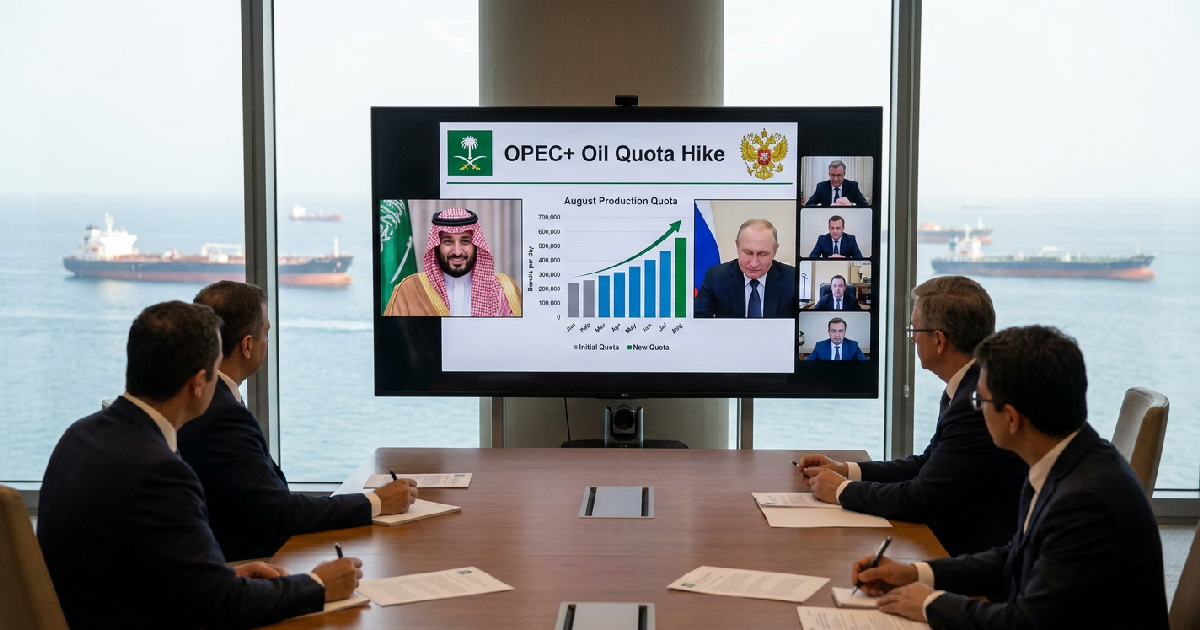
OPEC+ Nations Ratify August Oil Quota Hike as Gulf Flows Rebound
Seven key OPEC+ countries, including major producers Saudi Arabia and Russia, formally ratified a planned increase in oil production quotas on Sunday, July 5, 2026. This decision commits the alliance to bringing an additional 188,000 barrels per day (bpd) to market starting in August 2026.
The move is a strategic response to the gradual reopening of the vital Strait of Hormuz for oil exports and the subsequent recovery of Gulf crude flows. This rebound follows an interim peace pact struck between the United States and Iran, aiming to ease maritime traffic obstructions that had severely impacted global supply.
OPEC+ Oil Quota Hike: OPEC+ boosts August oil output amid market adjustments
The virtual meeting brought together Saudi Arabia, Russia, Iraq, Kuwait, Algeria, Kazakhstan, and Oman to confirm the August quota increase. This follows similar production adjustments that were agreed for June and July 2026, signalling the group’s ongoing strategy to systematically reverse earlier output curbs.
The alliance’s total quota for July stands at 35.83 million bpd, a figure that importantly excludes any overproduction compensation from countries breaching the OPEC+ agreement. Since the conflict began, these seven core members have collectively added a significant 940,000 bpd to their quotas.
This cumulative boost is equivalent to almost 1% of total global demand, underscoring the alliance’s crucial role in stabilizing international energy markets. The measured increments are designed to rebalance supply without flooding the market too quickly.
Strait of Hormuz reopening drives supply recovery
The decision to ramp up production is intrinsically linked to the improving situation in the Strait of Hormuz. This critical waterway, through which approximately 20% of globally traded oil flows, had been largely closed since February 28, 2026, due to the US-Israeli war on Iran.
This conflict effectively blocked oil exports for several months, severely disrupting global supply chains and causing significant economic fallout. The signing of an interim peace pact between Tehran and Washington on June 17, 2026, proved to be a turning point, committing both sides to removing obstacles to maritime traffic.
Reports from a U.S. official, quoted by Bloomberg, suggest that oil supplies through the Strait of Hormuz may already have exceeded 10 million bpd. This resurgence in traffic directly facilitates higher output, as the international community closely monitors the normalization of global crude flows after this period of maritime blockade against Iran.
Blockade’s economic toll on key producers
The earlier blockade had a severe economic impact on Gulf producers. Between the first quarter of 2026 and May, combined crude production from Saudi Arabia, Iraq, and Kuwait plummeted by about 6 million bpd.
Iraq alone bore a heavy cost, losing roughly 350 million barrels in exports by June 20. This substantial shortfall translated to an estimated $37.7 billion in lost revenue for the country.
Oil prices tumble amid increased supply
The return of more substantial crude volumes to the market, following months of geopolitical uncertainty, has had a clear effect on oil prices. Oil futures have tumbled 43% from their wartime peak, now trading near US$72 a barrel in London.
This decline reflects renewed market confidence in supply availability and an anticipation of a more balanced supply-demand dynamic in the short term. Traders are reacting to the increased output from OPEC+ and other major producers.
Key producers boost output in June
Individual OPEC members have already started boosting their output significantly. A Reuters survey indicated that OPEC’s crude oil production rose to 19.34 million bpd in June, marking a notable increase of 3.3 million bpd from the preceding month.
Key details
Bloomberg’s survey similarly reported a rise of 2.34 million bpd, pushing total production to 18.75 million bpd. Kuwait recorded the largest surge among OPEC’s 11 members in June, raising its output by an impressive 870,000 bpd to 1.36 million bpd.
Saudi Arabia also increased its production by 550,000 bpd, reaching an average of 7.2 million bpd. Iran, directly benefiting from the interim peace pact, boosted its output by 510,000 bpd to 2.85 million bpd.
Despite these significant increases, OPEC’s June production still registered 7.3 million bpd, or 28%, below its February levels. This figure is adjusted for the United Arab Emirates’ (UAE) exit, highlighting the substantial ground still to be recovered to reach pre-war output capacities.
Internal OPEC+ tensions and the UAE’s departure
The internal dynamics within OPEC+ continue to evolve, with member states navigating national interests alongside alliance commitments. Iraq, a significant producer, has openly hinted at the possibility of exiting OPEC if its demands for a higher production limit are not met.
This ambition stems from a desire to compensate for substantial shortfalls incurred during the recent conflict. Iraq’s position underscores the complex balancing act faced by the alliance, where individual countries push for greater flexibility to maximize their revenue and recovery.
The United Arab Emirates (UAE) already made a significant move by quitting the OPEC+ alliance in late April or May 2026. This decision was driven by frustrations with mandated output limits and a strategic desire to align its production more closely with its full capacity.
Since its withdrawal, the UAE has demonstrated its independent production capabilities. Kpler data indicates the UAE shipped a record volume of crude abroad in June, averaging 3.7 million bpd. Vortexa calculations suggest this figure could be as high as 4 million bpd, showcasing the impact of its newfound autonomy from OPEC+ restrictions.
Outlook for global oil supplies and market stability
The ratification of August’s quota hike marks another step in OPEC+’s cautious approach to recalibrating global oil supplies. The alliance has been careful not to flood the market too quickly, despite the urgent need for stability after months of disruption.
The next ministerial meeting of these seven OPEC+ countries is already slated for August 2, 2026. This upcoming gathering will be crucial for assessing evolving market conditions, monitoring the sustained stability of Gulf flows, and determining further adjustments to production policy.
Geopolitical developments, particularly the sustained implementation of the US-Iran interim peace pact, will remain central to these discussions. Any renewed instability in the Strait of Hormuz could quickly reverse the current trend towards increased supply and impact global market sentiment, as seen in broader international valuation trends.
The global energy landscape remains susceptible to various factors, from economic growth forecasts to ongoing regional tensions. OPEC+’s measured increases aim to meet rising demand without triggering a significant collapse in prices, a delicate balance in an ever-fluctuating market.
Market observers will be watching closely to see if these modest increases are sufficient to satisfy global demand, particularly if economic activity picks up momentum. The path forward for oil producers and consumers alike hinges on continued cooperation and the maintenance of geopolitical stability in key production regions.