

Global Oil Market Shifts from Scarcity to Glut as Prices Tumble
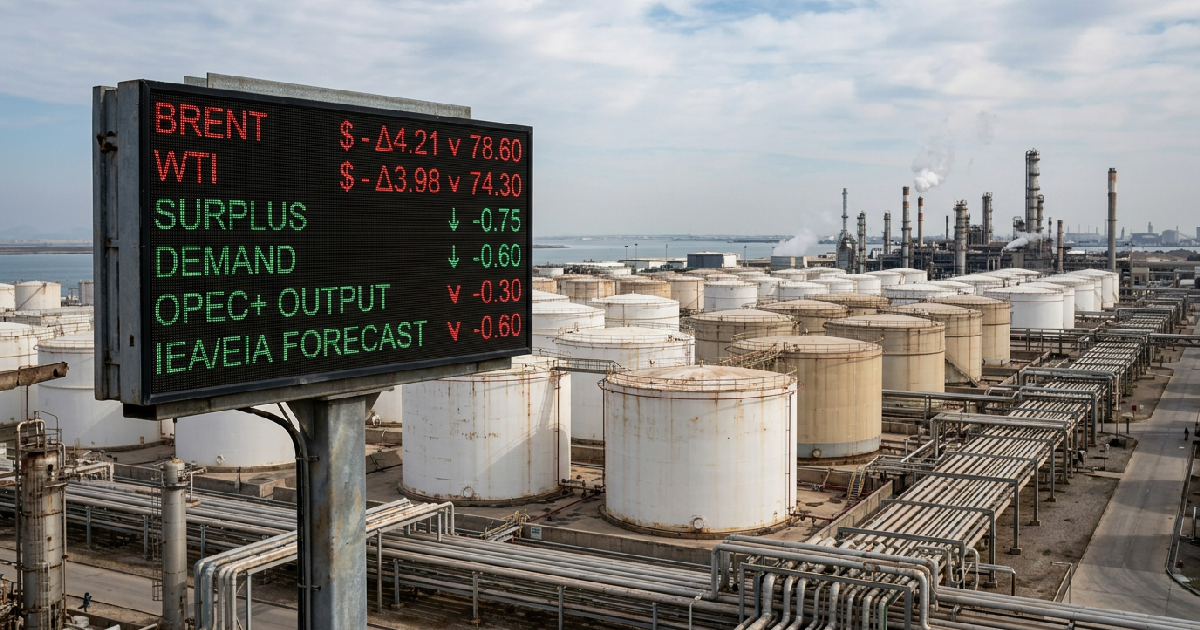
The global oil market has undergone a dramatic shift, moving rapidly from a period of geopolitical scarcity and high prices to a significant surplus, rekindling fears of a global glut. As of mid-June 2026, Brent crude is trading around $78.44 per barrel, with West Texas Intermediate (WTI) at $75.18. This represents a sharp contrast to the triple-digit prices seen just months ago.
An unexpected surge in supply, primarily driven by easing geopolitical tensions, has converged with revised downward global demand forecasts from major energy agencies. This combination points to a challenging environment for producers, even as it offers a potential boon for consumers worldwide.
Geopolitical easing fuels supply resurgence amid global glut concerns
The rapid pivot in the oil market largely stems from de-escalating geopolitical tensions in the Middle East. A conflict involving the United States, Israel, and Iran, which began on February 28, 2026, had severely disrupted oil transit through the region.
This conflict led to the de facto closure of the Strait of Hormuz, a critical chokepoint for world oil supplies. Brent crude oil spot prices had averaged $107 per barrel in May 2026, after peaking near $120/bbl in March due to the initial disruption.
For over three months, shipping traffic through the Strait of Hormuz remained extremely limited, with regional oil production largely shut-in. However, an interim peace deal between the U.S. and Iran, along with reports of an agreement to extend the ceasefire and reopen the strait, dramatically altered the supply outlook. Global stocks rose and oil prices fell on these expectations.
Flows through the Strait of Hormuz have begun to normalize faster than many anticipated. They rose from a May low of 9.6 million barrels per day (b/d) to approximately 12 million b/d in early June 2026. This restoration has significantly alleviated fears of prolonged supply disruption, creating the conditions for the current market surplus. During the maritime blockade, US naval forces were redirecting commercial vessels in the area.
Energy Agencies Slash Demand Projections
Compounding the increased supply, leading energy organizations have sharply cut their global oil demand forecasts. These revisions underscore the growing concern of a market imbalance and a persistent global glut.
IEA outlines significant demand decrease
The International Energy Agency (IEA), which advises industrialized nations, significantly reduced its global oil demand forecast for 2026. In its June 2026 Oil Market Report, the IEA now expects global oil demand to fall by 1.1 million b/d year-over-year.
This represents a substantial downgrade of 700,000 b/d from its May report, reflecting a pronounced 5 million b/d year-over-year decline in Q2 2026 deliveries. The IEA also forecasts global oil supply to decline by 3.9 million b/d to 102.4 million b/d in 2026, before an anticipated rebound.
Looking further ahead, the IEA projects a significant global supply surplus of 5.05 million b/d by 2027. This bleak outlook led the IEA to postpone its “Oil 2026” report, which was scheduled for June, to a later date.
EIA’s revised outlook for global oil demand
The U.S. Energy Information Administration (EIA), a key statistical and analytical agency within the U.S. Department of Energy (DOE), has also significantly revised its global oil demand projections. The EIA now forecasts global oil demand to decrease by an average of 1.1 million b/d in 2026.
This contrasts sharply with 104.0 million b/d in 2025 and represents a substantial revision from its February 2026 forecast, which had anticipated 1.2 million b/d growth. The agency assumes demand will rebound in 2027, growing by 2.5 million b/d to 105.3 million b/d, once prices drop and supply flows fully return later in 2026.
The EIA expects Brent crude oil spot prices to average around $105/b in June and July 2026. They then anticipate a decrease to an average of $89/b by Q4 2026. The agency also projects U.S. crude oil production to average around 13.5 million b/d in 2026, a slight decline of approximately 100,000 b/d from 2025 levels, marking the first year of slight contraction after four years of expansion.
OPEC+ navigating market shifts and supply targets
The Organization of the Petroleum Exporting Countries and allies, known as OPEC+, finds itself in a precarious position amidst these market dynamics. They’re attempting to balance price stability with market share preservation in the face of a potential global glut.
Sustaining output cuts and gradual reversals
OPEC+ had agreed on May 28, 2025, to maintain 3.6 million b/d of crude cuts until the end of 2026. This collective effort aimed to prop up prices during periods of anticipated demand weakness or supply concerns.
Eight OPEC+ countries, including Saudi Arabia, Russia, Iraq, and the UAE, reaffirmed a decision on November 2, 2025, to pause production increments in January, February, and March 2026. This pause was attributed to seasonal factors impacting demand.
On February 1, 2026, these same eight countries reiterated that 1.65 million b/d of additional voluntary adjustments could be returned, either in part or in full, contingent on evolving market conditions. However, the rapidly changing supply picture complicates these decisions.
More recently, OPEC+ decided to increase oil supply by an additional 188,000 b/d in July 2026. This move is part of a “gradual and orderly reversal” of voluntary cuts implemented in April 2023. It represents the third consecutive increment since the beginning of 2026.
Saudi Arabia’s balancing act
Saudi Arabia, a key player within OPEC+, aims to keep oil prices above $80/bbl to balance its public budget. This target price point is crucial for the kingdom’s ambitious economic diversification plans.
But they also seek to avoid losing market share to non-OPEC+ producers, particularly the United States. This dual objective creates a delicate balancing act, as increasing supply to maintain market share can push prices down, directly conflicting with their budgetary needs.
Broader implications of a global oil market surplus
The shift from scarcity to a global glut has wide-ranging implications extending beyond just producers’ balance sheets. Consumers could see some relief at the pump, but the instability itself carries risks.
Lower oil prices typically mean reduced input costs for many industries, potentially easing inflationary pressures globally. However, for oil-exporting nations, a sustained period of low prices can strain public finances and trigger economic challenges.
And for energy companies, this market reversal could lead to deferred investment in new production capacity. Such decisions, made in response to current low prices, might ironically set the stage for future supply shortages when demand eventually recovers.
Challenges for the oil market ahead
The oil market remains volatile, with several factors influencing its trajectory in the coming months and years. A full recovery of shipping through the Strait of Hormuz, for instance, is still expected to take time.
Operational and political constraints, including demining efforts and unresolved transit arrangements, contribute to this slower recovery. Any renewed geopolitical instability in the Middle East could quickly swing the market back towards scarcity.
Moreover, the accuracy of demand forecasts from agencies like the IEA and EIA will be critical. Unforeseen economic slowdowns or faster-than-expected energy transitions could further depress demand, exacerbating the global glut. OPEC+’s ability to effectively manage supply in such a fluid environment will be continuously tested.