

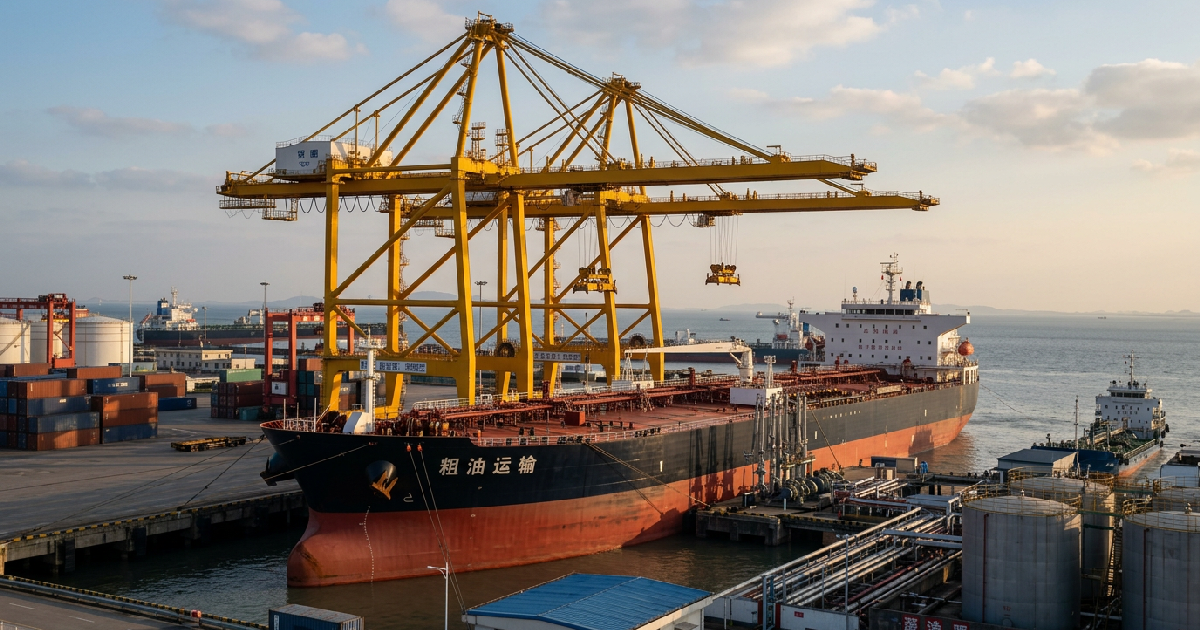
Beijing’s crude oil imports could fall 10% in June 2026 amid high stockpiles
Chinese crude oil imports are projected to fall significantly in June 2026, extending a downward trend that began with a sharp contraction in May.
Data from commodity tracking services and port schedules indicate that the world’s largest energy consumer is curbing its foreign purchases due to a combination of high domestic stockpiles, a strategic shift toward renewable energy, and cooling industrial demand.
Inventory drawdowns and the shift in Chinese crude oil imports
This retreat from the global market by Beijing represents a major shift in energy dynamics, as the country has historically served as the primary engine for global oil demand growth over the last three decades.
The downturn in June follows a May performance that analysts described as a “collapse” in momentum. While China became a net oil importer in 1993, its current pullback is not merely a seasonal fluctuation but appears to be a structural recalibration of its energy security strategy.
Reports suggest that state-owned refiners and independent “teapots” alike are reducing run rates as profit margins tighten and the domestic economy struggles to regain its pre-2024 vigor. For the global market, this means a significant loss of support for prices at a time when non-OPEC+ supply remains robust.
Industry observers note that the reduction in imports is also tied to a maritime environment that has become increasingly complex. While some US naval forces redirect commercial vessels during various geopolitical frictions, China has sought to insulate itself by drawing down record-high inventories built during periods of cheaper pricing.
This inventory management strategy allows Beijing to sit out of the market during price spikes, effectively capping the upside for global benchmarks like Brent and West Texas Intermediate (WTI).
One of the most pressing factors driving the June decline is the sheer volume of oil China currently holds in reserve. Over the past twenty-four months, Chinese authorities and private enterprises have aggressively filled strategic and commercial storage tanks.
Key details
Now that global prices have stabilized at higher levels, there is little incentive for these entities to continue high-volume buying. Instead, refineries are being encouraged to process existing stocks rather than signing new long-term delivery contracts for the summer months.
The “collapsing” nature of these imports is underscored by the year-over-year comparisons. Analysts tracking tanker movements suggest that June arrivals could be as much as 10% lower than the same period in 2025. This isn’t just a matter of storage capacity; it’s a matter of economic necessity.
In many provinces, the rapid adoption of electric vehicles (EVs) has permanently dented the demand for gasoline. As more freight moves via liquefied natural gas (LNG) trucks and passenger travel shifts to the massive high-speed rail network, the “floor” for Chinese oil demand is sinking lower than many Western analysts predicted.
Key details
Trade dynamics between China and its traditional suppliers are also evolving. Beijing has successfully diversified its sourcing, relying more heavily on discounted barrels from sanctioned nations and pipeline deliveries from Russia. This shift away from seaborne Middle Eastern crude has changed the math for tanker rates and global logistics.
The June import numbers reflect a preference for these “secure” routes over the volatile maritime lanes that are often subject to Western monitoring or intervention.
However, this diversification creates its own set of problems. As China buys more oil through non-dollar channels, the transparency of world oil demand decreases.
This “dark” trade makes it harder for analysts to get an accurate reading on exactly how much oil is moving, though the physical decline at major ports like Qingdao and Ningbo is impossible to hide.
The visible drop in June arrivals at these terminals provides the clearest evidence yet that the slowdown is real and accelerating.
Economic cooling and the transition to green energy
Beyond the immediate logistics of oil, the broader Chinese economy is flashing warning signs that affect energy consumption. The manufacturing sector, long the backbone of the country’s oil demand, has seen a steady cooling as global export markets soften and domestic consumption shifts toward services.
Factories that once hummed 24/7 are now operating on reduced shifts, and the heavy machinery used in construction—a prime consumer of diesel—is sitting idle as the real estate sector continues its long-term deleveraging process.
This economic reality is being compounded by China’s aggressive pursuit of carbon neutrality. The nation is currently installing more wind and solar capacity than the rest of the world combined. This “green leap forward” is not just a PR move; it is an industrial policy designed to reduce the country’s reliance on imported energy.
Key details
By 2026, the cumulative effect of millions of EVs on the road and a electrified power grid is finally showing up in the crude oil import data. June is simply the latest month to prove that the “energy transition” is no longer a future prospect—it is a current operational reality.
The financial sector is also adjusting to this new world. Much like how China trading curbs may hit HK assets, the tightening of credit and the focus on “high-quality growth” means that speculative buying of commodities is being discouraged by the central government.
The era of using crude oil as a liquid asset or a hedge against currency fluctuations is being curtailed by stricter regulatory oversight from Beijing.
What the June import slump means for the future
Looking ahead to the second half of 2026, the question is no longer whether Chinese imports will recover, but how low they will eventually settle. Most analysts now agree that China has passed “Peak Oil Demand,” or is at the very least on a long plateau.
June’s figures are expected to confirm that the decline is not a one-off event caused by refinery maintenance or temporary port congestion. Instead, it is the result of a deliberate policy to favor efficiency and domestic alternatives over foreign dependence.
This change has profound implications for every major oil-producing nation. From the shale fields of the United States to the offshore platforms of Brazil and the desert wells of the Middle East, the loss of the Chinese “growth engine” means that competition for the remaining market share will become much more aggressive.
Key details
Producers will need to find new markets in Southeast Asia or Africa to offset the losses in the Chinese market, but none of these regions currently possess the infrastructure or the scale to replace Beijing’s historical role.
In the short term, we should expect continued downward pressure on crude prices throughout the summer of 2026. Unless a major geopolitical disruption occurs, the fundamental reality of “too much supply and too little Chinese demand” will dominate the headlines.
For consumers in the West, this may lead to lower prices at the pump, but for the global financial system, it represents a period of significant uncertainty as a decades-old growth model finally comes to an end.